
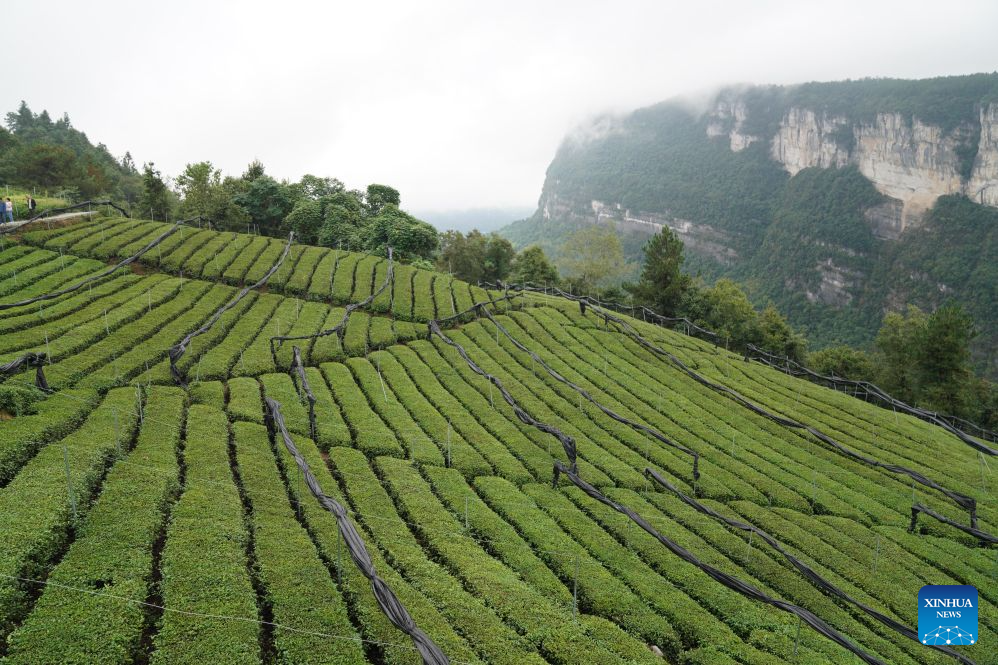
This photo taken on Sept. 18, 2026 shows Taozibao tea mountain, one of the main tea production areas in Enshi Tujia and Miao Autonomous Prefecture, central China's Hubei Province. (Xinhua/Lu Jinbo)
WUHAN, Sept. 19 (Xinhua) -- When Yin E enrolled in college in Enshi in 2010, she was among the first cohort of students in the school's newly established department of tourism.
"It used to be very hard for people to come in or out of Enshi," she said. "We had world-class scenery, but poor roads cut it off."
Enshi Tujia and Miao Autonomous Prefecture in central China's Hubei Province sits deep in the Wuling Mountains. The region averages about 1,000 meters in elevation, with peaks rising above 3,000 meters and steep cliffs at nearly every turn.
"Back then, it took three days by car just to reach Wuhan, the provincial capital," Yin said. The two cities are about 460 kilometers apart.
That situation began to change around 2010, when Enshi inaugurated its first railway and expressway, both of which were considered among the most technically challenging projects in China or the world.
"That's when the tourists really started coming," said Fan Houtao, general manager of a tourism company in Hubei.
Enshi Grand Canyon, one of the region's best-known attractions, opened to visitors in 2008 and received more than 100,000 visitors that year. By 2025, annual visitor numbers had climbed to 2 million, with more than 80 percent coming from outside the province.
The canyon has been designated a national 5A-rated tourist attraction, the highest in China, and included in the UNESCO Global Geoparks network.
"A growing share of our visitors now come from Southeast Asia, the Republic of Korea and Mongolia," Fan said. In 2025, the prefecture launched regular foreign-language training for tour guides and scenic-area staff to meet rising demand.
The region's well-preserved traditions, architecture and cuisine of the Tujia and Miao ethnic groups have become part of the draw as word has spread.
Tea tells a similar story. "Growing tea is one of the basic ways farmers here have always made a living," said Liu Qiangsheng of the Enshi Tea Industry Association. The high-altitude environment produces quality tea, but getting it out of the mountains used to be costly and difficult.
Improved transport has enabled tea producers in Enshi to scale up, with total industry output value tripling over the past decade to 30 billion yuan (about 4.44 billion U.S. dollars).
Tea is now Enshi's leading agricultural product, reaching every corner of China and more than 20 countries and regions abroad, including Morocco, Australia and Russia.
Enshi now has four railway lines and nine expressways in operation. The journey to Wuhan can now be completed in about four hours.
"Our tea now reaches markets by both sea and rail. Some is shipped from Ningbo in Zhejiang Province, while some travels to Europe on the China Railway Express," Liu said. "Some of our best-known varieties have even been served at state diplomatic events."
Other goods once locked away in the mountains, including selenium-rich vegetables, potatoes, and herbal medicines, are also finding their way to markets across China and overseas.
For Enshi, once one of the poorest areas in China, better transportation has opened up new markets and helped local people increase their incomes.
"Enshi underwent tremendous changes during the fight against poverty," said Xia Xifan, governor of the prefecture. "Every village with 20 or more households was connected by road with investment coming from both the central and local governments."
Enshi is a small piece of a much bigger story: China's sustained and massive push to expand its infrastructure.
China's high-speed rail network has surpassed 50,000 kilometers, accounting for over 70 percent of the world's total and more than the rest of the world combined. Its expressway network, at nearly 200,000 kilometers, is likewise the largest on earth -- a web of roads and rail stitching together the country's wealthier regions with its more remote ones.
Before entering college, Yin had never left Enshi. Her home village lies deep in the mountains, where her parents grew potatoes and corn. They used to carry their produce for two hours to reach the township market, and Yin herself also spent two hours walking to school.
"Life in Enshi has changed so much," she said. "I've been able to travel around the country, and now I've even been selected to showcase Enshi's culture and tourism to people around the world."
"Improving transportation is a project that speaks directly to people's hearts," Xia said. "Everything the government does comes back to one goal -- giving people a better life, and achieving common prosperity."
As China maps out its transport development for 2026-2030, the country aims to raise the completion rate of its integrated transport network from 91 percent to 95 percent by 2030. It also plans to basically complete a more connected high-speed rail network featuring eight vertical and eight horizontal main routes and a national expressway system.
The country will build or upgrade 500,000 kilometers of rural roads and strengthen railway and regional airport infrastructure in rural and less-developed areas.
In Enshi, the transformation is continuing.
Enshi Airport was upgraded to an international airport in 2025. Passenger traffic has exceeded expectations, prompting plans to relocate and rebuild the airport. Construction of the first high-speed railway linking Enshi began in late 2024.
From 2026 to 2030, Enshi plans to invest 268.8 billion yuan in transport infrastructure.
"These efforts will help Enshi achieve its goal of basically realizing modernization by 2035," Xia said. ■


