* Friday marked the 95th anniversary of the September 18 Incident, the start of China's 14-year war of resistance against Japanese aggression. On Sept. 18, 1931, Japanese troops blew up a section of railway near Shenyang under their control and accused Chinese troops of sabotage, using this as a pretext for their later attack that night on barracks near Shenyang, thus launching their premeditated invasion of China.
* The commemorations in Shenyang anchored nationwide events marking the 95th anniversary of the incident. The Chinese People's War of Resistance Against Japanese Aggression (1931-1945) broke out first and lasted the longest in the World Anti-Fascist War. Over 14 years, some 35 million Chinese were killed or wounded.
* Meanwhile, a nationwide effort is ongoing as China seeks to preserve memories of the War of Resistance, forming a multi-layered system that spans from top-level government planning to grassroots participation.
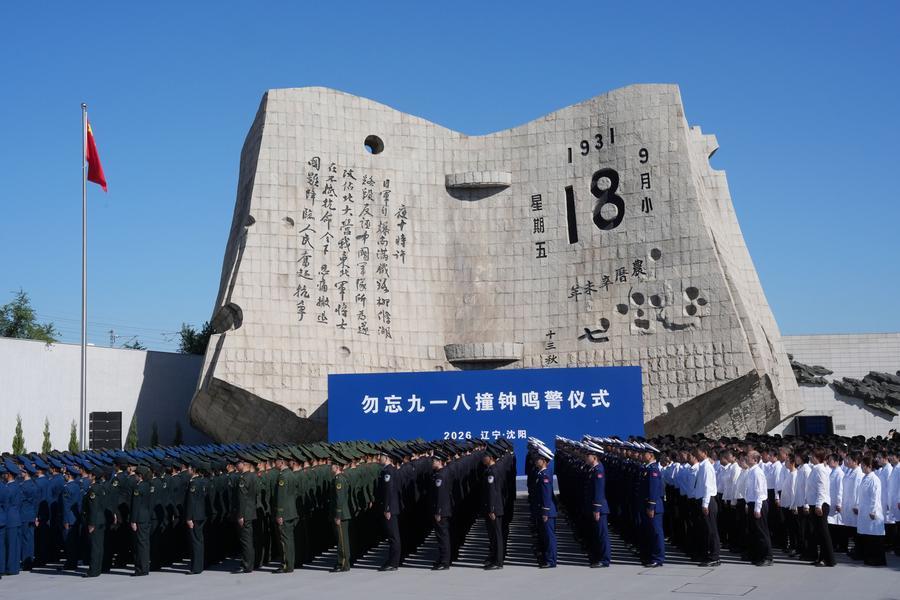
SHENYANG, Sept. 18 (Xinhua) -- Air-raid sirens wailed. Traffic halted. Pedestrians stood still. At 9:18 a.m. on Friday, the city of Shenyang in northeast China's Liaoning Province paused for a three-minute silence to mourn those killed in the Japanese invasion of China and to cherish hard-won peace.
Friday marked the 95th anniversary of the September 18 Incident, the start of China's 14-year war of resistance against Japanese aggression. On Sept. 18, 1931, Japanese troops blew up a section of railway near Shenyang under their control and accused Chinese troops of sabotage, using this as a pretext for their later attack that night on barracks near Shenyang, thus launching their premeditated invasion of China.
Since 1995, Shenyang has sounded air-raid sirens annually on this day to commemorate the incident.
"Those few minutes when everything stopped for the sirens reminded me that our everyday life is built on hard-won peace," said Li Xuyang, an employee of Brilliance Auto based in Shenyang.
The commemorations in Shenyang anchored nationwide events marking the 95th anniversary of the incident. The Chinese People's War of Resistance Against Japanese Aggression (1931-1945) broke out first and lasted the longest in the World Anti-Fascist War. Over 14 years, some 35 million Chinese were killed or wounded.
LEST WE FORGET
At a ceremony held on Friday morning at the 9.18 Historical Museum, which was built near the site of the railway explosion, 14 representatives from all walks of life solemnly tolled the Bell of Warning. The 14 chimes echoed through the air, symbolizing the 14 arduous years of the Chinese people's fight against Japanese invaders.
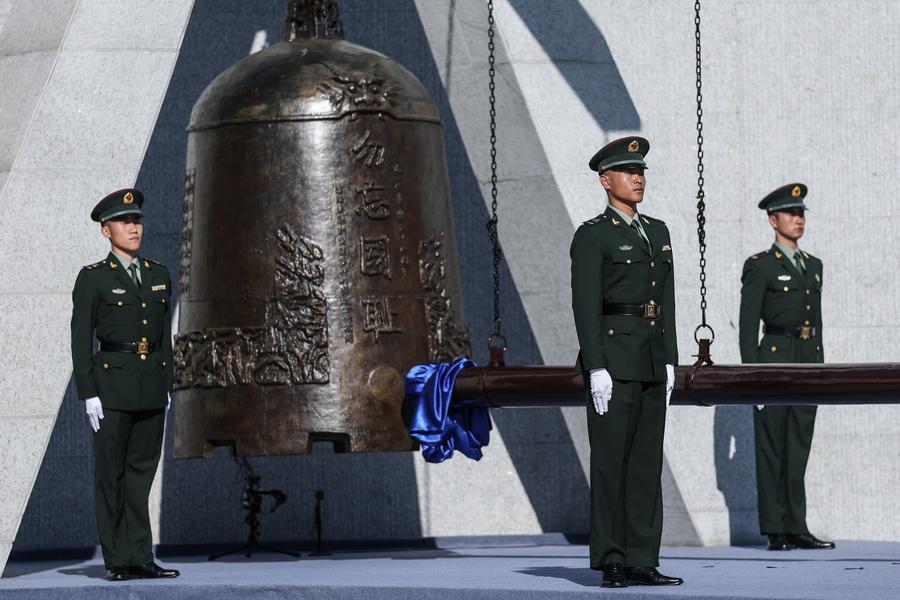
Li Hongzhong, vice chairman of the National People's Congress Standing Committee and a member of the Political Bureau of the Communist Party of China Central Committee, attended the ceremony and delivered a speech.
The War of Resistance marked China's first complete victory against foreign aggression in modern times, Li said. He called for drawing lessons from history to light the way forward, stressing the importance of upholding the Party's overall leadership, advancing Chinese modernization, and contributing to building a community with a shared future for humanity.
"I learned about the September 18 Incident in textbooks. Hearing the bell today, I want to know even more about what children of my age went through back then," said Ma Zihao, a sixth grader in Shenyang.
"Seeing today's children able to go to school without a worry makes me feel that the sacrifices back then were not in vain," said Yang Huafeng, a 93-year-old veteran of the war who attended the event. "I hope they remember the martyrs who laid down their lives for this country and understand how precious peace is."
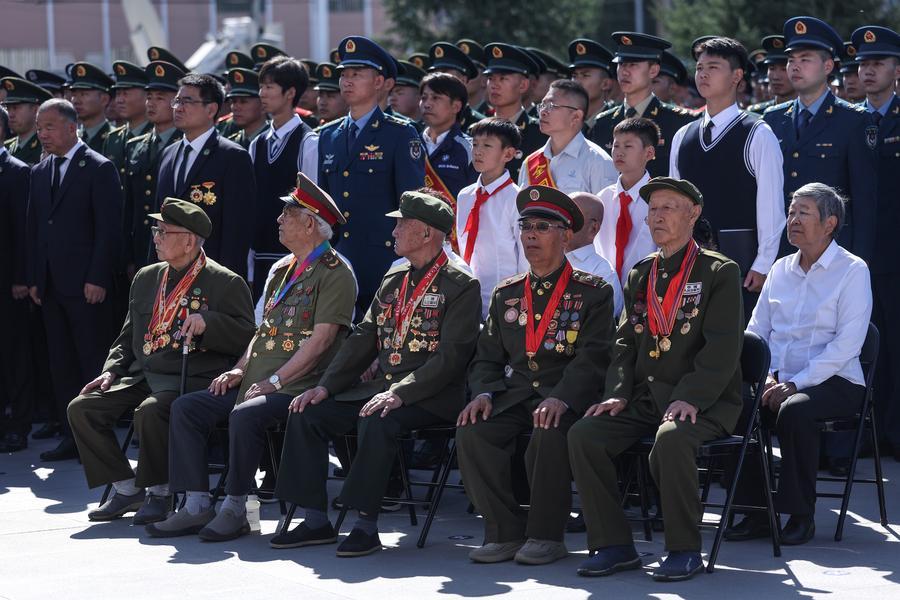
An exhibition of irrefutable evidence of Japan's invasion of northeast China also opened on Friday at the 9.18 Historical Museum. The exhibition features more than 300 historical photographs and archival documents, along with over 100 physical artifacts, including original archives, newspapers and pictorials, banknotes, stamps, and investigation reports.
"The annual observances give the younger generation a chance to rethink the relationship between war and their own lives. Only by remembering the suffering war brought to ordinary people can we truly appreciate how precious peace is and what it takes to protect it," said Gao Jian, a researcher at the museum.
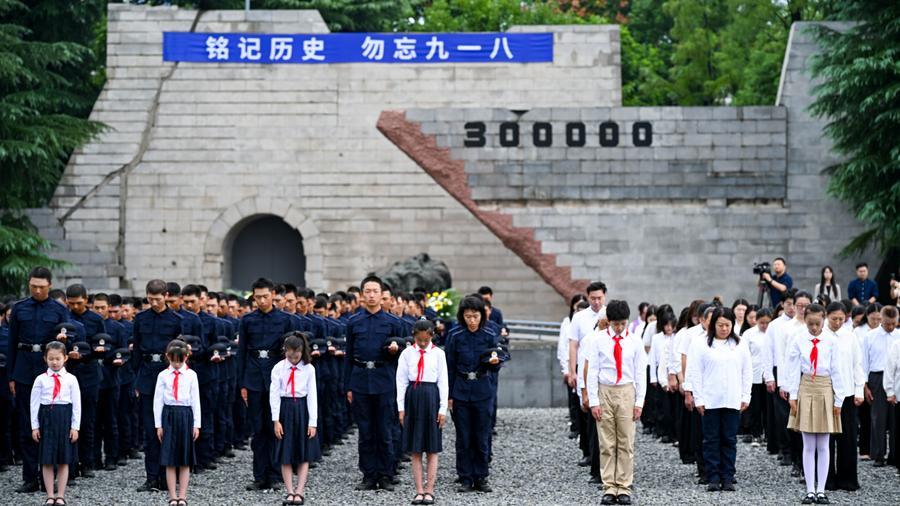
A similar bell-tolling ceremony was held on Friday at the Memorial Hall of the Victims in Nanjing Massacre by Japanese Invaders in Nanjing, capital of east China's Jiangsu Province. At this event, university students recited poetry honoring the Chinese people's unyielding spirit of resistance.
For Zhang Boxiang, a student at Nanjing University of the Arts, one line stood out: "The fate of our nation must now be decided by ourselves." "Standing on the memorial square and speaking those words felt like responding to peers from over 80 years ago," he said. "They had no way out. We today must never forget."
On Dec. 13, 1937, Japanese troops captured the then-Chinese capital Nanjing, unleashing six weeks of devastation that claimed the lives of an estimated 300,000 civilians and unarmed soldiers.
In late August this year, the 9.18 Historical Museum was officially designated a patriotism education base by the Taiwan Democratic Self-Government League (TDSL). It is the seventh such base established by the TDSL Central Committee. The designation reaffirms the inseparable historical role of Taiwan compatriots in the nationwide resistance against Japanese aggression and highlights the shared history of people on both sides of the Taiwan Strait, who fought together against foreign aggression and belong to one Chinese nation.
"Countless patriots and martyrs sacrificed their lives for the recovery of Taiwan -- a vivid testament to the unyielding spirit of the Chinese nation's resistance," Qiu Zhibin, grandnephew of veteran Taiwan patriot Qiu Niantai, said at the event. He called on people on both sides of the Taiwan Strait to remember their shared history, carry forward that spirit, and join hands in advancing the great rejuvenation of the Chinese nation.
KEEPING MEMORIES ALIVE
Meanwhile, a nationwide effort is ongoing as China seeks to preserve memories of the War of Resistance, forming a multi-layered system that spans from top-level government planning to grassroots participation.
According to the National Cultural Heritage Administration, China has completed a comprehensive survey of its wartime heritage. As of last year, the country had more than 10,000 immovable and over 500,000 movable cultural relics related to the War of Resistance. From 2021 to 2025, nearly 20 wartime memorial halls were renovated or expanded, bringing the total number of registered wartime memorial halls to 257.
Yet the most urgent task remains collecting oral histories from those with firsthand experience of the War of Resistance, which is a race against time.
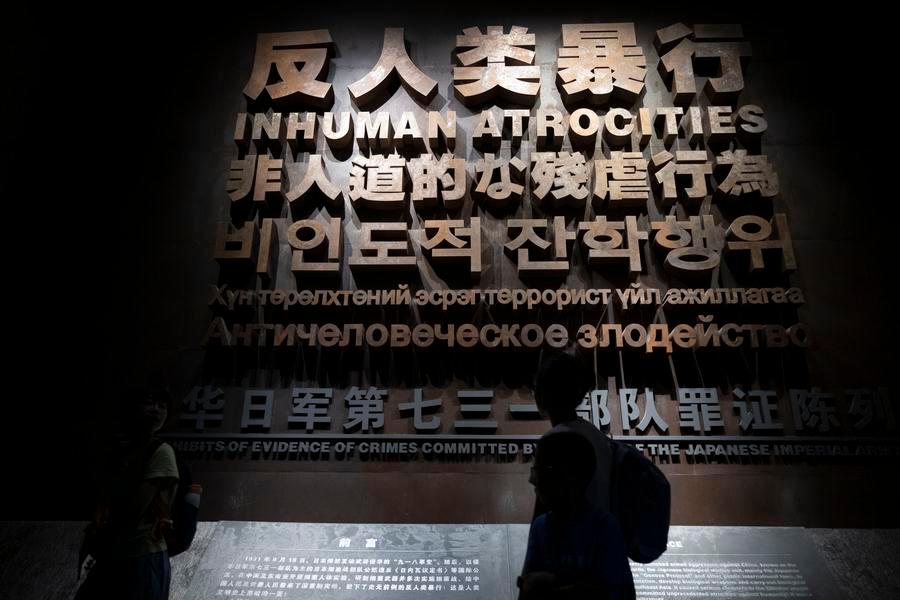
Over the past three decades, Jin Chengmin, a senior researcher at the Exhibition Hall of Evidence of Crimes Committed by Unit 731 of the Japanese Imperial Army in Harbin, capital of northeast China's Heilongjiang Province, and his team have conducted more than 40 cross-border investigations.
They traveled to countries including Japan, the United States and Russia, interviewing over 80 former Unit 731 members and collecting 423 hours of testimony. This testimony, together with almost 300,000 archival items, more than 20,000 artifacts, 22 hours of audio recordings from the Khabarovsk trial and 27 existing sites, forms a complete chain of evidence documenting Japan's bacterial warfare crimes.
"History cannot be buried, and peace is not for trade. This is our bottom line and our faith. The evidence of Unit 731's crimes does not belong to China alone. It is a wound shared by all humanity," Jin said. "What we can do is keep our research rigorous and bring the truth to light, so that more people see it, remember it and stay alert."
According to Zhang Lianhong, a professor at Nanjing Normal University, the university, in collaboration with other universities and volunteer organizations, earlier this year completed a major national research project on preserving the oral histories of veterans who fought in the War of Resistance. The 10-year project involved nearly 1,000 teachers, students and volunteers, who sought out 1,442 veterans with an average age of 95, producing over 10 million words in transcripts and more than 3,000 hours of video interviews.
"Ten years ago, the veterans were already in their twilight years, passing away one after another, with only tens of thousands still alive," said Zhang, who has long studied the history of the War of Resistance and the Nanjing Massacre. "As historians, we are duty-bound to seize the last chance to record their stories."
Grassroots efforts are also stepping up. Based in Qinxian County, north China's Shanxi Province, 81-year-old Li Guoqing spent over a decade traveling by motorcycle across 12 provincial-level regions, covering more than 100,000 kilometers. He located 595 witnesses to over 400 cases of Japanese wartime atrocities and recorded numerous oral histories with his own camera.
But keeping memories alive takes more than preservation. It also means passing them on.
From 2021 to 2025, an average of more than 500 exhibitions on the War of Resistance were held nationwide each year, with over 60 million visits recorded at wartime sites and memorial halls.
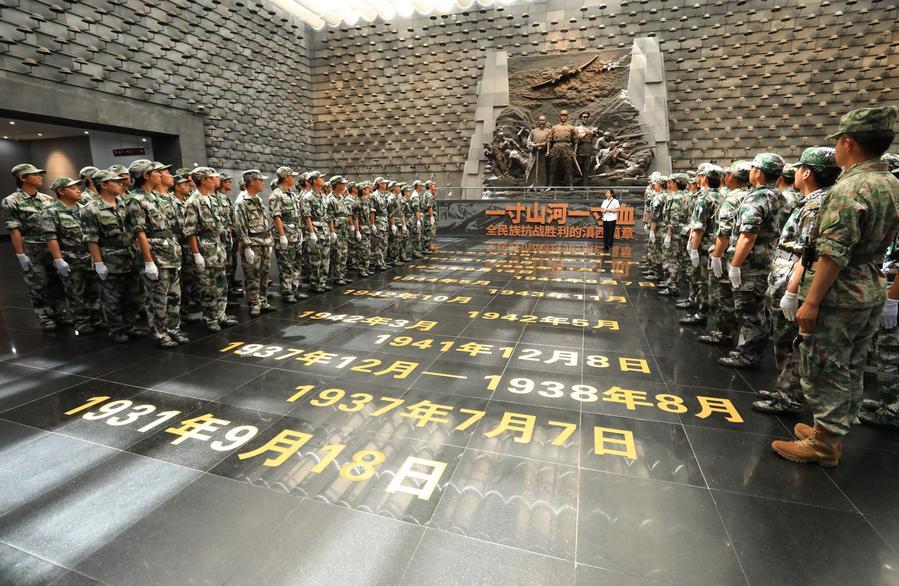
The rise of digital technology and new media is also giving the public new ways to engage with wartime history.
In June, a red archive knowledge base jointly built by Sichuan Archives and multiple partners went online, with its first phase in 2025 focusing on archives of the War of Resistance. By April, China's first AI agent for archival exhibitions, developed on this knowledge base, had served almost 10,000 visitors at the archives' offline exhibitions.
Even at his advanced age, Li Guoqing is still working to master new technologies. He spent 6,000 yuan (about 889 U.S. dollars) to learn how to produce and share short videos, turning witnesses' stories into oral history clips. More than 130 episodes have been posted online, with the series expected to reach 500 episodes.
"I need to hurry. I'm already in my 80s," he said. "I hope I can finish this series in my lifetime and do my part to preserve the memory of the War of Resistance."
(Reporting by Cui Enhui, Yao Yuan, Cui Shihao, Zhao Hongnan, Qiu Bingqing, Yang Siqi, Xu Kaixin and He Shan; Video reporters: Yang Qing, Ma Haoran, Jiang Zhaochen, Liu Bin, Zhao Yong and Gao Ming; Video editors: Zhou Yang, Wu You and Li Qin) ■