
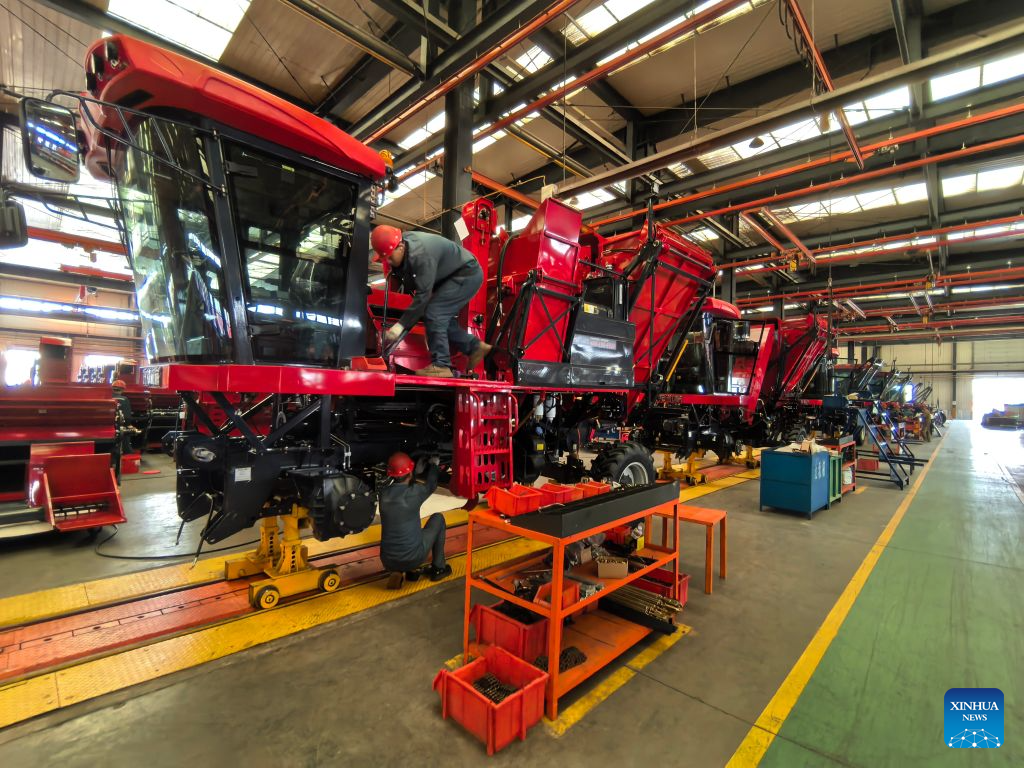
This photo taken with a mobile phone shows workers assembling a corn harvester at a workshop of Mushen Agricultural Machinery Co., Ltd. in Songyuan, northeast China's Jilin Province, June 17, 2026. (Xinhua/Xue Qinfeng)
CHANGCHUN, Sept. 18 (Xinhua) -- As cornfields in northeast China's Jilin Province turn golden for the autumn harvest, bringing in the crop now requires just a few taps on a touchscreen.
Inside a corn harvester at Mushen Agricultural Machinery Co., Ltd. in Songyuan, a major corn-producing area, an electronic control system allows the operator to manage every stage of harvesting through a single screen.
"Ten years ago, we could sell only a few hundred machines a year. Now, our annual sales have reached more than 2,000 at their peak," said Wang Xincheng, general manager of the company.
Over the past decade, the share of domestically produced components used in the company's harvesters has risen by about 15 percentage points to 95 percent, while advances in core components and electronic controls have helped narrow the technological gap with comparable foreign products, Wang said.
Some 200 kilometers away in Gongzhuling, another machine is tackling a different field task -- without the use of chemical herbicides.
At a test field in Changchun's National Agricultural High-Tech Industry Demonstration Zone, a silver-gray, fully electric self-propelled robot glides between rows of corn. An onboard camera scans the field, an AI system distinguishes weeds from crops, and millimeter-level laser beams remove weeds without touching the corn plants.
Developed by Changchun University of Science and Technology and its industry partners, the fourth-generation robot has a crop recognition rate of more than 99.5 percent. In field trials, it could remove 50,000 to 100,000 weeds in an hour.
By using lasers instead of herbicides, the machine provides a solution to reduce chemical usage and helps protect the fertile black soil of northeast China.
"We designed the robot around the needs of Chinese farming," said Wang Xiantao, a member of the research team. "Each laser-weeding unit works like a building block, allowing the machine to be adapted for various farming scenarios."
He said the robot is expected to enter mass production by the end of 2026.
The changes seen in Jilin are also unfolding elsewhere in China. From touchscreen harvesters to laser-weeding robots, machines are taking on more farm work and performing it with greater precision.
During the 14th Five-Year Plan period (2021-2025), China's comprehensive mechanization rate for crop plowing, sowing and harvesting reached 76.7 percent, with major grain crops basically achieving full-process mechanization, according to the Ministry of Agriculture and Rural Affairs.
Meanwhile, more than 300,000 agricultural drones are now in use nationwide, the largest number in the world.
China's 15th Five-Year Plan (2026-2030) calls for high-quality development of agricultural machinery and closer integration of farmland, crop varieties, machinery and farming practices. A specific national plan for crop farming development released recently also calls for the development and application of high-end intelligent machinery for large-scale farmland and lighter, more efficient equipment for hilly and mountainous areas.
"Rapid advances in information technology and AI are becoming deeply integrated with agricultural production," said Xia Xianfei, a researcher with the Nanjing Institute of Agricultural Mechanization under the Ministry of Agriculture and Rural Affairs. Smart equipment such as drones and agricultural robots can take over labor-intensive and repetitive tasks while improving farming efficiency, Xia added.
In Jilin, where the comprehensive mechanization rate for the plowing, sowing and harvesting of major crops has reached 95 percent, research institutes, universities and manufacturers are being brought together to develop smarter agricultural equipment.
In Henan, another major corn-producing province, BeiDou navigation, 5G communications, new energy technologies and autonomous driving are being integrated into farm machinery to refine the precision and automation of field operations.
In Xinjiang, research projects launched this year are targeting unmanned cotton-field operations, intelligent sowing, precise control of water, fertilizer and pesticides, and improvements to domestically produced cotton pickers.
Chinese-made agricultural machinery is also reaching overseas markets.
Chinese cotton pickers are gaining ground in Central Asia, with manufacturers adapting their machines to local planting patterns and harvesting conditions.
The Xinjiang branch of China Railway Construction Heavy Industry Co., Ltd. delivered a new batch of cotton pickers to Central Asia in July. Orders from the region account for more than 70 percent of its production capacity this year, according to the company.
Feng Guang, vice president of Xinjiang Boshiran Intelligent Agricultural Machinery Co., Ltd., said Chinese high-end cotton pickers can match leading international products in harvesting efficiency while costing about half as much as comparable European and U.S. machines.
What is happening in Jilin, Henan, Xinjiang and many other areas reflects a broad shift in how farming is done -- toward greater precision, automation and intelligence. ■
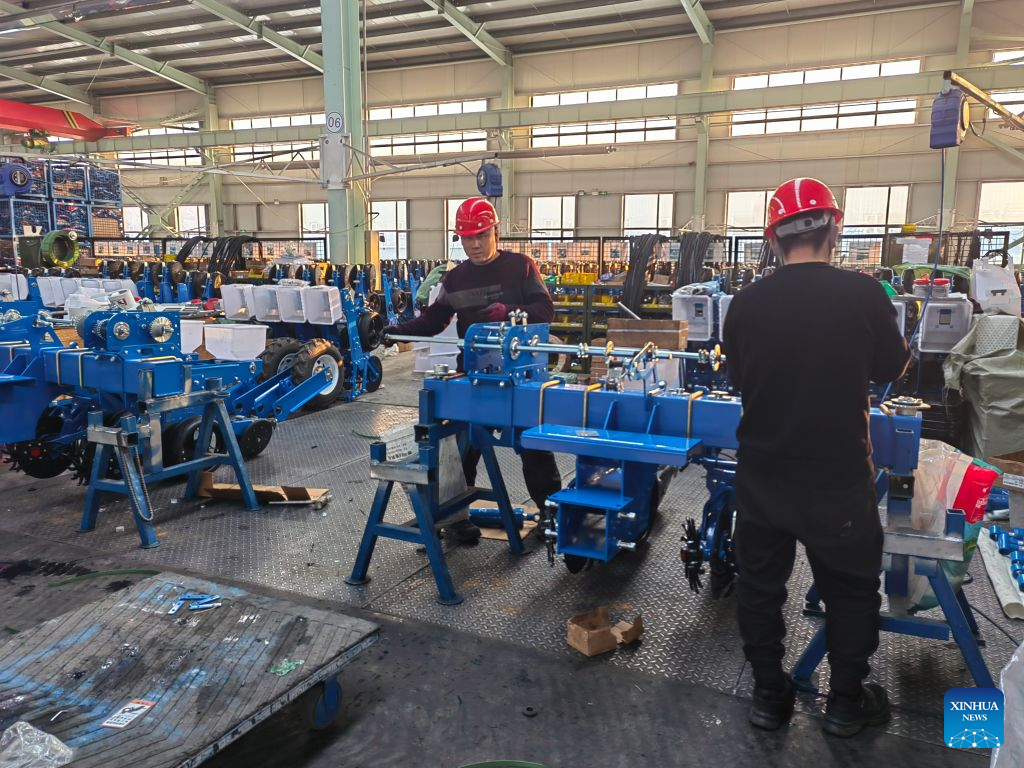
This photo taken with a mobile phone shows workers assembling components at a workshop of Jilin Kangda Agricultural Machinery Co., Ltd. in Siping, northeast China's Jilin Province, Jan. 29, 2026. (Xinhua/Xue Qinfeng)


