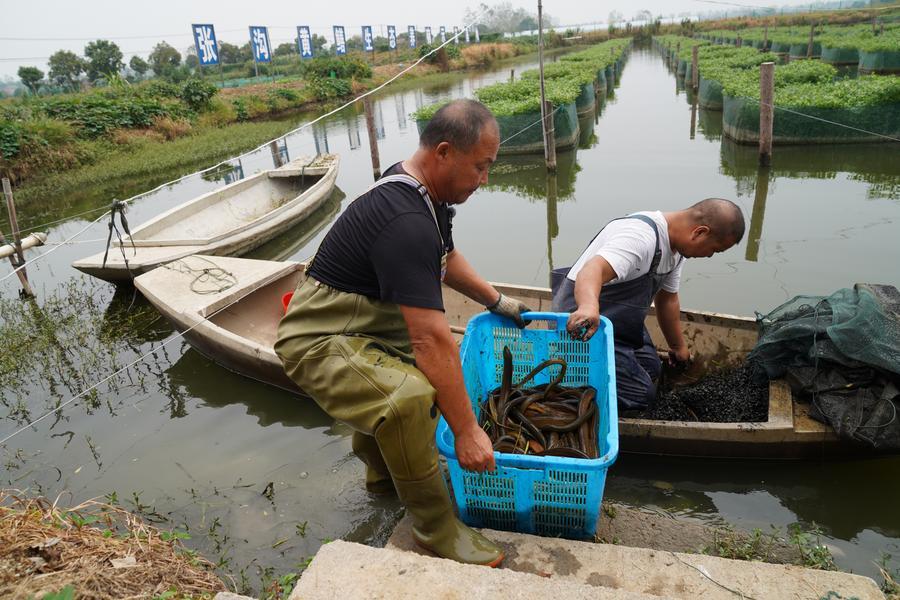
WUHAN, Sept. 17 (Xinhua) -- Across a patchwork of village ponds in central China, rows of floating cages ripple on the water. Beneath the surface, slender, snake-like rice eels twist through the nets -- the fish are a common dish at Chinese meals and a big part of how local farmers make a living.
Also known as the Asian swamp eel, the slippery freshwater fish is still somewhat of a niche delicacy outside of Asia. In China, however, it is widely consumed and has long been prized for its distinctive flavor and nutritional value.
The ponds are in Xiantao, a major hub for rice eel breeding and farming in Hubei Province. The city now accounts for roughly one-quarter of China's rice eel output, according to local industry figures.
The industry began to take shape more than three decades ago, when local farmers started experimenting with raising rice eels in cages.
Getting rice eel farming off the ground wasn't always easy. When people saw how profitable it could be, producers all over China jumped in, creating an oversupply and sending prices tumbling. A lot of farming communities gave up, but Xiantao stuck with it.
"With much of our farmland converted into ponds, rice eel farming had become the only viable way forward," said Zhu Chuanbao, Party secretary of Xianfeng Village in Zhanggou Town and president of the Xiantao rice eel industry association.
The village alone produces about one billion rice eels a year. "That is enough to put Xianfeng's rice eels on the table of nearly every household in China on average," Zhu said. The industry has helped lift villagers out of poverty and onto a path toward prosperity.
Xiantao is now home to China's biggest rice eel processing enterprise and the largest rice eel trading market at the production site. The city's rice eel industry generates an annual output value of over 12 billion yuan (1.77 billion U.S. dollars).
The growth of this industry has been supported by the central government's policies to advance rural revitalization. China aims to basically achieve modernization by 2035, and that cannot happen without the modernization of agriculture and rural areas.
"We are entering a new era of rice eel farming," said Zhu.
Researchers at Huazhong Agricultural University in Wuhan, the provincial capital, and the Institute of Hydrobiology under the Chinese Academy of Sciences have worked with local producers to develop large-scale artificial breeding techniques and controlled-environment aquaculture systems.
These advances have reduced the industry's dependence on seasonal cycles, making year-round production possible.
By allowing precise control of water quality and temperature, the systems help farmers cope with increasingly frequent extreme weather. They also protect rice eels from predators, raising juvenile survival rates in the lab from 50 percent to 90 percent.
The real challenge isn't just raising more rice eels. It's about getting more people to try them, especially outside Asia where many folks are not as familiar with the fish.
That means tapping overseas markets. In the first half of this year, Xiantao exported more than 125 tonnes of frozen rice eels and processed rice eel products to more than 10 countries and regions, including North America, Australia, Japan, the Republic of Korea and Southeast Asia.
"There are more than 60 million overseas Chinese, and rice eels are already widely accepted in East Asia and Southeast Asia. We are now seeking to reach more consumers in Europe and North America by developing products suited to their tastes, including grilled rice eel and rice eel steaks," Zhu said.
Rice eel farmers in Xiantao have built a digital platform covering the entire supply chain, from breeding and farming to feeding and processing. Consumers can use it to trace products through every stage of production.
"Traceability gives Xiantao rice eels the confidence to reach consumers across China and around the world," said Lu Huawei, a local government official.
Some farmers are already looking ahead to the next technological upgrade.
Xiao Tiebing is closely following the development of an unmanned boat by a local company in collaboration with leading Chinese universities. Designed to automate repetitive tasks, the vessel can feed the fish and remove uneaten feed.
"I hope new technologies can further improve farming efficiency, just as earlier innovations have done, and help us earn more," Xiao said. ■