
TAIPEI/BEIJING, Sept. 15 (Xinhua) -- When fruit harvests peak, Taiwan farmers not only need favorable weather but also buyers capable of absorbing large volumes quickly. For an increasing number of them, these buyers are on the Chinese mainland, with its proximity, vast consumer market and measures to facilitate agricultural trade.
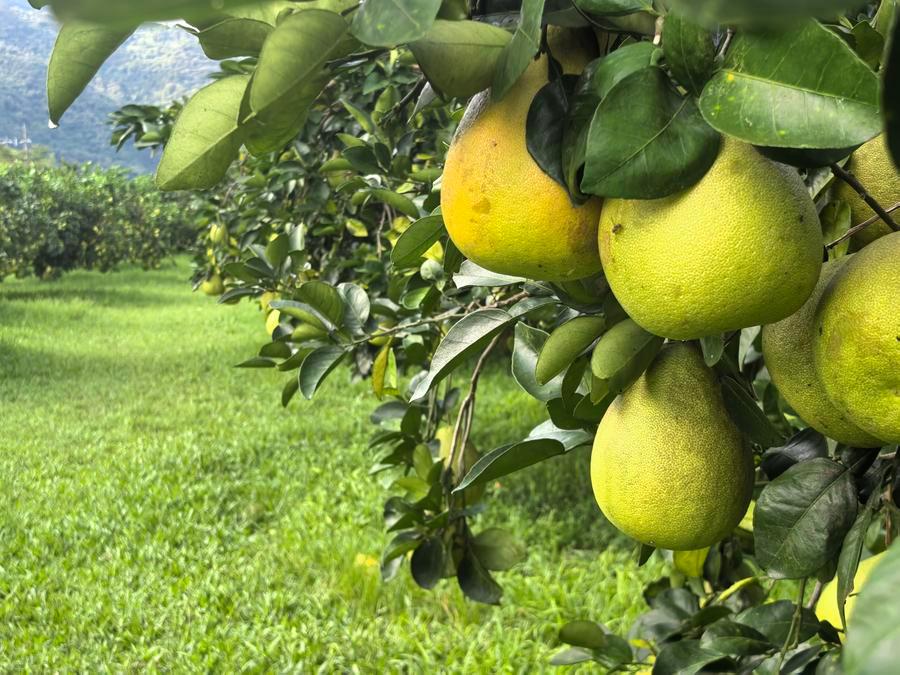
In Juisui Township of east Taiwan's Hualien County, farmers are racing to harvest and pack pomelos, a seasonal fruit with a mildly sour and sweet aftertaste. For growers like Yang Ju-huang, who cultivates more than 10,000 pomelo trees across a 22-mu (about 1.47 hectares) orchard, securing sales channels is as important as producing a good crop.
The pomelos grown in Juisui have relatively thick peels and can undergo a post-harvest process in which moisture gradually moves from the peel back into the flesh, making them well suited to long-distance transportation.
"That gives our pomelos a particular advantage in reaching consumers across the Taiwan Strait," Yang said.
Access to the mainland market has expanded this year. On Aug. 25 and Sept. 1 respectively, mainland authorities added more Taiwan pomelo orchards and packing facilities to the list eligible to export to the mainland.
The Farmers' Association in Juisui said that exports to the mainland and Hong Kong Special Administrative Region are expected to further grow this year.
For farmers, the significance lies not only in individual orders, but also in the predictability of demand.
"Pomelos exported to the mainland have stable sales, which gives farmers greater peace of mind," said Chen Ting, a Hualien grower.
This demand is increasingly visible beyond the orchards. Hualien pomelos have been showcased at major trade and agricultural events in Beijing, south China's Dongguan and Nanjing in east China this season, giving producers direct access to consumers and distributors in mainland cities.
"The good harvest this year coincided with sluggish sales of some fruits in the local market, making mainland demand particularly valuable," said Tsai Yao-cheng, director of Taiwan Farmers' Association Development Co., Ltd. "Taiwan pomelos are now arriving in Nanjing every week, while Guangdong in south China and east China's Fujian are also actively seeking to introduce Taiwan fruits."
The same market dynamic is even more pronounced for pineapple custard apples, one of Taitung's signature agricultural products.
Pineapple custard apple orchards stretch for more than 100 km across the county. Roughly 95 percent of the island's overseas shipments of the fruit have gone to the mainland, making this market a key part of the industry's sales structure.
Lin Chao-hung, head of a fruit growers' cooperative group in Beinan Township, Taitung, told Xinhua that her group established a stable partnership with a mainland warehouse retailer two years ago, enabling the fruit to reach mainland shelves from the orchard in as little as nine days.
The mainland has traditionally been a major market for Taiwan farm produce. In 2019, the mainland was the largest export market for such produce, taking up a share of 22.9 percent of the island's total farm produce exports.
However, driven by a cross-Strait economic decoupling policy, Taiwan's Democratic Progressive Party (DPP) authorities intentionally abandoned the mainland market that is geographically close, connected by relatively short shipping routes, and capable of absorbing large volumes of seasonal produce.
Meanwhile, the mainland has never stopped trying to reconnect and promote agricultural exchanges across the Strait.
The mainland in April rolled out a package of 10 policies and measures to promote cross-Strait exchanges and cooperation. One of these measures aims to facilitate the entry of Taiwan agricultural and fishery products that meet quarantine requirements and supports their participation in mainland trade fairs to expand sales channels.
Implementation has since moved beyond policy announcements to concrete trade facilitation. At the Straits Forum in June, a matchmaking and signing event brought together Taiwan agricultural and fishery producers and mainland buyers. Mainland companies signed procurement agreements with enterprises and industry associations from several Taiwan localities covering products ranging from pineapple custard apples to pomelos and tea.
Figures point to a broader trend. According to Taiwan's agricultural authorities, the island's total agricultural exports declined in the first half of 2026, as shipments to the United States and Japan fell. By contrast, exports to the mainland rose 11.3 percent in this period, with pineapple custard apples among the main growth items.
Yet the expansion of agricultural trade has not been matched by an equally open and facilitating approach from Taiwan authorities.
When mainland enterprises placed orders for Taiwan agricultural and fishery products, including pineapple custard apples from Taitung and groupers from Pingtung, at the Straits Forum matchmaking event, the DPP authorities accused the mainland of using agricultural products as a political tool and launched investigations into five Taiwan agricultural and fishery organizations that participated in the event.
This episode underscored the gap between the commercial nature of cross-Strait agricultural exchanges and the political lens through which they are viewed by the DPP authorities.
A similar pattern has emerged in tourism and other areas covered by the 10 measures. While the mainland has sought to promote people-to-people exchanges and expand business links, the DPP authorities have imposed additional political conditions and administrative barriers on such contacts.
"The 10 measures fully align with the common interests of people on both sides of the Strait," said Sheng Jiuyuan, director of the center for Taiwan studies at Shanghai Jiao Tong University in east China. These measures, he said, are pragmatic steps to promote the peaceful development of cross-Strait relations and deepen integrated development, with benefits reaching grassroots farmers and fishermen, small and micro businesses, young people and other groups in Taiwan.
After the measures were released, the DPP authorities immediately launched a campaign to discredit them, Sheng said, arguing that such efforts deliberately fueled confrontation across the Strait and played up the so-called "mainland threat" to divert attention from governance problems.
"The DPP authorities' actions were driven entirely by the party's own political interests at the expense of the island's overall development and the well-being and livelihoods of its people," Sheng noted.
For Taiwan's fruit growers, however, the calculation is more straightforward: when harvests arrive, a reliable market matters. For an increasing number of them, the mainland remains a market large enough, close enough and stable enough to make a tangible difference.
"A sufficient and stable market is the most practical guarantee," Lin Chao-hung from Taitung said. ■