* In 1996, China launched a pairing initiative linking coastal Fujian Province with landlocked Ningxia as part of the country's east-west poverty alleviation collaboration program.
* The east-west collaboration program is part of a broader national strategy to narrow regional development gaps and promote common prosperity.
* Through this model, the country has formed an all-round pattern of poverty alleviation and targeted support at various levels, providing a "Chinese solution" for countries around the world to address poverty.
YINCHUAN, Sept. 15 (Xinhua) -- A lifelong farmer from northwest China's Ningxia Hui Autonomous Region, Wang Guozhong has taken on a new role at the age of 64 by stepping onto the stage as an actor.
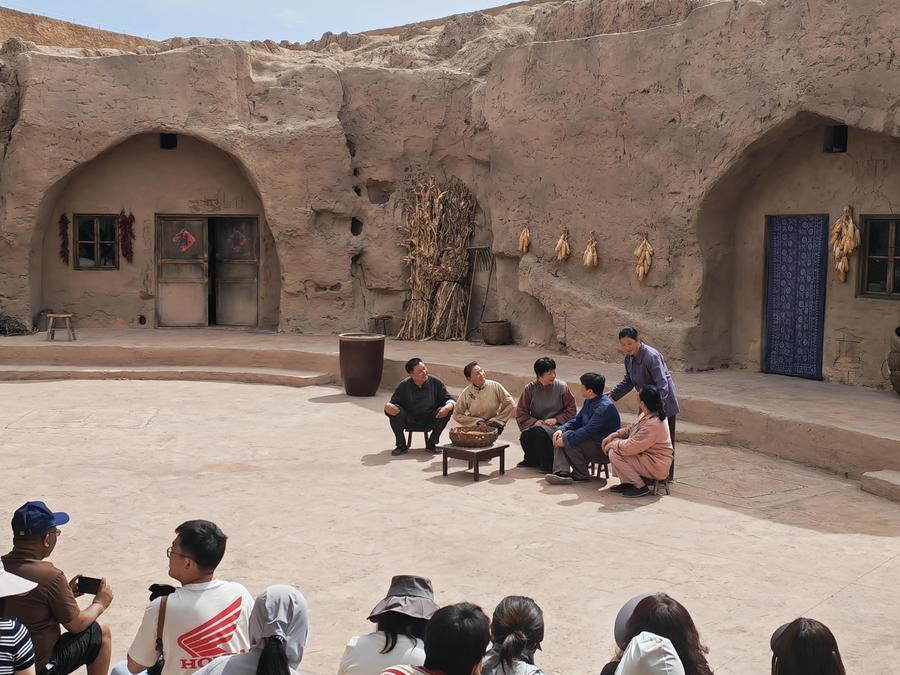
He now stars as the lead in a play at "See Minning Drama Village," China's first theater complex themed around the country's fight against poverty.
Located in Minning Town in Ningxia's Yongning County, the complex stages more than 100 performances a day, featuring 36 original productions. Many of the plays are inspired by Minning's history of resettlement and development, with performers like Wang bringing their firsthand experiences to the stage.
"When we cry on stage, it is because we really went hungry back then. When we laugh, it is because we are now living a life we once could only dream of," he said.
Wang was born in Xihaigu, a place the United Nations deemed the "most unfit place for human settlement" in the 1970s due to severe drought and ecological fragility.
Three decades ago, China launched a pairing initiative linking coastal Fujian Province with landlocked Ningxia to target poverty alleviation as part of the country's east-west poverty alleviation collaboration program. At the time, Fujian's GDP stood at 260 billion yuan (about 38 billion U.S. dollars), dwarfing Ningxia's 20.29 billion yuan to roughly one-thirteenth.
In 1997, construction began on Minning Village on barren land near Yinchuan, the regional capital. The cross-provincial effort transformed Minning, named after the abbreviations of Fujian and Ningxia, into a modern town, with a population rising from some 8,000 to over 60,000, mainly living on growing wine grapes, mushrooms, and goji berries and raising cattle.
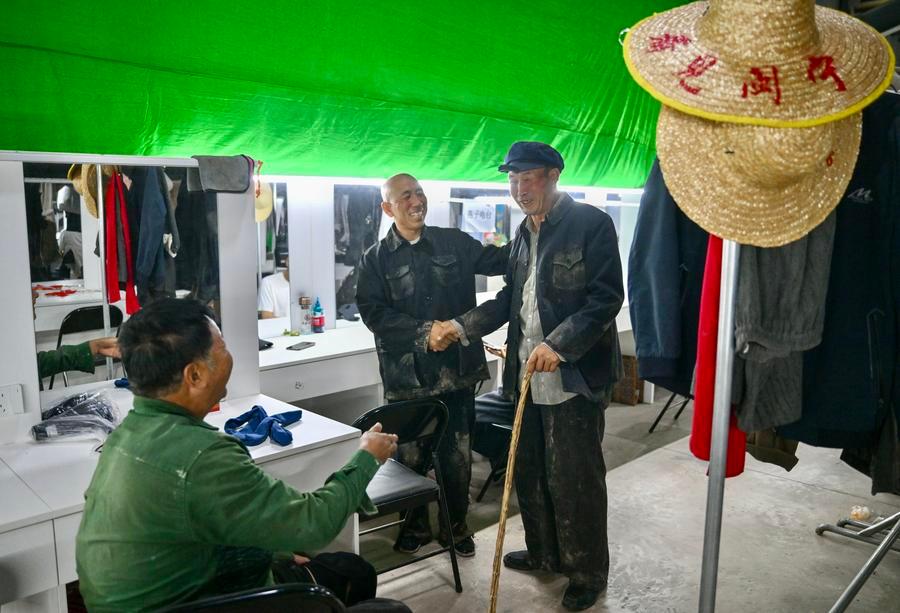
The theater complex has become another source of employment. Since its opening in July, it has helped create jobs and boost incomes for around 2,500 local residents.
"For me, earning 4,000 yuan a month means I can have a stable income without leaving home," Wang said. "More importantly, I can tell our story to audiences and let more people know how east-west collaboration has changed ordinary people's lives."
Wang's personal transformation mirrors a broader historical shift. Figures show that the east-west collaboration has helped Ningxia eradicate absolute poverty, lifting 803,000 rural residents out of destitution.
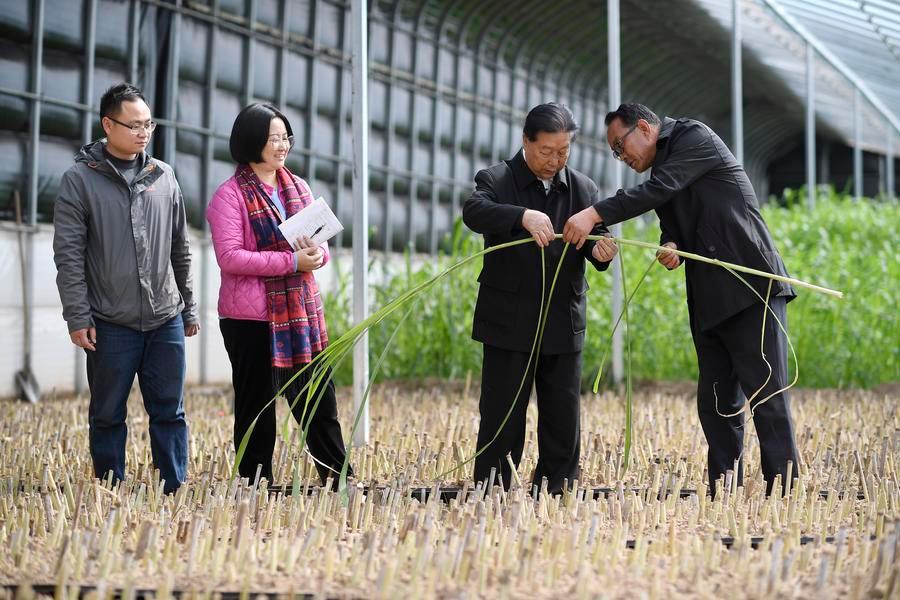
Since 1996, Fujian has channeled 7.68 billion yuan in aid, guided over 1,600 enterprises to invest in Ningxia, with actual invested funds exceeding 100 billion yuan. Today, nearly 6,000 Fujian-based enterprises operate steadily in Ningxia, laying a solid foundation for the region's socioeconomic development, according to Wang Jian, head of Ningxia's regional department of agriculture and rural affairs.
In 2025, Ningxia's per capita GDP reached 78,000 yuan, nearly 19 times higher than in 1996, underlining a compelling story of success.
Guided increasingly by market forces, the two regions are facilitating a two-way flow of resources. Their digital cooperation stands out as a prime example, as Ningxia's computing resources are meeting Fujian's rising demand while helping to ease Fujian's energy constraints. This synergy is not only transforming Ningxia's resource advantages into new economic drivers but also establishing a new model for east-west digital cooperation.

China's east-west collaboration program is part of a broader national strategy to narrow regional development gaps and promote common prosperity.
Over years of experimentation, the program has developed a relatively mature system featuring joint coordination, paired assistance, financial support, exchanges of officials and professionals, and broad participation from businesses and society.
By combining capital and markets from the east with resources from the west, the initiative has helped spark thriving local industries.
For instance, the partnership between the eastern Jiangsu and northwestern Shaanxi transformed Ankang, a city in Shaanxi Province, into a "plush toy capital," with over 800 enterprises generating an annual output of 10 billion yuan and employing nearly 20,000 people.
Similarly, the economic powerhouse of Guangdong and the less developed Guizhou in southwest China created a "guitar capital" in Guizhou's Zheng'an County through a cross-regional model linking Macao's design, manufacturing in Zheng'an and sales in Guangdong's Hengqin, boosting exports to 248 million yuan in 2025.
Furthermore, agricultural trade has evolved from emergency charity sales to stable market integration, with Shanghai now hosting over 300 direct outlets for Yunnan's specialty products.
As a long-term institutional arrangement for promoting coordinated regional development and common prosperity, the east-west collaboration has been upgraded from phased poverty alleviation measures to long-term and stable cooperation mechanisms.

China's 15th Five-Year Plan (2026-2030) released this year underscores the need to optimize the east-west collaboration. As 2026 marks the first year of implementing regular assistance, Chinese leadership urges drawing on the valuable experience gained from the Fujian-Ningxia partnership to further refine these mechanisms and broaden the scope of cooperation.
Maierdan Mugaiti, vice minister of agriculture and rural affairs, said China would maintain the long-term pairing of eight eastern provincial-level areas with 10 western ones. Additionally, economically developed eastern counties will be linked with key western counties for rural revitalization, ensuring paired assistance reaches a wide range of people.
Through this model, the country has formed an all-round pattern of poverty alleviation and targeted support at various levels, providing a "Chinese solution" for countries around the world to address poverty.
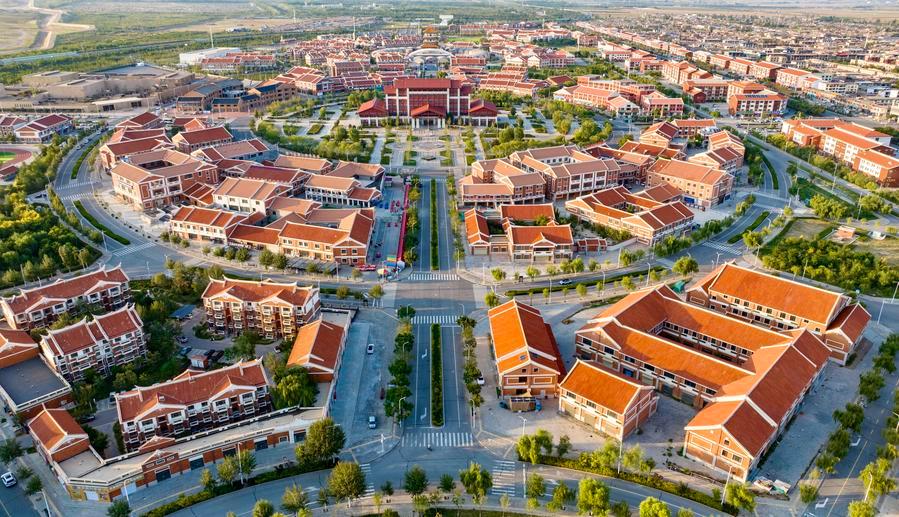
In July, officials, experts and scholars from more than 50 countries visited Ningxia to decode Chinese modernization by exploring and learning from local poverty alleviation stories.
Ghulom Halimzoda, chairman of the Socialist Party of Tajikistan, valued most from the Ningxia trip a complete set of institutions and mechanisms for socioeconomic operation, which could be borrowed by Central Asian countries.
"The core inspiration China's experience brings us is not simply that huge resources were invested. The continuity of policy, the governance capacity to coordinate and mobilize all forces, and, most crucially, the people-centered principle are what matter most," he said. (Video reporter: Lyu Ze; Video editors: Hong Ling and Li Qin) ■