
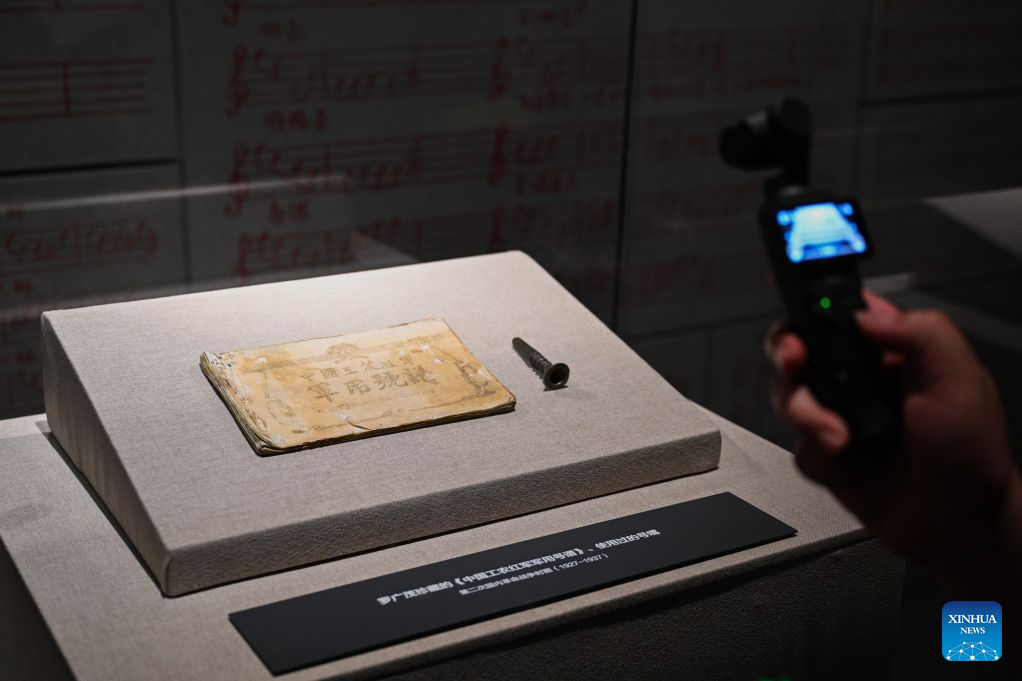
This photo taken on Sept. 8, 2026 shows the historic bugle score donated by Luo Guangmao (L) and a bugle mouthpiece he once used, both displayed at the Ninghua Revolutionary Memorial Museum in Ninghua County in southeast China's Fujian Province. (Xinhua/Zheng Huansong)
FUZHOU, Sept. 14 (Xinhua) -- For many visitors to Ninghua County in southeast China's Fujian Province, the journey begins with a historic bugle score.
Once used by the Chinese Workers' and Peasants' Red Army, the score now sits silently in a display case at the Ninghua Revolutionary Memorial Museum, its yellowed pages evoking the stirring calls that echoed across battlefields more than nine decades ago.
In an era of limited technology, bugles played an essential role in military communications. Described as a "codebook" for troops, the exhibited booklet contains more than 340 pieces of bugle music, covering the Red Army's daily routines, training, and combat commands.
"It is the most complete surviving Red Army bugle score formally published in China," said Yang Liting, a museum docent, highlighting its value in research on the Red Army's revolutionary history.
Behind this precious artifact lies the story of a Red Army soldier's commitment to the revolutionary cause.
Luo Guangmao joined the Red Army in the early 1930s. Selected as a bugler for his powerful voice, he was sent to a military school for systematic training. Upon graduation, he received a copy of the bugle score from the school and promised to protect it as he would his own life.
In 1934, Luo was wounded in battle and later lost contact with the main force. Fearing the score might fall into enemy hands, he secretly made his way home, entrusted it to his mother, and then left to evade enemy capture.
After the founding of the People's Republic of China in 1949, when Luo sought to retrieve the score, his aging mother could no longer remember where she had hidden it. Not knowing the score's whereabouts had long weighed on the veteran soldier.
It was not until 1974 that Luo discovered a package while dismantling the family's granary. "He burst into tears the moment he saw the score wrapped in layers of cloth and oil paper," Yang said.
Finally, Luo fulfilled the promise he had made as a young bugler. He donated the score to the museum, helping preserve the memory of the Red Army and the contributions of Ninghua soldiers in the Long March.
During the Long March, an epic 1934-1936 military trek that broke through the siege of the Kuomintang (Nationalist Party) forces, the Red Army soldiers braved raging rivers, frigid mountains, and arid grasslands, with some marching as far as 12,500 kilometers.
More than 6,000 people from Ninghua joined the Long March, many dying amid fierce battles against enemy forces. Only 58 reached the destination in northwest China, data from local authorities showed.
The sacrifices are not forgotten. Efforts are underway in Ninghua to keep the history alive, and the bugle remains one of the most vivid links to that past.
Since the early 1990s, Xia Chufa, a resident of Quanshang Town in Ninghua, has devoted himself to collecting revolutionary artifacts, especially bugles. To date, the 70-year-old has traveled to more than 20 provinces nationwide and handled over 20,000 items.
In 2018, Xia built a dedicated museum for his collections with financial support from the local government and over 10 million yuan (about 1.5 million U.S. dollars) of self-raised funds. The museum now houses more than 1,500 bugles of different types.
"It's something that I must do, even if it means going without food or drink," he said.
Asked why he keeps collecting bugles, Xia offers a simple answer. "I just want those who have never seen these things to have a place to see them. I don't want future generations to forget our difficult past."
Fortunately, young people are taking up the bugle, as the bugler system continues in the military today, to carry forward the revolutionary spirit and boost morale.
Zhang Jiahao, 24, is a bugler with the Ninghua unit of the Chinese People's Armed Police Force. After struggling three years ago with high notes he could barely produce, he is now passing on his skills to newcomers.
Meanwhile, Zhang also serves as a guide at the Ninghua Revolutionary Memorial Museum. He feels a sense of responsibility to share stories of Red Army soldiers who once charged forward at the sound of bugle calls with a growing number of visitors, as this year marks the 90th anniversary of the victory of the Long March.
"Standing beside the bugle score that a veteran bugler vowed to protect with his life, how could we not sound the bugle today?" Zhang said. ■


