
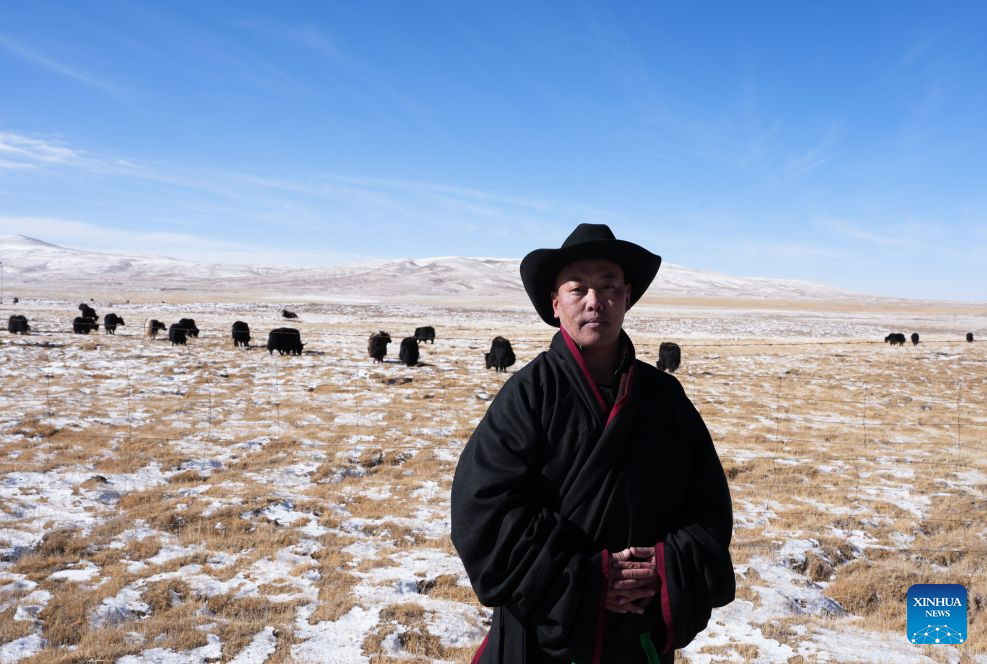
Gechu poses for a photo in Yushu Tibetan Autonomous Prefecture, northwest China's Qinghai Province, Jan. 31, 2026. (Xinhua/Zhang Long)
by Xinhua writers Wang Jinjin, Yuan Min and Ma Yunfei
XINING, Sept. 12 (Xinhua) -- Standing at the bow of a boat, Gechu spent a considerable amount of time gazing at the spot where the Yellow River meets the sea in east China.
For most of his 39 years, the herder had known the Yellow River only at its source in the highlands of Qinghai Province, northwest China. The grasslands there were his home, where he patrolled the pasture, watched over the headwaters and measured the grass with a tape measure.
Until this summer, he had never seen where the river flowed.
"My father used to say, 'The Yellow River doesn't enter the sea, and the sea doesn't enter the Yellow River,'" Gechu said.
It was an old saying among herders at the river's source, referring to the distinct boundary that can sometimes be seen where the sediment-laden Yellow River meets the clearer, saltier seawater. Differences in sediment concentration and water density can make the two bodies of water appear to remain separate before gradually mixing.
"I didn't understand," Gechu said. "They are both water. Why wouldn't they mix? Now I've seen it."
Gechu lives in the Yoigilangleb basin, deep in the Sanjiangyuan area known as China's "water tower," where the Yellow River begins its long journey across the country.
Gechu grew up there. In his late teens, he started to notice changes in the surrounding landscape. The grass grew shorter and the water shallower. A river that once had to be crossed on horseback could later be crossed on foot, he recalled.
As an adult, he took on the work of patrolling the grasslands, traveling on horseback and by motorcycle, picking up rubbish, helping injured wildlife, and keeping track of changes in the pasture.
A tape measure has long been one of his essential tools. He worried when the grass grew thin. But in recent years, as it became thicker, he found that these positive changes left him with a refreshing sense of satisfaction.
Monitoring data show the change on a wider scale. Vegetation cover in the Yellow River source section of Sanjiangyuan National Park has reached 68.7 percent, while coverage in restored areas of severely degraded grassland has risen from below 20 percent to more than 80 percent.
This year marks five years since Sanjiangyuan National Park was formally established and 10 years since its pilot program began. After the park was established, Gechu formally became an ecological ranger.
His respect for the headwaters was rooted in rules passed down by his father's generation. People were not supposed to shout near the source at night. Animals were not to be slaughtered there. Even after butchering cattle elsewhere, people were not supposed to wash their hands in the headwaters.
His father passed away in 2009. Before his death, he told Gechu to protect the source of the Yellow River, not to lease out the pasture, and not to leave. In his 20s at the time, Gechu became the head of the household and has lived in and patrolled the area ever since.
Someone once asked him what rubbish at the source of the Yellow River had to do with them. Gechu had no grand answer. The headwaters, he said, supplied water to countless people downstream. If the source became dirty or damaged, "that would be bad for the country."
This year marks the 80th anniversary of China's efforts to protect and harness the Yellow River. In 2025, the river's main stream maintained a Class II water quality rating along its entire course for a fourth consecutive year, a level that meets the hygienic standard for drinking water after conventional water purification treatment, according to the Ministry of Ecology and Environment.
Gechu's part in that story remains small and intensely local. He had rarely traveled far from the headwaters. He cannot read and speaks little Mandarin, and before this summer, the farthest he and his family had been was Lhasa, capital of Xizang Autonomous Region which is adjacent to Qinghai. He had long wanted to see more, he said, but had never managed to make it very far.
The idea for this journey began with a question from his nephew, Sonam Doje: What does the Yellow River look like where it meets the sea? Gechu did not know. He wanted to find out.
This summer, accompanied by his nephew, Gechu left the headwaters for his first trip off the plateau. On his first flight, he sat quietly by the window, watching unfamiliar landscapes pass below and thinking about his father.
When the plane crossed the lower reaches of the Yellow River, he leaned toward the window. "This is the first time I've seen that the Yellow River can be so wide," he said.
By plane, car and boat, the journey eventually brought him to the Yellow River estuary in east China's Shandong Province.
At the Yellow River Delta National Nature Reserve, Gechu learned about the wetlands around the estuary, saw rare birds including Oriental storks and Saunders's gulls. In 2025, the reserve recorded 536 oriental stork chicks, the highest annual number on record, while the breeding population of Saunders's gulls remained above 10,000. He also met people working to protect the river at its other end.
"The Yellow River is like a mother," he said. Its water nourishes the land and allows grass and other plants to grow.
When the journey was over, Gechu and Sonam Doje returned to the headwaters. The pasture was still there, and the river continued to run downstream. Gechu went back to patrolling, watching the water and measuring the grass.
"Don't worry," he told his nephew. "The grass will grow back." ■
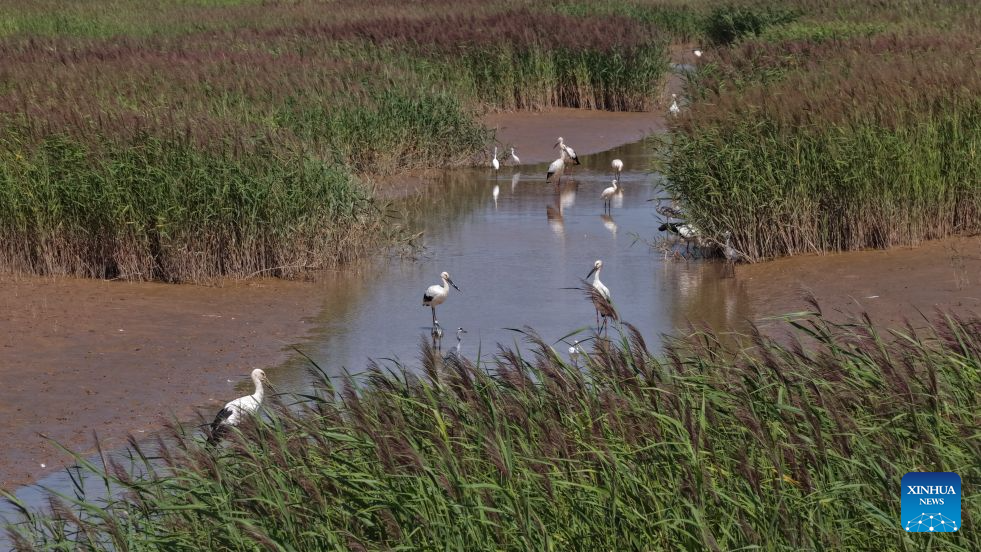
Oriental white storks forage at a wetland at the Yellow River's estuary in Dongying, east China's Shandong Province, Sept. 6, 2026. (Photo by Yang Tingkui/Xinhua)
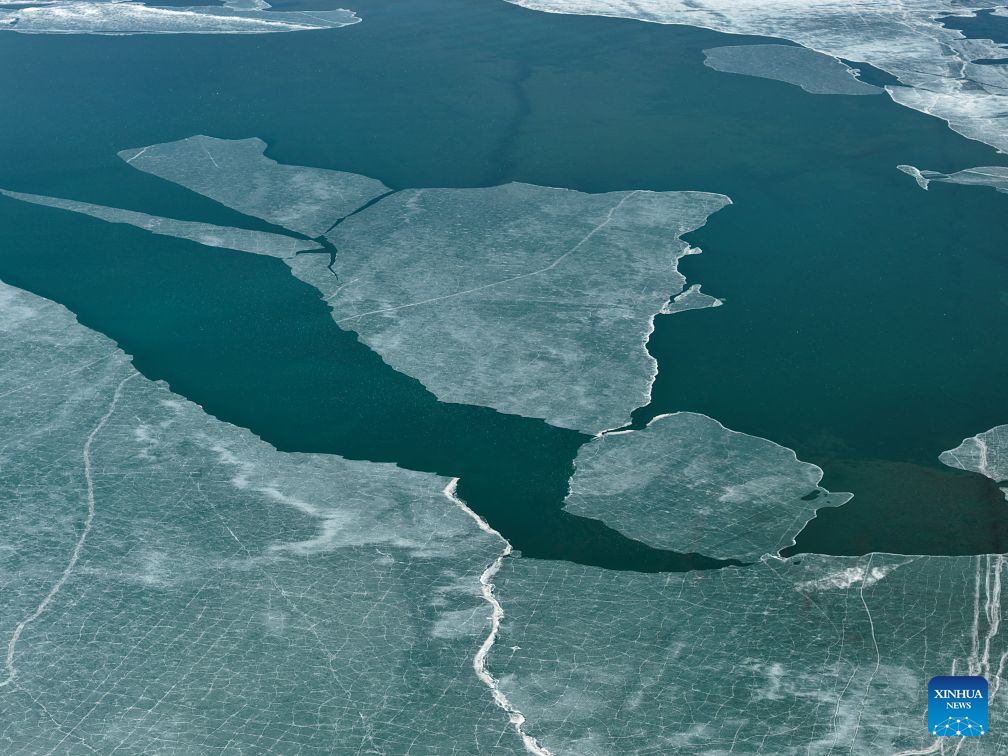
An aerial drone photo taken on March 10, 2026 shows a view of the Gyaring Lake at the Yellow River's source in Maduo County, northwest China's Qinghai Province. (Xinhua/Li Zhanyi)
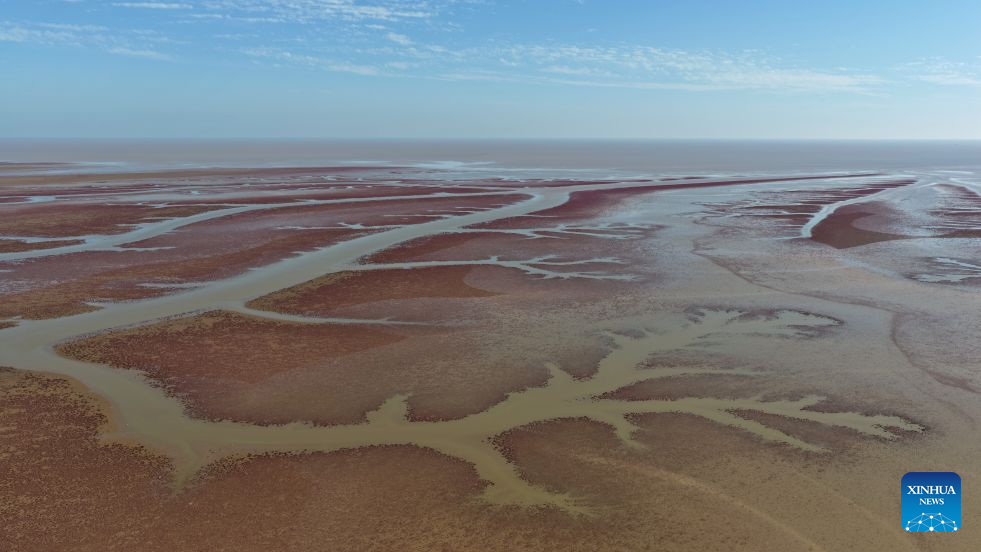
An aerial drone photo taken on Sept. 5, 2026 shows a view of the Yellow River's estuary in Dongying, east China's Shandong Province. (Photo by Yang Tingkui/Xinhua)


