BEIJING, Sept. 12 (Xinhua) -- Carlos Alberto Corro Martin used to work for Ebro, an iconic brand of Spain's auto sector that had once faded into memory after its factories fell silent and jobs disappeared.
In 2024, with Chinese automaker Chery partnering with Spanish automaker EV Motors, the legendary brand was revived. Electric models rolled off production lines, creating some 1,000 local jobs.
"I'm very happy to see it return to the market," said Corro Martin, now a Chery dealer. "I believe the cooperation can open even broader prospects for the Spanish auto industry."
Supported by battery technology advantages, intelligent systems and supply-chain efficiency, Chinese new energy vehicle (NEV) brands are not just winning the hearts of global consumers, but also generating greater spillovers beyond the market expansion -- creating local jobs, supporting industrialization, and making the green transition more affordable and achievable.
In the first eight months, China's total auto exports reached 7.153 million units, up 66.7 percent, including 3.435 million NEVs, a 1.2-fold increase, according to the China Association of Automobile Manufacturers.
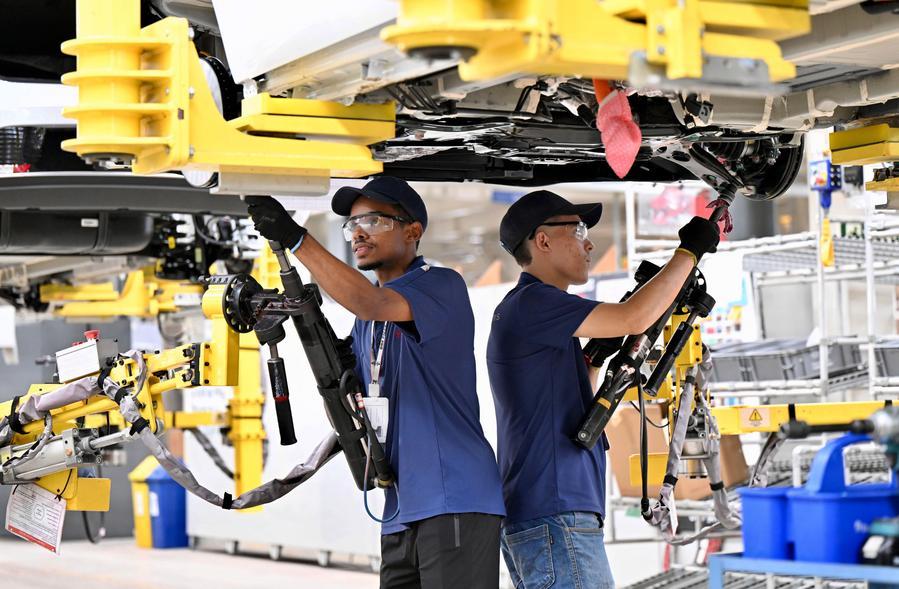
Rather than simply shipping cars, many Chinese automakers are building manufacturing and research facilities overseas. In South Africa, Chery inaugurated a manufacturing plant in Rosslyn in July, retaining all 692 employees, with expectations of creating nearly 3,000 jobs across the supply chain.
"Chery's investment will pave the way for technology transfer, automation, digitalization and advanced manufacturing systems," said South African Deputy President Paul Mashatile, adding that these developments will strengthen South Africa's industrial capacity.
In Brazil, Chinese automaker BYD is embedding R&D, production, sales, services and supply chains into the local economy. Its plant in the state of Bahia employed 5,500 direct workers as of July this year, 86 percent of them from Bahia. Once fully operational, it is expected to support 20,000 direct and indirect jobs, with the company aiming for local suppliers to account for over 50 percent of components by 2027.
The expanding footprints of overseas investment came along with the increasing popularity of Chinese NEVs across diverse markets. In Europe, new-car registrations of Chinese brands have for two consecutive months surpassed those of Japanese automakers. In Southeast Asia, consumers in Thailand and Singapore have queued for popular Chinese NEV models, while in the Middle East, Chinese brands have continued to gain traction even amid regional instability.
Chinese automakers are also tailoring vehicles to local demands. Chery, now present in over 130 countries and regions, optimized acceleration and hill-climbing for South America's mountains and strengthened interior sealing for the Middle East's deserts.
Chinese NEV brands are especially gaining market share in the Middle East, Africa, Southeast Asia and other parts of the Global South, according to Ron Zheng, senior partner of Roland Berger and Asia head of automotive practice.
"For consumers in these emerging markets, Chinese NEVs are not only affordable but also offer superior features," Zheng said.
In Malaysia, Zeekr, the premium NEV brand under Chinese automaker Geely, entered the market in December 2024. Within months, Zeekr vehicles were more visible on Malaysian roads.
"Previously, Malaysians may have associated Chinese cars mainly with affordability," said Zarul Fadzly, sales manager for Zeekr's KLCC and Johor Bahru outlets. "But with the entry of Zeekr and other Chinese brands, they have experienced firsthand the safety, performance and quality of the vehicles. Their perception has changed. Now they are more inclined to pursue the performance and quality of Chinese brands."
On the broader impact of Chinese brands entering Malaysia, Fadzly added: "They bring more advanced technology, so other brands will follow suit and compete. Eventually the biggest beneficiaries are consumers -- everyone is competing to improve technology."
Beyond cost-effectiveness and technological advantages, Chinese NEVs are also accelerating the global energy transition. The International Energy Agency (IEA) estimated that the global electric vehicle fleet displaced about 1.7 million barrels of oil demand a day in 2025, with China accounting for roughly 1 million barrels a day.
The increasing cost-competitiveness of electric vehicles, along with tighter standards to cut carbon emissions, is poised to drive market growth, pushing up the share of electric vehicles in global car sales to around 50 percent in 2035 from 25 percent in 2025, according to an IEA report.
"China's NEV industry offers the world an alternative to the Western high-cost green transition path, making green transition no longer a privilege of developed countries, but an affordable development opportunity for all nations," said Zhu Yifang, deputy chief engineer at the China Automotive Strategy and Policy Research Center.
Still, Chinese automakers' overseas expansion is currently in its early stages, far from reaching the globalization level of traditional automotive powerhouses, Zheng from Roland Berger said.
Roland Berger forecasts that by 2030, overseas sales of Chinese passenger car brands will grow to about 10 million units, with local manufacturing accounting for more than 50 percent.
With that growth on the horizon, China stresses that its aim is shared progress, not dominance. Wan Gang, honorary president of the China Association for Science and Technology and a former minister of science and technology, said China is building its automotive strength to share its achievements with the global community.
"We strive to make the global auto industry strong as a whole and to solve the common problems we face -- oil, emissions, affordable mobility for ordinary people, climate and the environment, among others," he said. ■