BEIJING, Sept. 11 (Xinhua) -- A diverse cohort of officials, scholars and industry leaders from more than 20 countries and regions gathered in Beijing to discuss a common challenge: how to harness digital technology to preserve cultural heritage through collaborative efforts.
The 8th International Symposium on Cultural Heritage Conservation by Digitization (CHCD) kicked off on Wednesday in the capital. The four-day event was hosted by Tsinghua University, which has been exploring digital heritage since its pioneering "Digital Yuanmingyuan (Old Summer Palace)" project in 1998.
"Science history tells us that landmark breakthroughs rarely happen at the center of a discipline -- they emerge where disciplines collide," said Bai Benfeng, vice president of Tsinghua University. "Cultural heritage digitization is exactly such a crossroads. It needs deep roots in history, archaeology, architecture and the arts, alongside continuous advances in computing, artificial intelligence (AI) and spatial information technology."
Launched as a joint initiative in 2010, the CHCD has continued to broaden and deepen its international exchanges and cooperation, Bai added.

Greece participated as the guest country of honor for this year's symposium. Over the past two decades since China and Greece established a comprehensive strategic partnership, bilateral cooperation in cultural heritage and other fields has become increasingly substantive.
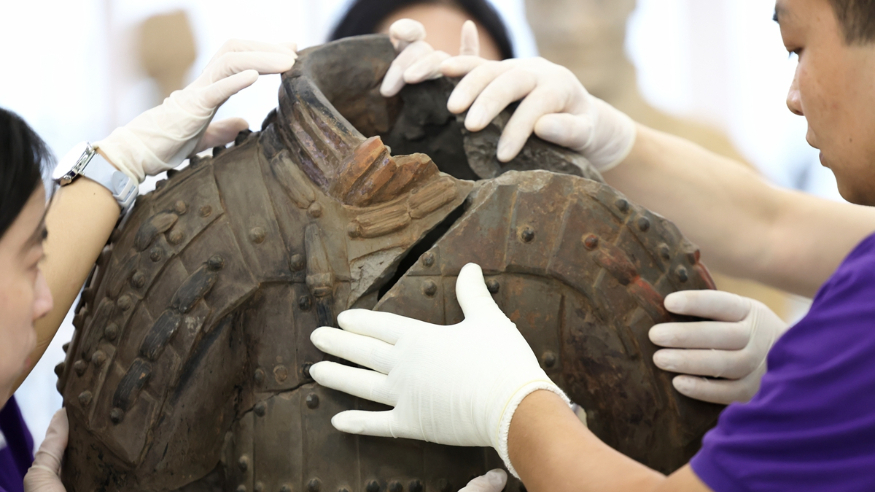
In 2021, the National Archaeological Museum in Athens launched a digital Terracotta Warriors exhibition during the China-Greece Year of Culture and Tourism. The following year, "RE Olympia," a China-Greece cultural exchange exhibition in Beijing, brought the ancient Olympic civilization to Chinese audiences through cutting-edge digital technology.
Building on this momentum, 2024 saw the signing of the Sino-Hellenic Digital Heritage Joint Laboratory at the 7th CHCD by top heritage research institutions from both countries -- the first international joint laboratory dedicated to digital heritage.
That same year, Konstantinos Eleftheriadis, director of the Institute of Nuclear and Radiological Sciences and Technology, Energy and Safety at Greece's National Centre for Scientific Research (NCSR) Demokritos, joined a Greek scholars' delegation on a visit to Beijing's Shougang Park, a flagship example of adaptive reuse for industrial heritage in China.
He hopes to apply the digital technologies developed at Shougang to Greece's GRR1 research nuclear reactor, a key piece of the country's nuclear energy industrial heritage. "Our challenge is how to preserve, document and showcase the historical and technological heritage of the nuclear reactor over the past decades. It deserves to be better understood by the public," he said.
His wish came true at this year's symposium, where the joint laboratory's flagship project was unveiled -- the Digital Revitalization Project of NCSR's GRR1 Nuclear Energy Industrial Heritage -- marking a major step forward in bilateral cooperation from institutional framework-building to tangible project implementation.
"We are proud not only because this joint laboratory has yielded significant results and is attracting more partners, but also because Greece and China have more than one partnership to showcase in this field," said Evgenios Kalpyris, ambassador of Greece to China.

The symposium also included a special session focused on Greece, where Chinese and Greek experts discussed and shared experiences on precision heritage mapping, digital twin applications, and smart heritage information systems.
During a separate session, Fulvio Rinaudo, president of CIPA (Comité International de la Photogrammétrie Architecturale) Heritage Documentation and professor at the Polytechnic University of Turin, spoke about the challenge of documenting cultural heritage in the age of AI. "The strongest future is not AI replacing human intelligence (HI), but HI and AI working as a cognitive partnership," he said.
The professor noted that HI brings purpose, ethics, empathy and judgment, while AI contributes speed, scale, memory and pattern recognition. "Together, they enable augmented intelligence," he added, urging young people to "study the theory more deeply to be able to spot errors and correct them."
A signing ceremony for a China-Italy digital cultural tourism collaboration was also held during the symposium, with the Xanadu Site in China's northern Inner Mongolia Autonomous Region serving as the central cultural anchor of the initiative. Italian explorer Marco Polo (1254-1324) described Xanadu in his book "The Travels of Marco Polo." The site was inscribed on the UNESCO World Heritage List in 2012.
As early as June last year, the Tsinghua Heritage Institute for Digitalization, one of the CHCD's executive organizers, signed a memorandum of cooperation with Civita, an Italian company specializing in cultural exhibitions and museum management, to deepen bilateral collaboration in digital heritage. The partnership involves inviting Italian experts to serve as technical advisors and curatorial consultants for the digital recreation of Yuanmingyuan's grandeur, as well as using digital technology to showcase Italian culture and art at Shougang Park.
"Cultural heritage is fragile. Digital technology can help ensure its sustainable transmission and preservation, giving traditional cultural heritage new vitality and greater international reach," said Elisa Messina, cultural attache at the Italian Embassy in China.
Liu Yuzhu, chairman of the China Foundation for Cultural Heritage Conservation, was also involved in China-Greece digital heritage exchanges in the early years and is pleased to see the joint laboratory moving steadily forward.
"I have also witnessed China-Italy cooperation on the restitution of lost cultural relics. In the future, both sides can further explore 'digital return' as a way to comprehensively document and present dispersed artifacts," he said, adding that the foundation will step up support for international exchanges in heritage digitization and promote mutual learning between China and other countries.
"The protection of cultural heritage is no longer a purely local matter or the responsibility of any single country," said Ashraf Al-Azzazi, secretary-general of Egypt's Supreme Council of Culture. "It has become a shared responsibility of humanity, requiring concerted efforts, the exchange of knowledge, and stronger cooperation among countries around the world."
He believes that cooperation among great civilizations such as China, Egypt, Greece and Austria "can provide the foundation for building a shared global model for the protection of human heritage, one that makes technology an instrument for bringing peoples closer together, rather than merely a means of technological advancement." ■