
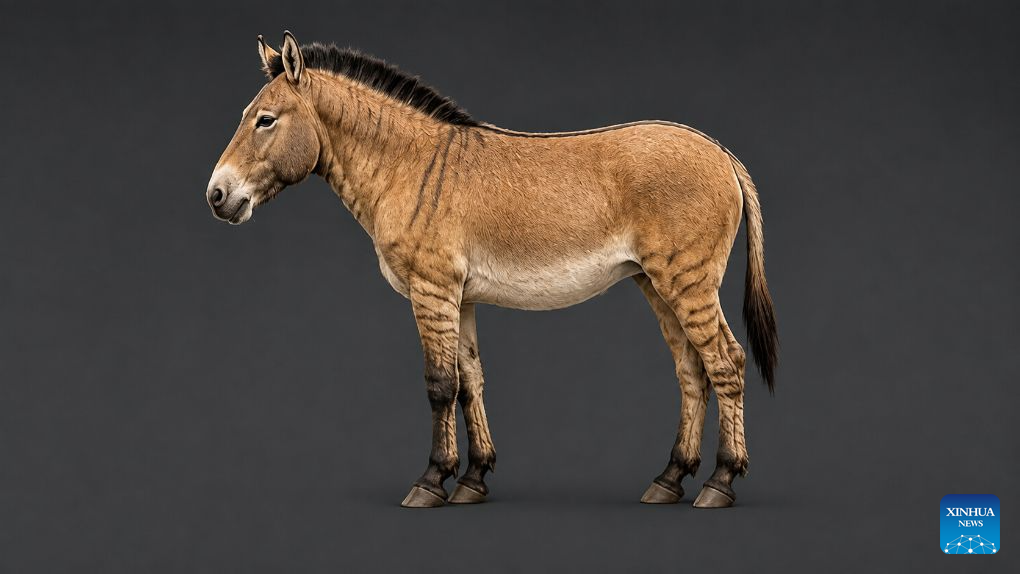
This undated file image provided by Jilin University in northeast China's Jilin Province shows a reconstructed 3D image of Equus ovodovi, an extinct ancient horse. (Jilin University/Handout via Xinhua)
CHANGCHUN, Sept. 11 (Xinhua) -- The year 2026 is the Year of the Horse in the Chinese zodiac, and scientists have welcomed a long-lost relative back to the horse family tree.
A China-U.S. research team has, for the first time, reconstructed the full appearance of an extinct ancient horse, known as Equus ovodovi, giving a face to a species that had puzzled scientists for over a century.
Jilin University in northeast China on Thursday unveiled a 3D image of the animal, a brown-furred creature about the size of a donkey. According to the university, using ancient DNA data and comparative anatomy, its bioarchaeology laboratory carried out the reconstruction in collaboration with U.S. company Evolutio LLC.
This joint work fills a gap in terms of what this animal looked like, and establishes a complete research chain from ancient DNA to visual reconstruction, the university told Xinhua.
The horse fossils, dating back roughly 40,000 years, were first found in a cave in southwestern Siberia in Russia. Initially, only broken jawbones and teeth were discovered, without a complete skull. Over the years, related fossils have also been unearthed in North America, Africa, Siberia and northeast China. However, because the bones were scattered fragments, the animal's true appearance had remained a mystery for more than a hundred years.
In 2022, Chinese researchers at Jilin University and Northwest A&F University in northwest China's Shaanxi Province successfully extracted high-quality gene data from the fossils. Building on that work, they worked with American researchers in 2026, comparing the fossil data with living species, such as the Asian wild donkey and domestic horse. They reconstructed the skeleton, built up muscle structure, and eventually recreated the animal's full appearance.
The study shows that the "returned horse" is a fourth independent lineage of the horse family tree, alongside horses, zebras and donkeys. It split off roughly 2.7 million to 2.3 million years ago. Genetically, it is more closely related to donkeys and zebras than to domestic horses. It noted that this horse survived into the Bronze Age before eventually going extinct.
Lead researcher Cai Dawei, at Jilin University in Jilin Province, said that gene data can only tell what this animal was and when it disappeared, but together with evidence from its bones and body shape "scientists can understand this extinct species as a complete organism, from its skeleton to its physical appearance."
Evolutio LLC said every stage of the workflow was grounded in verifiable scientific data, and the resulting model can be used for both research and science education.
The research team expects that the reconstruction will enable the public to gain an intuitive understanding of an extinct horse that once coexisted with humans. ■


