by Xinhua writers Pang Mengxia, Sui Lixi and Wu Jianfeng
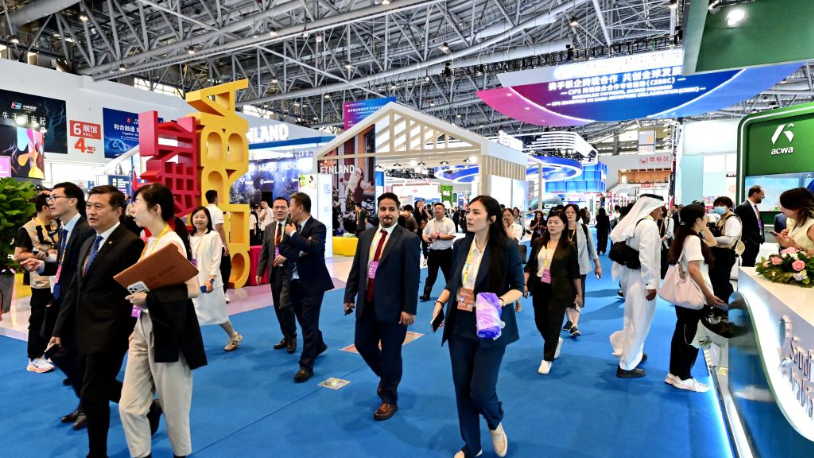
XIAMEN, China, Sept. 11 (Xinhua) -- The 26th China International Fair for Investment and Trade (CIFIT), being held from Sept. 8 to 11 in Xiamen, southeast China's Fujian Province, has drawn exhibitors and delegations from 129 countries and regions to its 14 themed exhibition areas.
Beyond the deals on display, executives say the event is increasingly serving as a barometer of where global capital sees opportunities in China.
At Hall 5 of the Xiamen International Expo Center, the booth of Yihai Kerry Arawana Holdings Co., Ltd. -- the China unit of Singapore-listed agribusiness group Wilmar International -- was packed with visitors. Products on display included low-GI, high-fiber oats, black highland barley and tartary buckwheat -- a lineup the company says is aimed at China's booming "big health" market.
"We have observed new changes in the Chinese market, and the most prominent is the upgrading of health demand," Mu Yankui, president of Yihai Kerry Arawana, told Xinhua.
Noting that China's elderly population has reached 300 million and that young people are showing growing personalized health needs, he said national health demand is driving the company to keep pace with the times in developing "big health" products.
Mu said the company has invested a total of roughly 100 billion yuan (about 14.9 billion U.S. dollars) in China, of which around 60 billion yuan (about 8.95 billion U.S. dollars) was invested in just the past eight years.
"Going forward, we will firmly continue to invest in China and help the country's agriculture transform from 'big' to 'strong,'" he said.
China has grown into the world's second-largest consumer market, with household consumption shifting from "whether there is enough" to "whether it is good enough." In recent years, the structural opportunities created by consumption upgrading have drawn global investors to vote with real money.
Decathlon, the French sporting goods brand, feels this trend keenly.

"China's sports market enjoys vast room for growth," said Zhao Jie, public relations and media communications director at Decathlon China. To meet consumers' increasingly diverse, segmented and specialized sports needs, Decathlon is advancing product innovation, local research and development, and sports service upgrades, offering more than 8,000 products in China covering more than 80 sports.
"China boasts a complete and efficient manufacturing and supply chain system. Over 94 percent of the products Decathlon sells in China are made locally, enabling faster response to local demand. Meanwhile, the fast-developing tech ecosystem and rich consumer scenarios allow the company to stay closer to consumers' real needs and connect more quickly with frontier technologies, product R&D and industrial resources," Zhao said.
Beyond the livelihood opportunities brought by consumption upgrading, new industrial openings under the green and low-carbon transition are also drawing global capital.
Guided by the "dual carbon" goals, new sectors such as energy conservation and environmental protection, resource recycling, and low-carbon smart manufacturing are emerging rapidly, with a "green China" becoming a "new blue ocean" for multinational companies.
Veolia, the French environmental services group founded in 1853, entered the Chinese market in the early 1990s. It now invests in and operates more than 100 projects in over 40 Chinese cities, serving more than 650 project sites, with businesses covering water supply and wastewater treatment, liquid and hazardous waste treatment and recycling, and solid waste recovery and reuse.
"Phrases such as 'green, low-carbon and circular economy system,' 'zero-carbon industrial parks' and 'expanding the scale of recycled material use' appear frequently in localities' plans for the 15th Five-Year Plan period," noted Huang Xiaojun, global senior vice president of Veolia China. "This is exactly one of the key areas where we hope to deepen cooperation," he said at CIFIT.

From selling products to building ecosystems, and from expanding markets to pursuing co-innovation, for many foreign businesses, China today is no longer merely a sales market, but an innovation system integrating R&D, manufacturing and commercialization.
"In the past, many multinational companies introduced innovative products into China. Today, that notion is far outdated. Companies need to place greater importance on innovative R&D systems, commercialized operation systems, and production and supply chain systems," said Wayne Shi, president of Sanofi Greater China.
China, Shi noted, has made remarkable progress in life sciences over the past decade and more. "The growing pool of outstanding research talent and biotech companies, higher-level clinical research capabilities, and the accelerating integration of artificial intelligence and digital technologies with life sciences means China is not only an important global pharmaceutical market, but is also becoming an important part of the global pharmaceutical innovation landscape," he said.
Data from China's Ministry of Commerce show that nearly 4,800 foreign-invested enterprises increased their investment in China in the first half of this year, while more than 37,700 new foreign-invested enterprises were established in the first seven months, up 4.4 percent year on year, and foreign investment actually utilized in high-tech industries surged 32.7 percent. The 2026 Kearney Foreign Direct Investment Confidence Index shows China rose to fourth place globally.
Ling Ji, China's vice minister of commerce and deputy China international trade representative, said at a press conference of the State Council Information Office earlier that foreign investors in China are no longer focusing solely on traditional factor costs such as labor and land.
"They are now paying more attention to an efficient industrial ecosystem, superior infrastructure -- especially the supply of new production factors such as green power and computing capacity -- an efficient supply chain system, a vibrant innovation ecosystem and a high-caliber talent pool," Ling said.
"In our exchanges with executives of many multinational companies, we often hear them say, 'If you can succeed in the Chinese market, you can achieve even greater success in the rest of the world,'" Ling added.■