
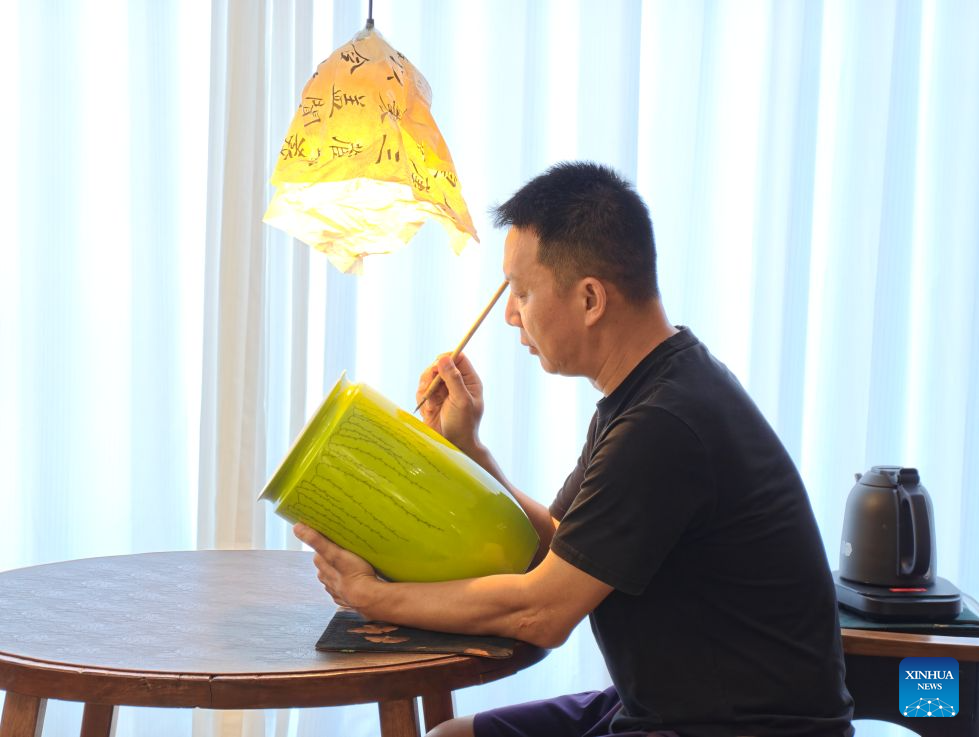
Liu Dachuan creates a ceramic micro-calligraphy artwork at his studio in Jingdezhen, east China's Jiangxi Province, Aug. 14, 2026.
There goes an old Chinese saying that "the scenery changes with each step." This saying can be true when you look at a ceramic micro-calligraphy artwork, on which Chinese characters are written in tiny little sizes so that you can not even notice them from a distance.
Micro-calligraphy, or weishu, is an age-old Chinese art that wields the traditional Chinese writing brush to produce Chinese characters of astonishing minuteness with naked vision. This art form has deep roots in antiquity, with its earliest traces found in the oracle bone inscriptions from the Western Zhou Dynasty (1046 BC-771 BC).
Ceramic micro-calligraphy, which combines the delicate art with polychrome ceramic, demands high in its making as the ceramic needs to go through high-temperature firing in kiln after the writing. To create a piece, the craftsman, relying solely on his naked eyes, uses a custom fashioned brush, with ultra-fine hairs and high-temperature-resistant pigments, to paint delicate motifs directly onto the ceramic's surface, no errors or corrections allowed. When the ceramic goes through repeated firings in the kiln, even the slightest deviation in temperature control can make all previous labors in vain. Upon completion, the artwork is seen with tiny little Chinese characters interlaced with paintings, complementing each other beautifully.
The art has become a treasure of traditional Chinese crafts with irreplaceable artistic values, and was inscribed as one of China's national-level intangible cultural heritages in 2014.
Liu Dachuan, a 47-year-old senior craftsman from south China's Guangdong Province, has dedicated himself to the art of ceramic micro-calligraphy for decades. He can inscribe up to 163 Chinese characters on a single square centimeter of porcelain, all perfectly distinguishable under a magnifying glass. Liu has formed a modern artistic style while carrying on the traditions, and his works have won multiple widely recognized awards.
"Writing micro-calligraphy with the naked eye tests not only your eyesight, but also your very soul," Liu said, adding that a machine might replicate the shapes of characters, but it could never depict the flowing spirit unique to the tip of a brush.
To bring ceramic micro-calligraphy to a wider audience, Liu held solo thematic exhibitions, and further established a studio in Jingdezhen, where he formally accepts apprentices and guides them step by step in the art. He also hosts public welfare open classes and intangible cultural heritage experiencing salons, where he offers lectures on the history of micro-calligraphy to local ceramics artisans and tourists on study tours.
Regarded as premium collectible art pieces, ceramic micro-calligraphy artworks have won great favor from cultural institutions and museums, collectors and art lovers across the country. Meanwhile, as craftworks embodying the charm of oriental beauty, they have also appeared in exhibitions of many foreign countries, often being selected as gifts for culture exchanges, and being collected by overseas museums. In a way, they have become artistic carriers to promote the traditional Chinese culture and the exchanges between China and the world. (Xinhua)
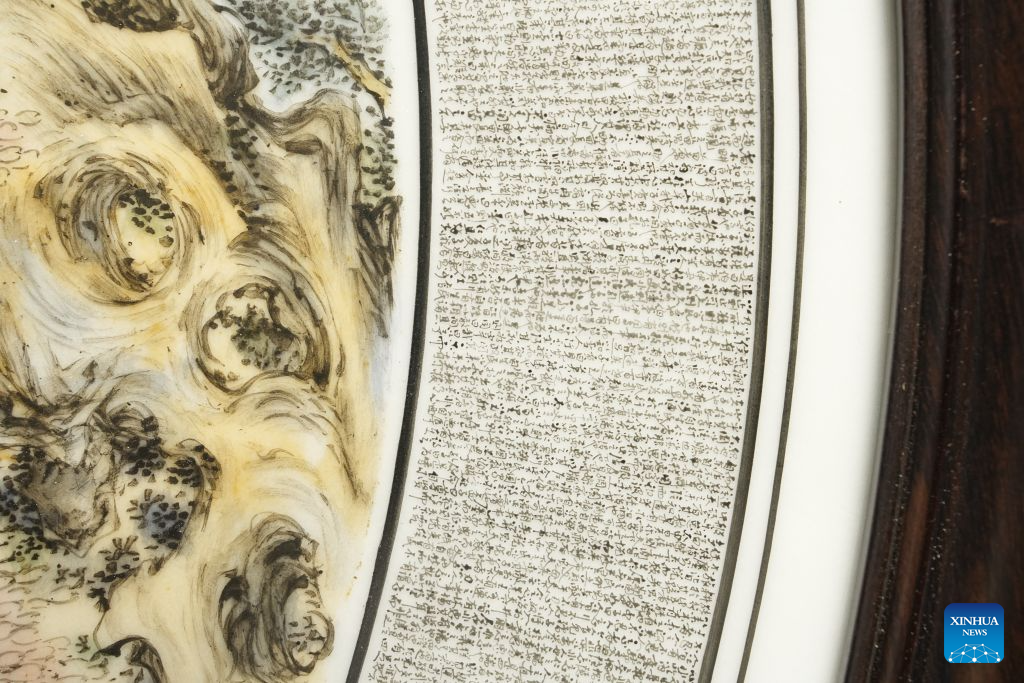
This file photo shows a partial view of a ceramic micro-calligraphy artwork created by Liu Dachuan in Jingdezhen, east China's Jiangxi Province. (Xinhua)
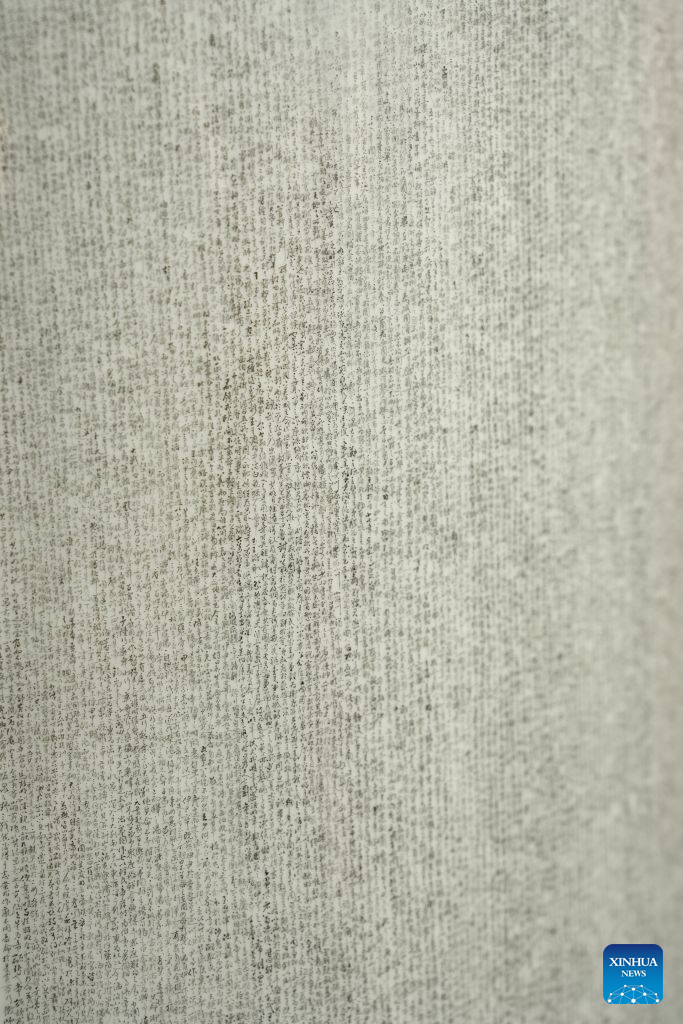
This file photo shows a view of a ceramic micro-calligraphy artwork created by Liu Dachuan in Jingdezhen, east China's Jiangxi Province. (Xinhua)
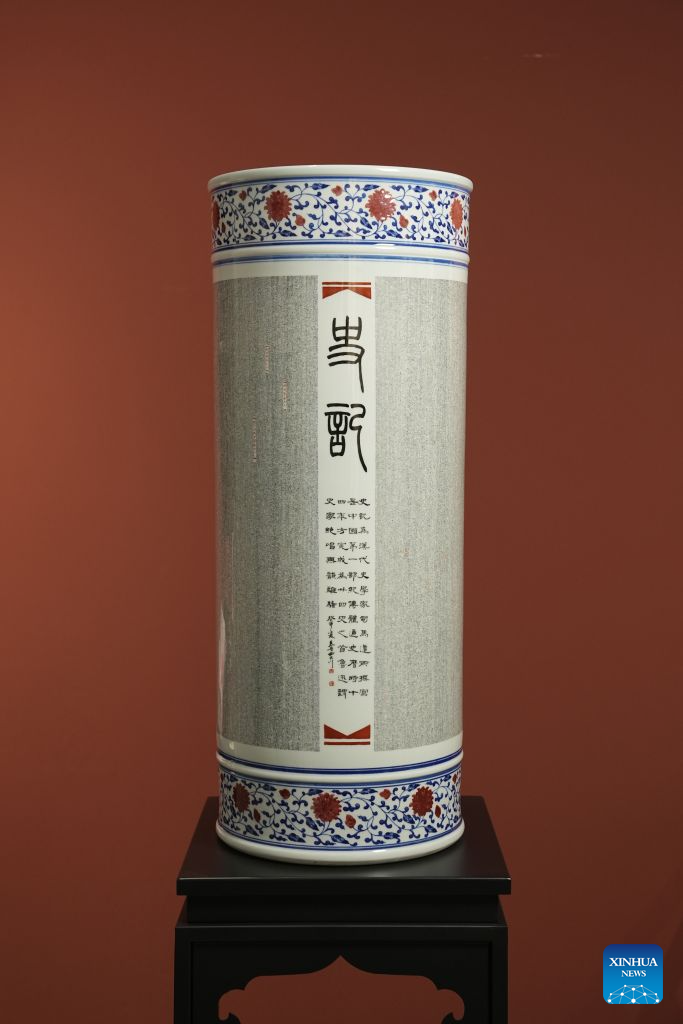
This file photo shows a 520,000-character ceramic micro-calligraphy artwork of Shiji, or Records of the Grand Historian, created by Liu Dachuan in Jingdezhen, east China's Jiangxi Province. (Xinhua)
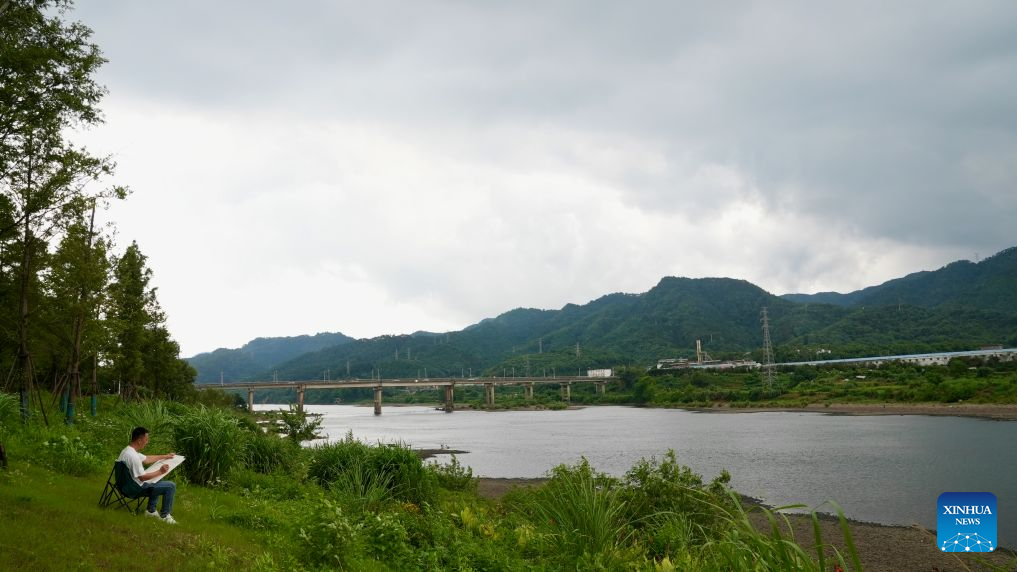
Liu Dachuan paints by the Changjiang River in Jingdezhen, east China's Jiangxi Province, Aug. 11, 2026. (Xinhua/Hu Chenhuan)
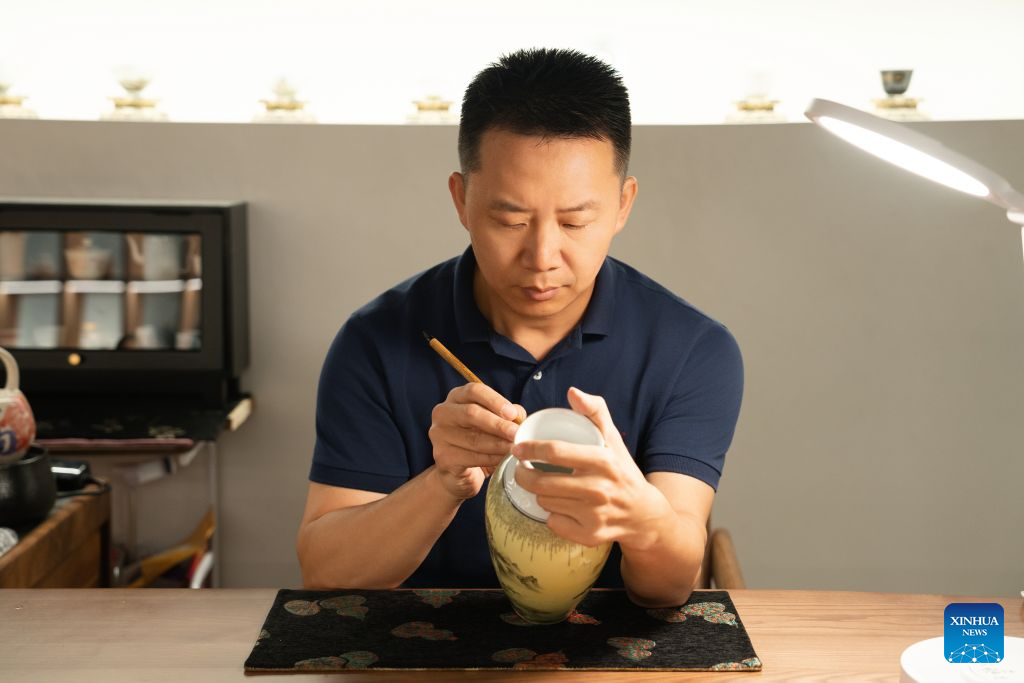
Liu Dachuan creates a ceramic micro-calligraphy artwork at his studio in Jingdezhen, east China's Jiangxi Province, Aug. 14, 2026. (Xinhua)
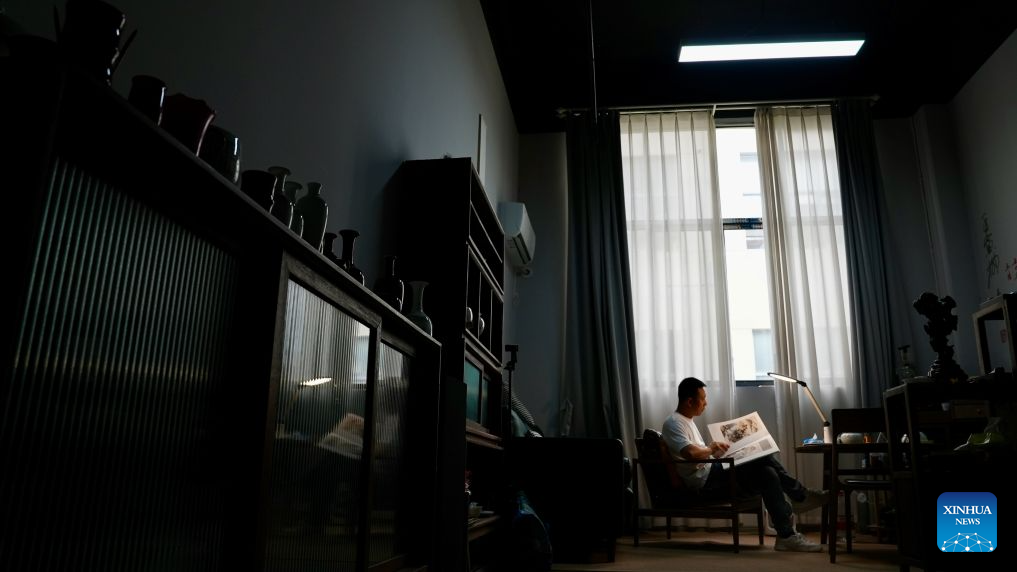
Liu Dachuan reads books related to micro-calligraphy at his studio in Jingdezhen, east China's Jiangxi Province, Aug. 11, 2026. (Xinhua/Hu Chenhuan)
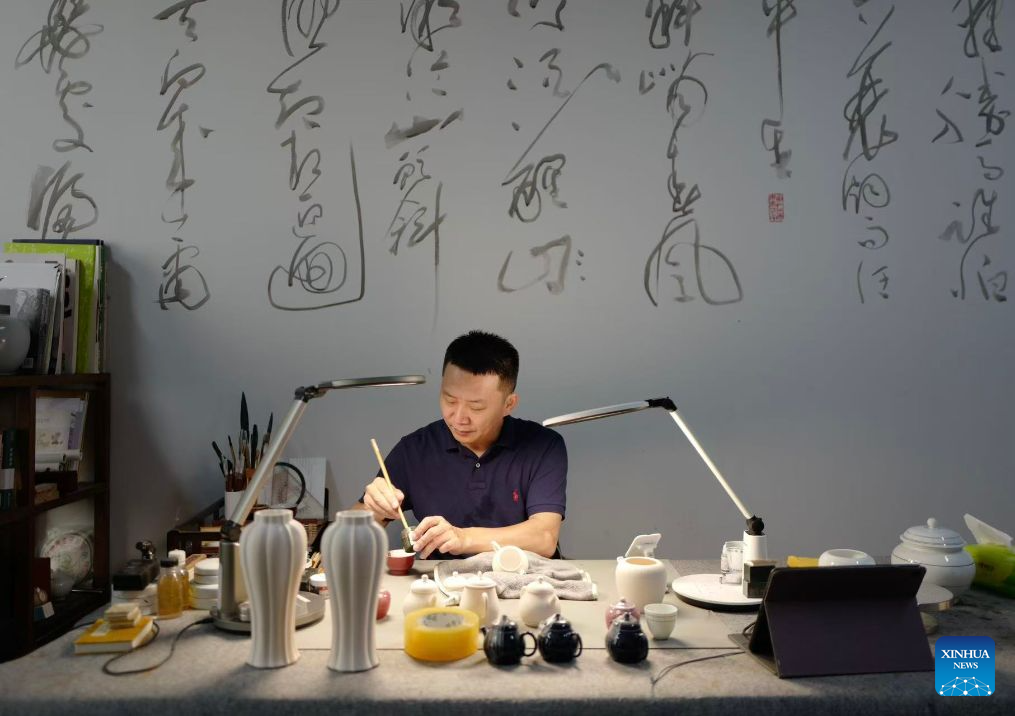
Liu Dachuan works at his studio in Jingdezhen, east China's Jiangxi Province, March 11, 2026. (Xinhua)
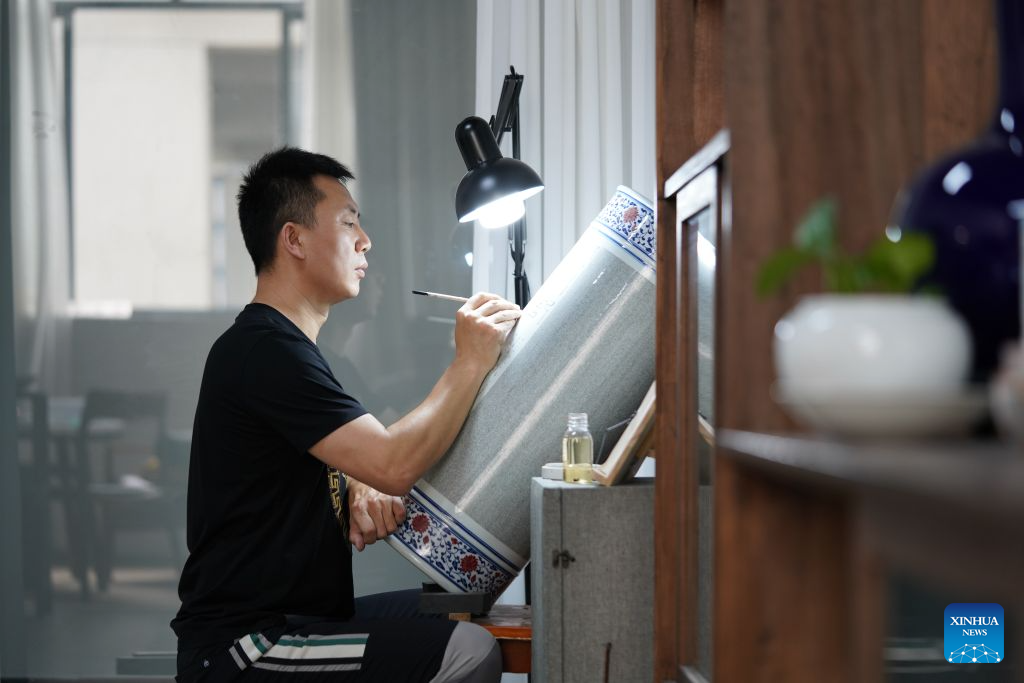
Liu Dachuan creates a 520,000-character ceramic micro-calligraphy artwork of Shiji, or Records of the Grand Historian, at his studio in Jingdezhen, east China's Jiangxi Province, Nov. 3, 2025. (Xinhua)
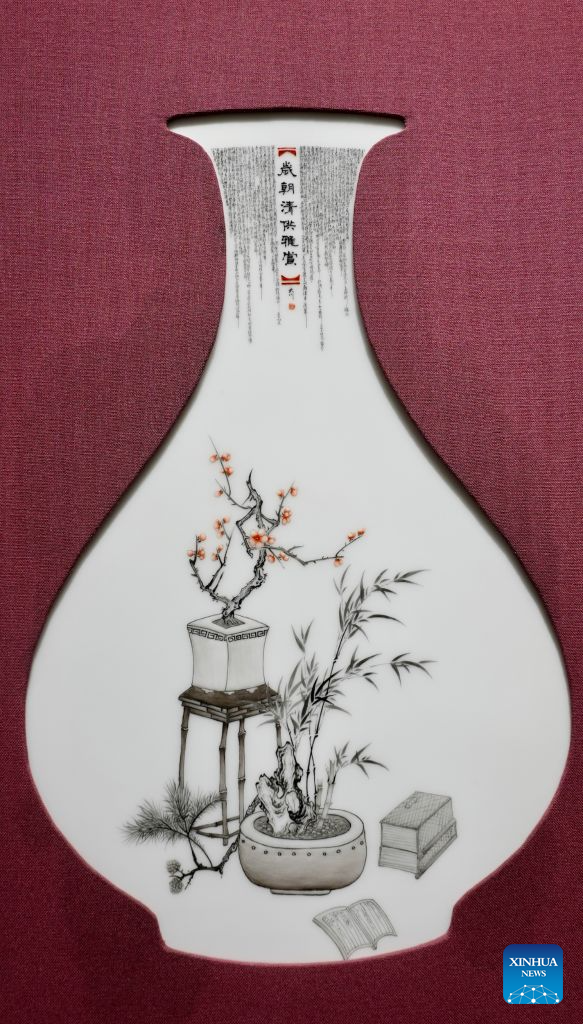
This photo taken on July 8, 2026 shows a ceramic micro-calligraphy artwork with over 2,000 tiny little Chinese characters created by Liu Dachuan in Jingdezhen, east China's Jiangxi Province. (Xinhua/Hu Chenhuan)
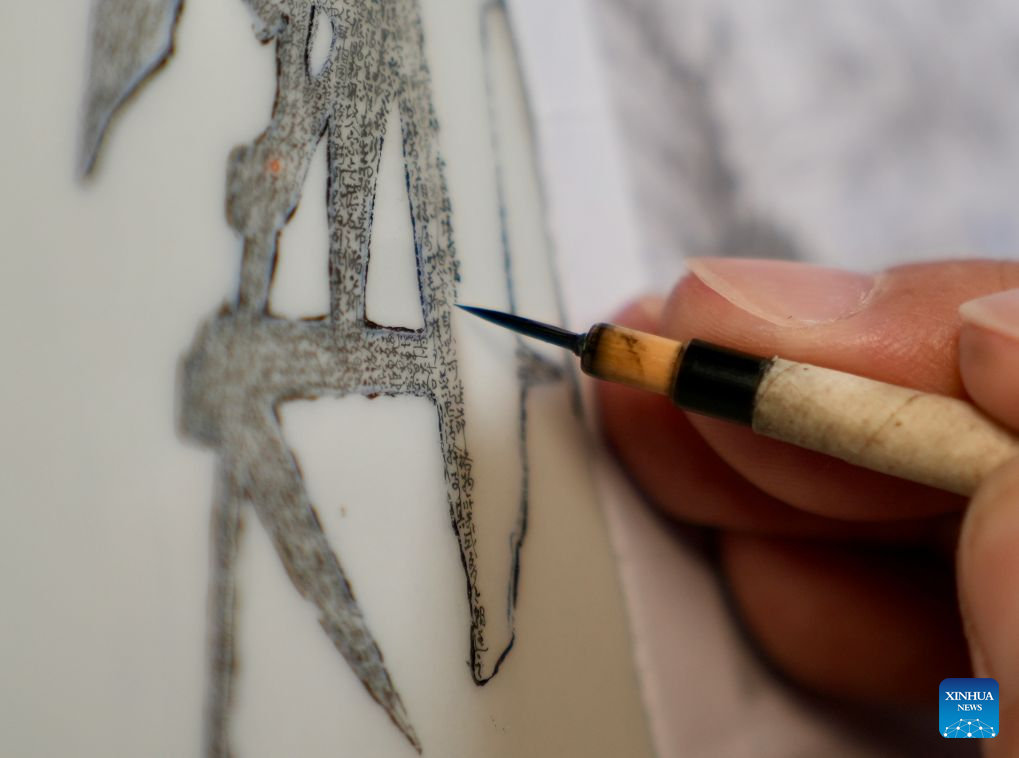
Liu Dachuan writes tiny characters on a porcelain plate in Jingdezhen, east China's Jiangxi Province, July 7, 2026. (Xinhua/Hu Chenhuan)
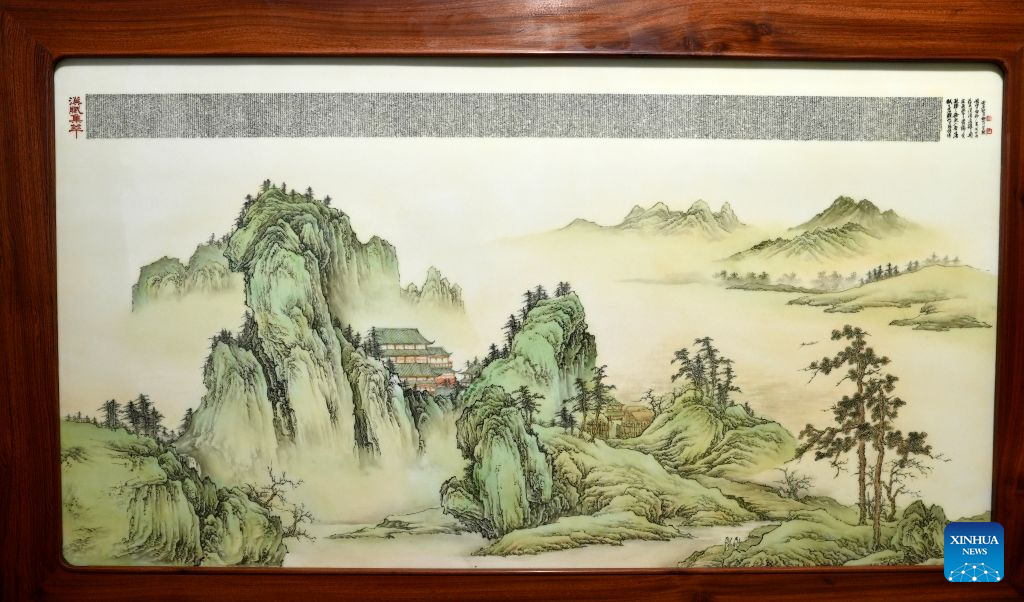
This photo taken on Aug. 11, 2026 shows a ceramic micro-calligraphy artwork, containing over 22,000 tiny little Chinese characters, created by Liu Dachuan in Jingdezhen, east China's Jiangxi Province. (Xinhua/Hu Chenhuan)
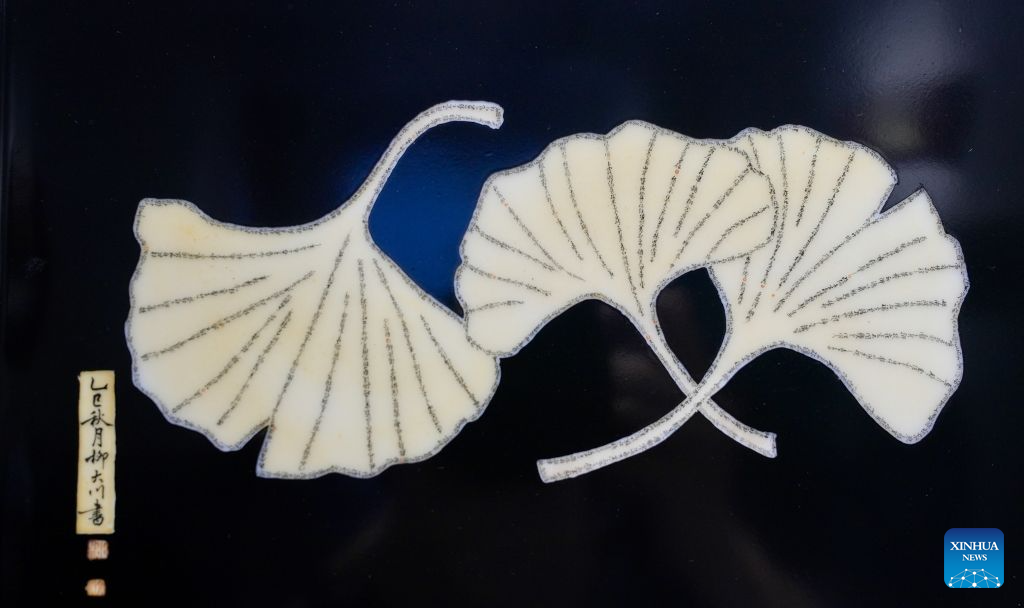
This photo taken on July 8, 2026 shows a ceramic micro-calligraphy artwork of gingko leaves created by Liu Dachuan, composed with nearly 5,000 tiny little Chinese characters excerpted from poems and odes to autumn, in Jingdezhen, east China's Jiangxi Province. (Xinhua/Hu Chenhuan)
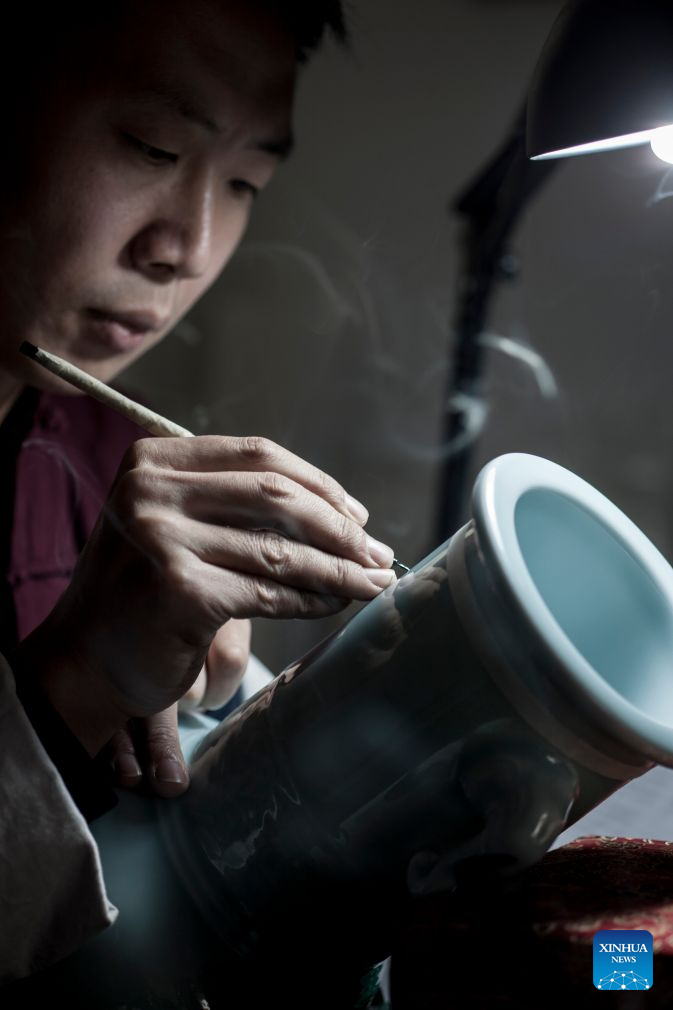
Liu Dachuan creates a celadon micro-calligraphy artwork at his studio in Jingdezhen, east China's Jiangxi Province, Sept. 25, 2025. (Xinhua)
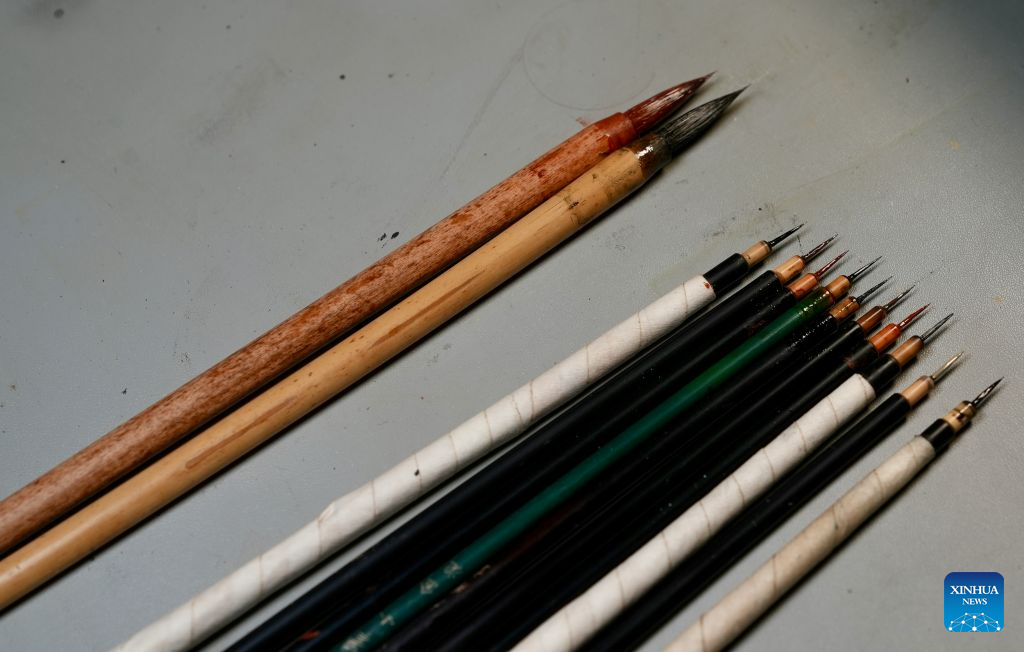
This photo taken on July 7, 2026 compares the brushes used by Liu Dachuan, with two on the left used for regular calligraphy works and others specially made for ceramic micro-calligraphy, in Jingdezhen, east China's Jiangxi Province. (Xinhua/Hu Chenhuan)
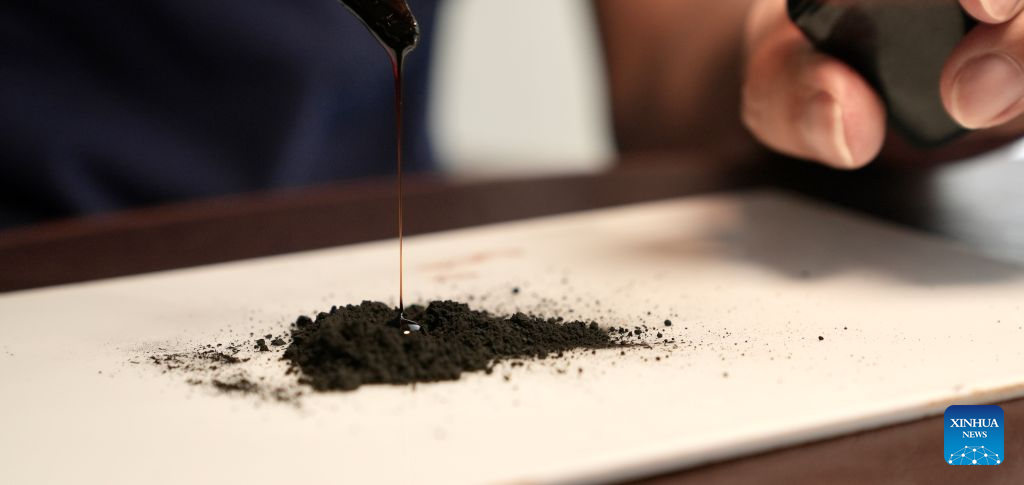
Liu Dachuan prepares glazes specifically for ceramic micro-calligraphy in Jingdezhen, east China's Jiangxi Province, July 8, 2026. (Xinhua/Hu Chenhuan)
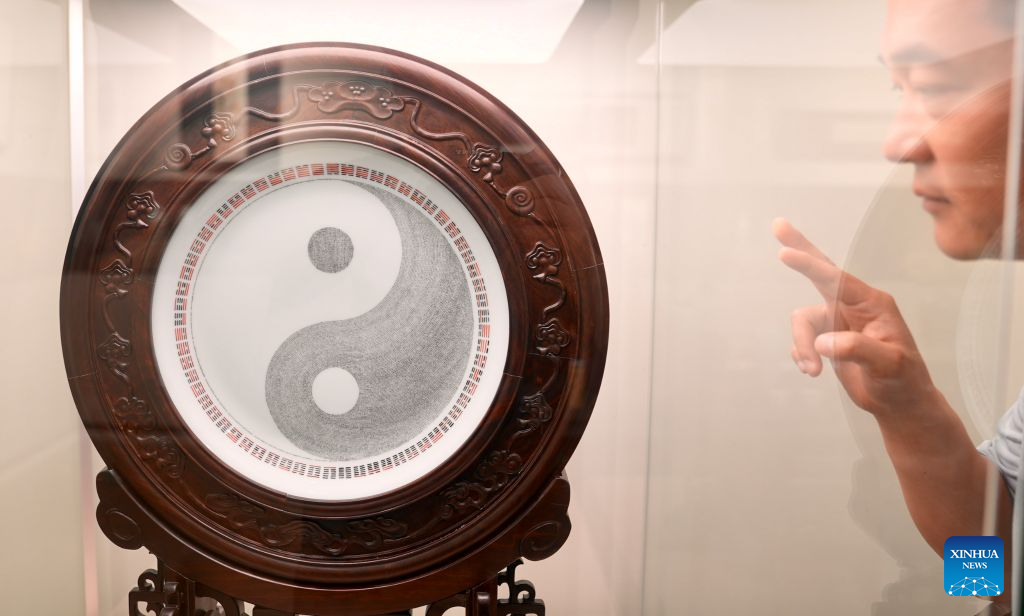
A visitor views a ceramic micro-calligraphy artwork of a Tai Chi diagram composed of over 19,000 tiny little Chinese characters at Liu Dachuan's personal exhibition hall in Jingdezhen, east China's Jiangxi Province, July 7, 2026. (Xinhua/Hu Chenhuan)
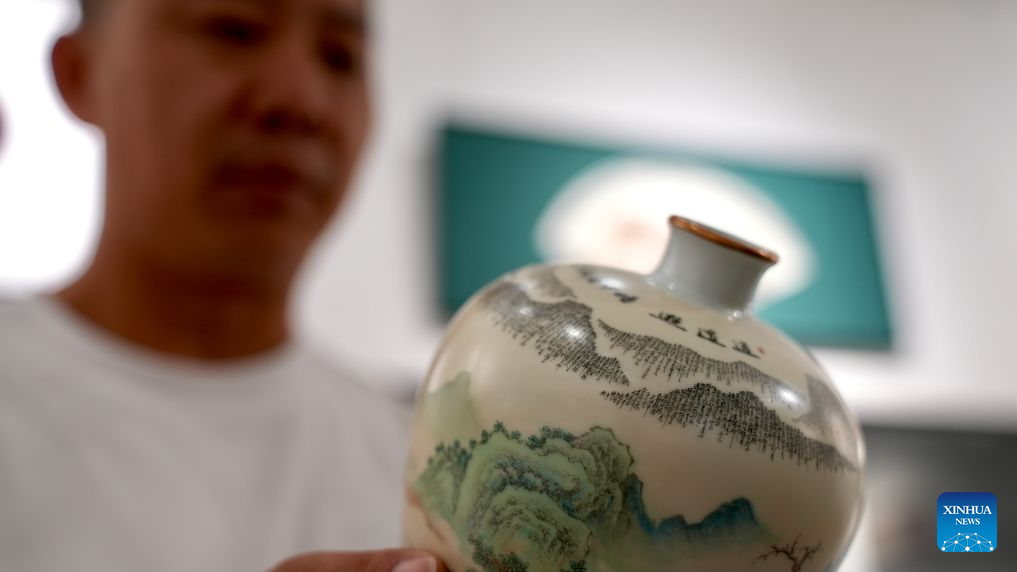
Liu Dachuan displays one of his ceramic micro-calligraphy artworks to visitors at his studio in Jingdezhen, east China's Jiangxi Province, Aug. 11, 2026. (Xinhua/Hu Chenhuan)
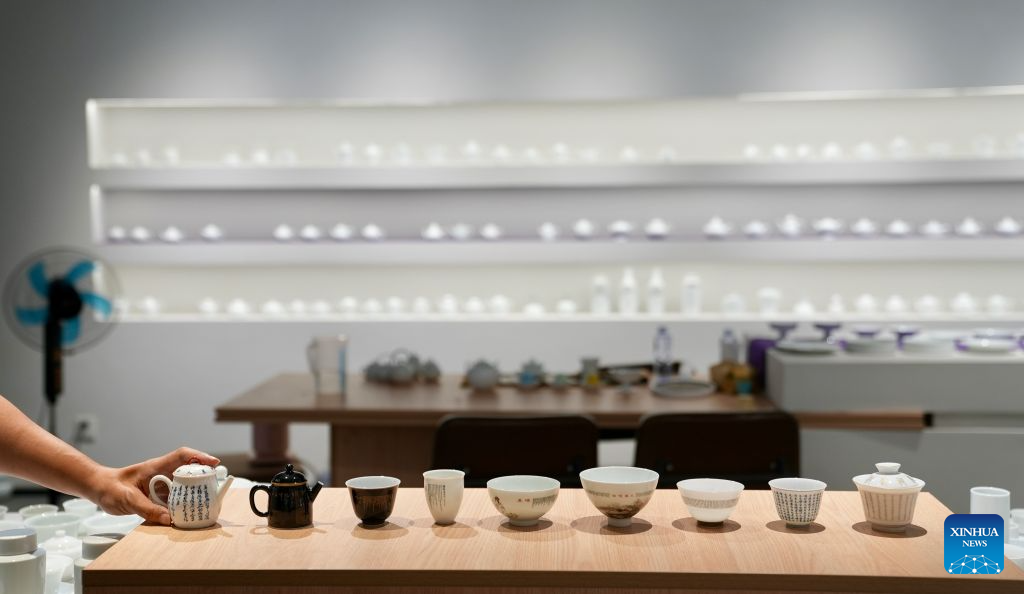
This photo taken on Aug. 11, 2026 shows some teaware featuring micro-calligraphy created by Liu Dachuan in Jingdezhen, east China's Jiangxi Province. (Xinhua/Hu Chenhuan)
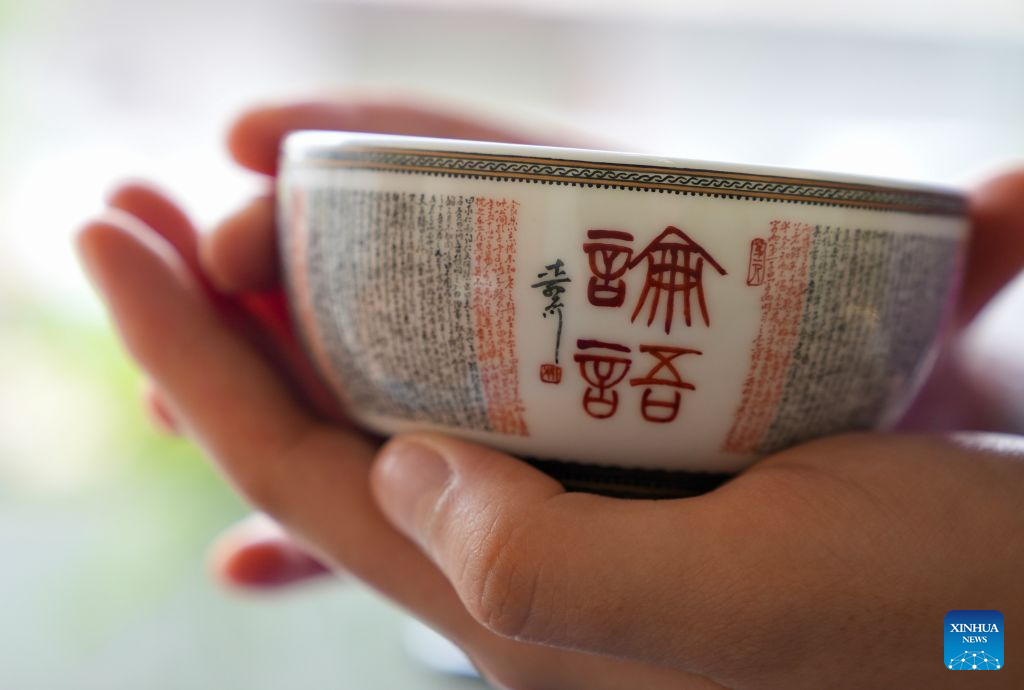
This photo taken on July 8, 2026 shows a teacup created by Liu Dachuan with ceramic micro-calligraphy techniques in Jingdezhen, east China's Jiangxi Province. (Xinhua/Hu Chenhuan)
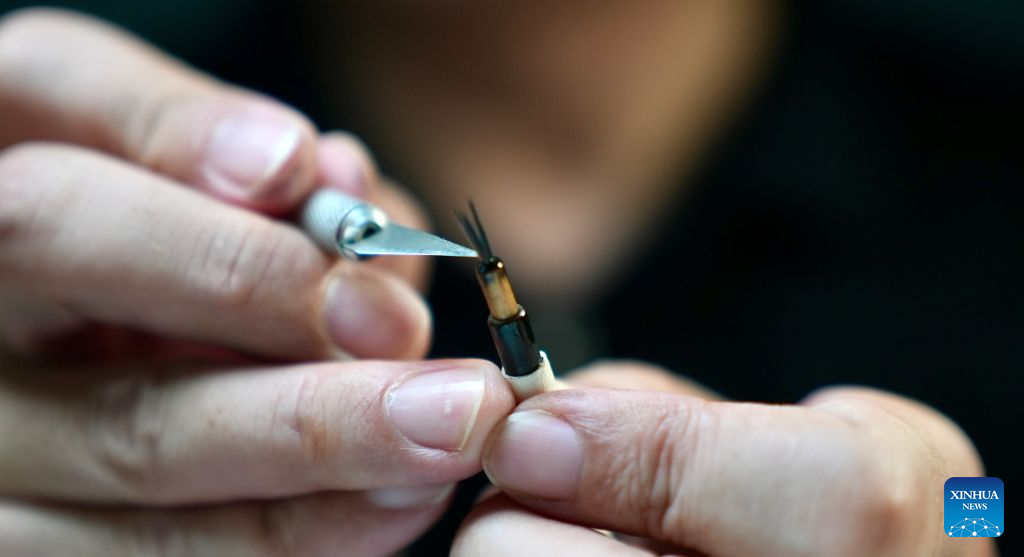
Liu Dachuan trims a custom fashioned brush used to create ceramic micro-calligraphy artworks in Jingdezhen, east China's Jiangxi Province, July 7, 2026. (Xinhua/Hu Chenhuan)
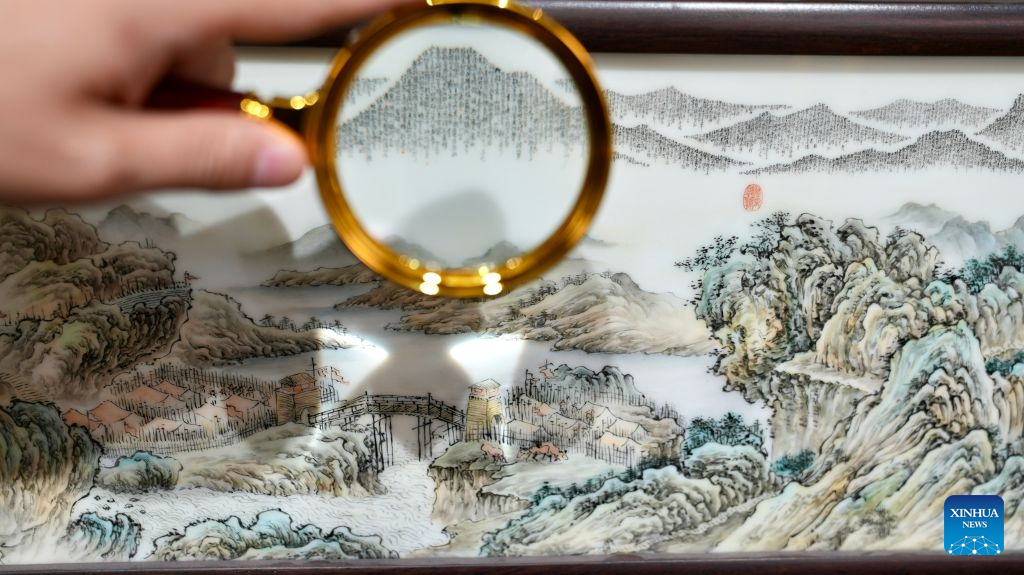
This photo taken on July 7, 2026 shows a ceramic micro-calligraphy artwork, in which the images of mountains are consisted of over 11,000 tiny little Chinese characters excerpted from poems depicting mountains and waters by prestigious authors in history, in Jingdezhen, east China's Jiangxi Province. (Xinhua/Hu Chenhuan)
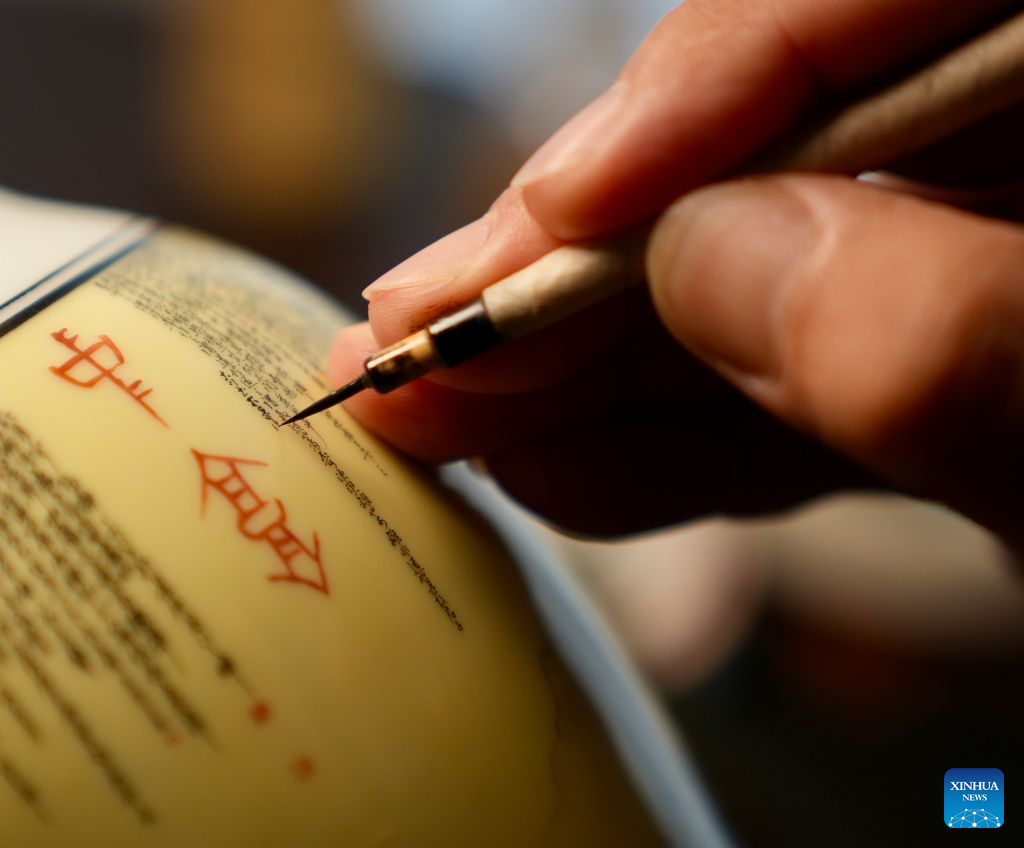
Liu Dachuan writes tiny characters on a ceramic vase in Jingdezhen, east China's Jiangxi Province, July 7, 2026.(Xinhua/Hu Chenhuan)
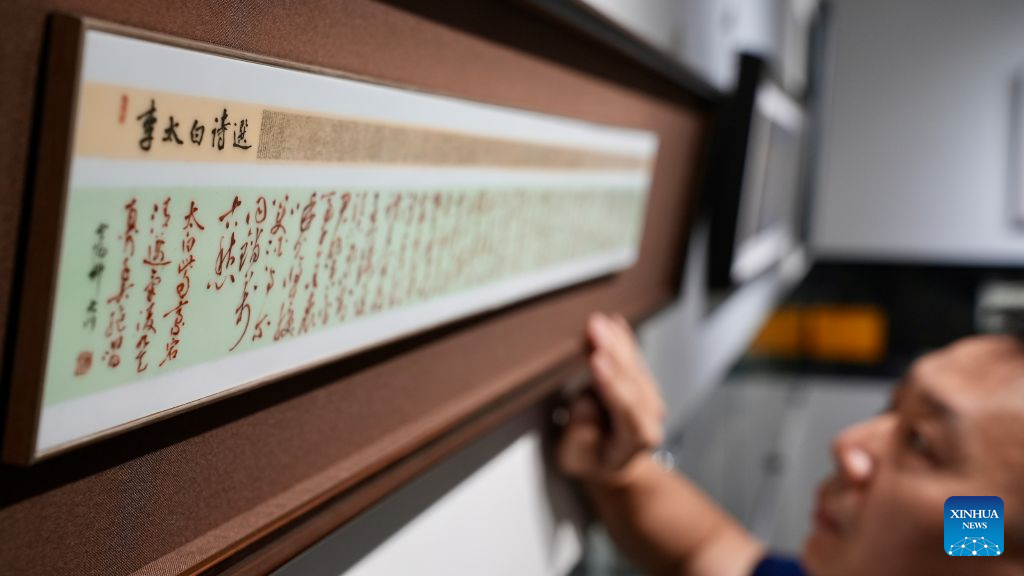
Liu Dachuan looks at a porcelain plaque painting artwork he created with ceramic micro-calligraphy technique in Jingdezhen, east China's Jiangxi Province, July 8, 2026. (Xinhua/Hu Chenhuan)
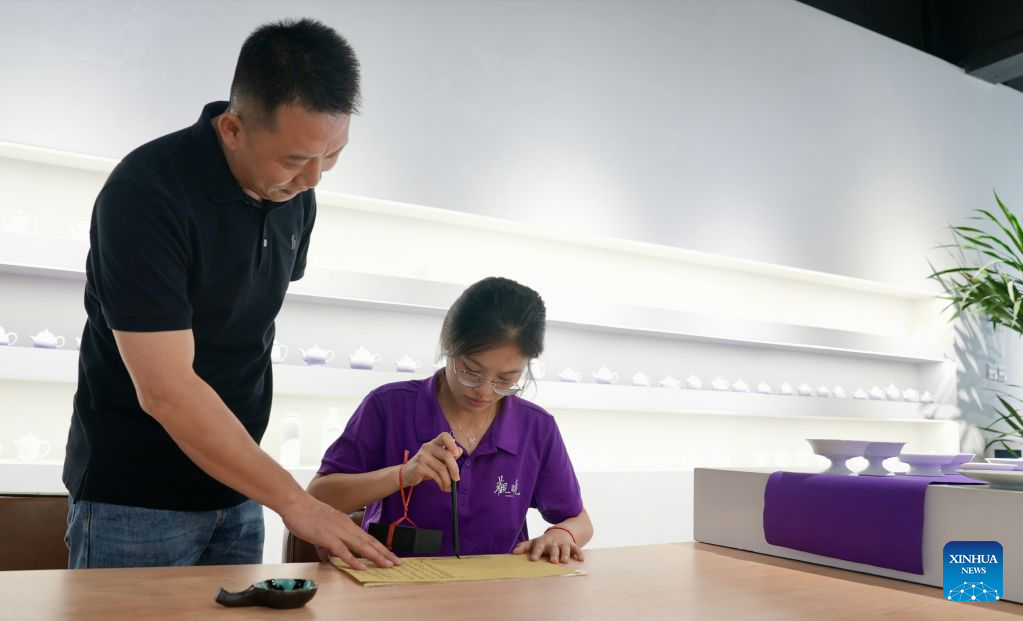
Liu Dachuan (L) instructs an apprentice to practice micro-calligraphy at his studio in Jingdezhen, east China's Jiangxi Province, July 7, 2026. (Xinhua/Hu Chenhuan)
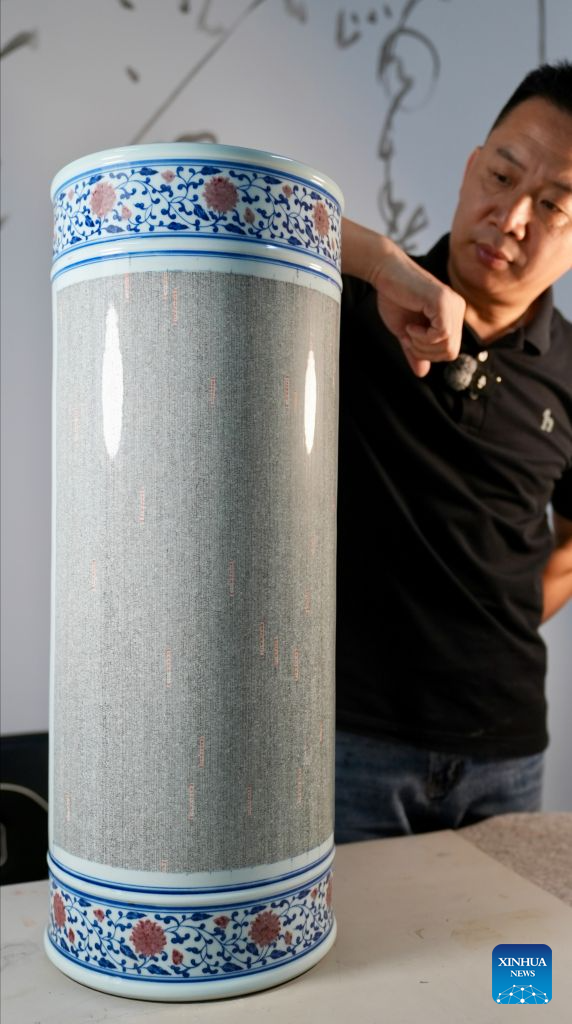
Liu Dachuan displays a 520,000-character ceramic micro-calligraphy artwork of Shiji, or Records of the Grand Historian, in Jingdezhen, east China's Jiangxi Province, July 7, 2026. (Xinhua/Hu Chenhuan)


