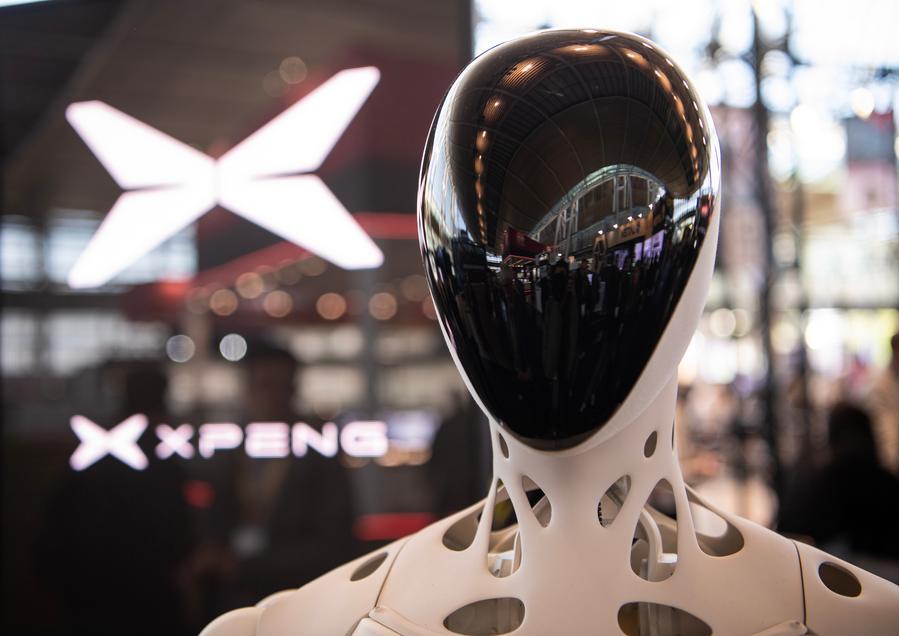
BEIJING, Sept. 10 (Xinhua) -- Chinese new energy vehicle (NEV) brands are pioneering their competition toward a new frontier: the robotics industry.
Nearly 20 automakers, including XPeng, Li Auto and BYD, have entered the robotics sector through research and development, subsidiaries, or industrial investment, as embodied intelligence goes industrial, according to Beijing Daily.
AUTOMAKERS' AMBITION
XPeng shows how far an automaker's ambition can go. Its robotics unit recently closed an initial external funding round of over 900 million U.S. dollars at a valuation exceeding 6.3 billion dollars, led by IDG Capital, with participation from Gaorong Ventures and support from Tencent and Alibaba as strategic investors.
The company unveiled its IRON humanoid last November, which was designed with a humanoid spine, bionic muscles and flexible skin. Sharing the chips, perception systems and end-to-end models of XPeng's smart cars, IRON began small-batch trial production at a Guangzhou plant in July. The company has signed for a 110,000-square-meter production base in the southern Chinese city and targets monthly capacity of over 1,000 units by year-end.
Li Auto confirmed in May that it had started R&D on a humanoid robot, viewing autonomous driving and general-purpose humanoids as the two key components of embodied intelligence.
NIO, by contrast, has pledged to "invest rather than build," backing an embodied AI startup founded by its head of intelligent driving.
In addition to self-development, collaboration and industrial investment are also important channels. BYD inked a strategic partnership agreement with PaXini Tech in August to advance robot applications in industrial manufacturing, and ModelBest and Geely's AI center jointly released in July an embodied intelligence agent framework, which is already in routine use in Geely's factories.
EDGE OVER STARTUPS
"The fundamental driver behind automakers' forays into robotics is the pursuit of a second growth curve," said Cui Dongshu, secretary general of the China Passenger Car Association.
"Automakers may even have an edge over many robotics startups," Cui said. He added that skills developed for smart driving -- like perception, decision-making, control, and computing power -- can be applied to embodied intelligence. Moreover, components such as electric motors, batteries, controllers, and expertise in supply chain management, quality control, and mass production also overlap with the robotics industry.
Cui noted that automotive plants are ideal application grounds for humanoid robots, given that tasks such as material handling, loading and unloading, assembly and quality inspection involve a certain degree of repetitiveness.
"Automakers can deploy robots in their own plants for testing and continuously gather data in real-world environments in order to iterate their products," Cui said.
Cui suggests a path of "business customers first, households later; specialized applications first, general-purpose ones later."
"If robots expand from industrial settings to commercial services and even household consumption in the future, automakers' stores, post-sales services and overseas networks could potentially contribute their new sales and service channels," Cui added.
But unlike the auto sector, which benefits from mature parts supply chains for mass production, humanoid robots still rely on immature core components and supply chains, a point Tesla has also stressed about its Optimus humanoid robot.
TOP-LEVEL BLUEPRINT
The Chinese government's latest five-year development roadmap has placed embodied intelligence among its priority future industries. The market is expected to reach 400 billion yuan (about 56.5 billion U.S. dollars) in 2030 and exceed 1 trillion yuan in 2035, the Development Research Center of the State Council projects.
China is now home to more than 140 humanoid robot manufacturers. With an annual shipment volume of 14,400 units, the country now accounts for eight out of every ten humanoid robots produced globally, according to the National Development and Reform Commission.
However, the commission has warned against a glut of homogeneous products and is establishing industry standards and entry-exit mechanisms.
Industry insiders note that challenges in the sector also include scarce high-quality training data, distant profitability, chip export controls and implications for employment. Whether embodied intelligence will become the next NEV-scale success story still hinges on how quickly the industry moves from dazzling demos to dependable products. ■