ANKARA, Sept. 9 (Xinhua) -- Türkiye has stepped up its security efforts in recent months. On the one hand, it has signed a joint defense agreement with Saudi Arabia and Pakistan; on the other, it has announced a significant increase in its defense spending.
Türkiye's measures reflect Ankara's push to adapt its security policy to a rapidly shifting landscape, regional analysts have said.
They noted that the Russia-Ukraine conflict and the U.S.-Iran confrontation are creating increasingly interconnected pressures on Türkiye, exposing it to risks on its northern and southern flanks while pushing Ankara toward greater strategic flexibility.
TWO CONFLICTS
The Russia-Ukraine conflict has increasingly spilled into the Black Sea, directly affecting Türkiye's maritime and economic interests.
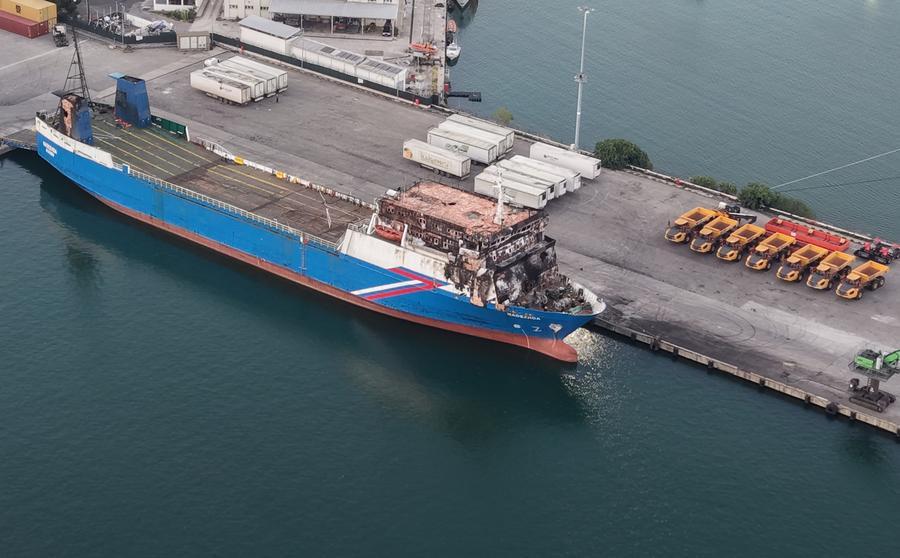
Turkish-owned or -operated civilian vessels have been repeatedly attacked in recent months, raising Ankara's concerns over commercial shipping safety and the broader security of the Black Sea, a key waterway for Türkiye's trade, energy and food security.
Meanwhile, the U.S.-Iran confrontation has added another layer of uncertainty to Türkiye's neighborhood.
Ankara-based foreign policy analyst Serkan Demirtas said the country was confronting a considerably more complicated strategic environment than a few years ago.
"Türkiye sits simultaneously on NATO's eastern and southern flanks. Ankara therefore sees threats coming from several directions rather than from one conventional adversary," Demirtas told Xinhua.
He said that, as a heavy energy importer, Türkiye would face both economic and security fallout from prolonged regional instability.
The developments were also changing the way Ankara viewed its security, Canan Tercan, a scholar at Istanbul Aydin University, said.
"Yes, there are U.S. bases here, but how much did they protect? It is a massive question mark. Regional countries had to overcome this vulnerability with new partnerships," Tercan noted, explaining Ankara's motivation for joining the Makkah agreement.
TWO-TRACK RESPONSE
Against this backdrop, Ankara appears to be pursuing a two-track response, analysts have said.
On one side, Turkish officials keep pushing dialogue and restraint to stop regional conflicts from widening; on the other, they are boosting military capabilities, expanding defense production and building new security partnerships, they noted.
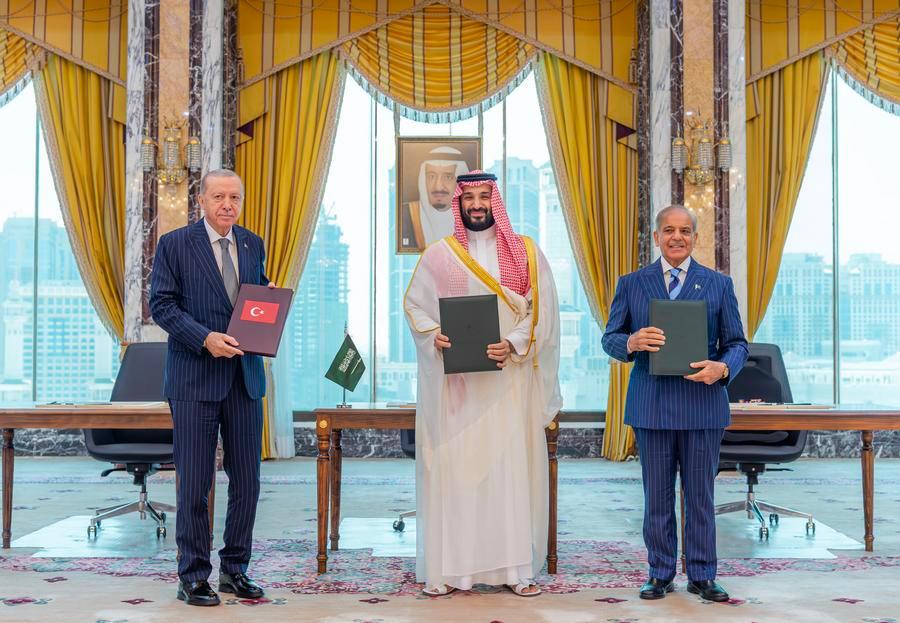
One notable step was the Makkah Joint Defense Agreement signed by Türkiye, Saudi Arabia and Pakistan in August, stipulating that an armed attack on one is an attack on all.
Turkish officials described the arrangement as defensive and said it was not aimed at any particular country. However, observers argue that it nevertheless represents an effort to build an additional layer of regional security cooperation amid heightened uncertainty.
The move is also accompanied by a major planned increase in defense spending.
Presenting the new three-year economic program in Ankara on Sunday, Vice President Cevdet Yilmaz said Türkiye plans to raise defense spending by 229 percent over the 2027-2029 period.
Yilmaz said the objective was to strengthen Türkiye's ability to develop its own technologies, meet its own defense needs, and produce higher-value-added goods.
"In dollar terms, the Defense Ministry budget has roughly tripled in five years," Turkish economist Atilla Yesilada told Xinhua.
EFFECTIVENESS REMAINS TO BE SEEN
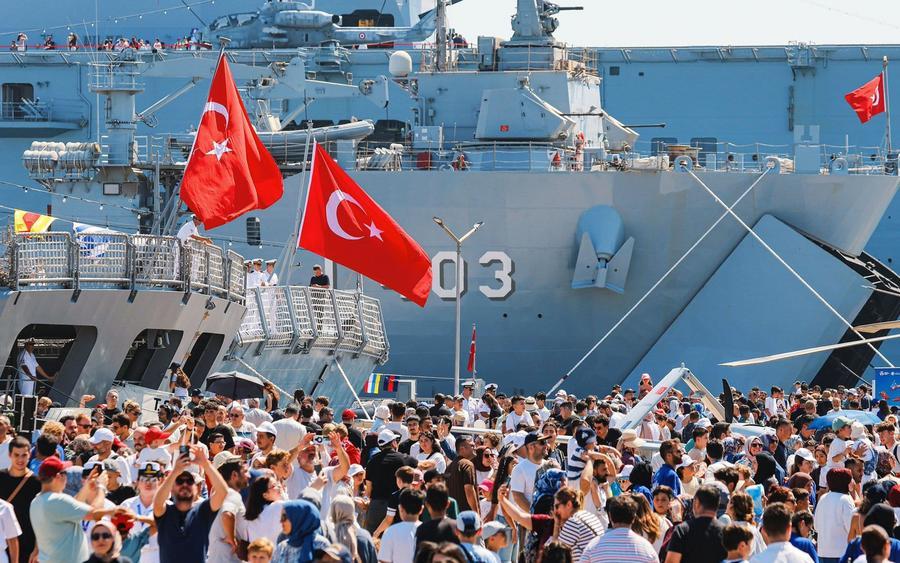
Although Türkiye has taken a series of steps to pursue a new security approach, the effectiveness of these efforts in enhancing its security remains to be seen.
In recent days, the Houthis have claimed responsibility for multiple attacks on Saudi Arabia, one of the Makkah agreement's signatories. Yet the other parties to the agreement have refrained from directly intervening, suggesting, as Tercan noted, that its collective-defense provision does not automatically trigger a military response to every incident.
As for the increased defense budget, experts point out that the key question is where the additional resources will be allocated.
The spending hike comes as Türkiye pursues several major indigenous defense programs, including the KAAN fighter jet, unmanned combat aircraft, and the ALTAY main battle tank.
Analysts believe the domestic-production push reflects Ankara's longer-term effort to cut reliance on foreign suppliers and sustain military operations through its own industrial base.
But whatever the outcome, Türkiye's actions show that the regional security landscape is undergoing a fundamental transformation.
For Ankara, "the central calculation appears to be that a more uncertain regional environment requires greater military preparedness and a broader range of security partnerships," Demirtas said.■