BEIJING, Sept. 9 (Xinhua) -- For much of modern economic history, development has been a process of expansion and creation, which features emerging industries, lower production costs and growing markets benefiting more economies and peoples. That's what China has been contributing to the world.
Few examples illustrate this dynamic more powerfully than China's economic transformation. Over the past decades, China has built the world's most comprehensive manufacturing system and now contributes around 30 percent of global economic growth. Its impact has reshaped markets, supply chains and production capacity far beyond its borders.
Yet the scale of China's industrial rise has in turn prompted a familiar allegation that China's growing presence in global manufacturing and trade is squeezing space for other developing economies. This argument implies such an assumption: if China's share of global production grows, there must be less room for others.
The global economy, though, is never a fixed pie. The experience of developing economies offers a useful check on the "China Squeeze" assumption. For instance, between 2014 and 2024, several developing countries recorded notable increases in their shares of global exports, with Vietnam, Cambodia and Laos roughly tripling theirs, according to the UN Trade and Development.
Far from squeezing the space for developing economies, China's open market, advanced technologies and extensive supply chains have helped expand the global economic pie and provided an important source of growth.
A report by S&P Global last year found that China's imports of goods from Global South economies had more than doubled since 2015. In May, China implemented a zero-tariff treatment for 53 African countries with which it has diplomatic relations, further expanding market access for African economies.
China's import growth exceeded that of exports for the sixth successive month in August, according to the latest customs data. In the first eight months of 2026, imports from Africa rose 14.2 percent year on year, while those from Latin America and ASEAN increased 21 percent and 20.3 percent, respectively.
The country's vast consumer market has provided stable export channels for primary commodities, manufactured goods and agricultural products from developing economies, helping them gain a foothold in global trade and generate the resources needed for further industrialization -- especially when certain developed economies have gone to considerable lengths to shield their domestic industries.
"Industrial development is never a game of 'queuing for a spot,'" said Xia Chun, a scholar with the think tank New Economist. "Rather, it is a dynamic process driven by technological advances, deeper specialization and expanding areas of application."
China's industrial rise has not squeezed global industrial space; it has instead created vast new opportunities for industrial development, he said.
A McKinsey report earlier this year noted that China, long known as the "factory of the world," is increasingly serving as a "factory to the factories" with a growing emphasis on intermediate inputs and capital goods. In 2025, the country exported fewer consumer goods but 175 billion U.S. dollars more in intermediate inputs and capital goods.
Data from China's Ministry of Commerce reveals a longer trend. Between 2012 and 2024, China exported more than 30 billion U.S. dollars' worth of textile machinery to developing countries, helping economies in Southeast and South Asia expand their manufacturing capacity and emerge as major producers and exporters in the sector.
This shift in China's export structure has helped lay a strong foundation for developing countries to build their own industrial systems, according to Xia.
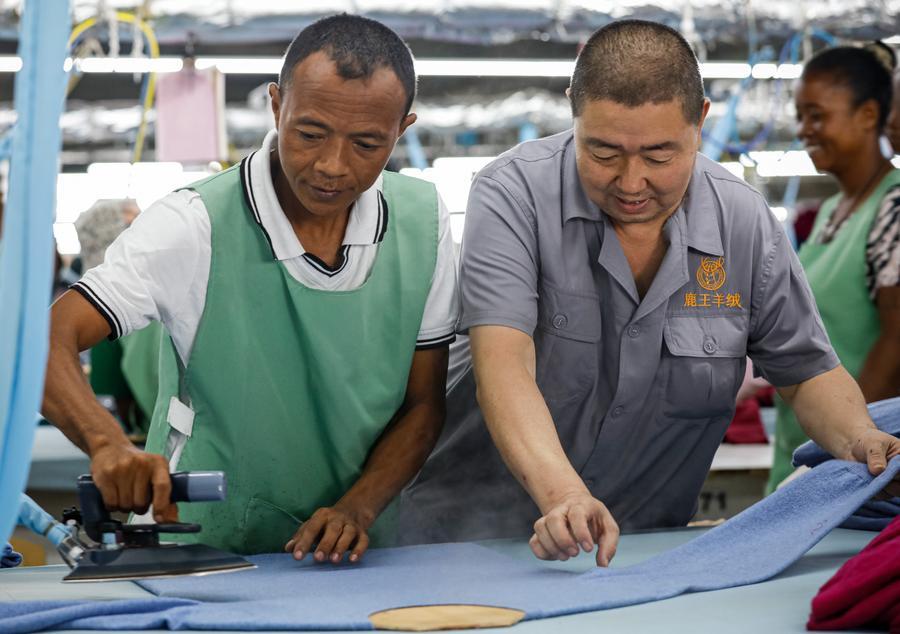
The story does not end with trade. Increasingly, Chinese companies are taking infrastructure, investment and know-how overseas, creating jobs and helping local economies move further up the ladder of development.
In July, Chinese automaker Chery inaugurated its manufacturing plant in Rosslyn, South Africa, a historic factory with deep roots in the country's automotive industry. Retaining the 692 existing employees, the plant will begin production in mid-2027, creating nearly 3,000 jobs across the supply chain and serving markets across East and West Africa.
"Chery's investment will pave the way for technology transfer, automation, digitalization and advanced manufacturing systems," said South African Deputy President Paul Mashatile, noting that these developments will strengthen South Africa's industrial capacity.
China has more than 50,000 overseas enterprises operating across 190 countries and regions, according to the commerce ministry. Nearly 90 percent of these enterprises are located in developing economies.
According to estimates by the Chinese Academy of Sciences, the value added in local exports generated by Chinese companies in 24 developing economies rose nearly fivefold, from 24.4 billion U.S. dollars in 2012 to 142.4 billion dollars in 2025.
The ladder of development is also extending into the digital economy, as China makes some of its latest technological advances more accessible to developing countries. From power grids in Chile to rubber production floors in Malaysia, Chinese smart technologies are boosting industrial capacity across the Global South.
At the World Artificial Intelligence Conference 2026 in July, China pledged to provide 5,000 AI training slots for developing countries and promote the deployment of its "Mazu" intelligent weather warning system in 30 countries. The majority of the world's high-performance open-source large language models currently come from China, with total downloads exceeding 10 billion.
"There is no single modernization model in the world, nor universally applicable modernization standards," Li Chao, spokesperson for China's National Development and Reform Commission, told the press last month.
"China has been 'setting up ladders' through concrete actions to support the industrialization and green development of developing countries. Its contribution is tangible, and the opportunities it creates are within reach," she said. ■