
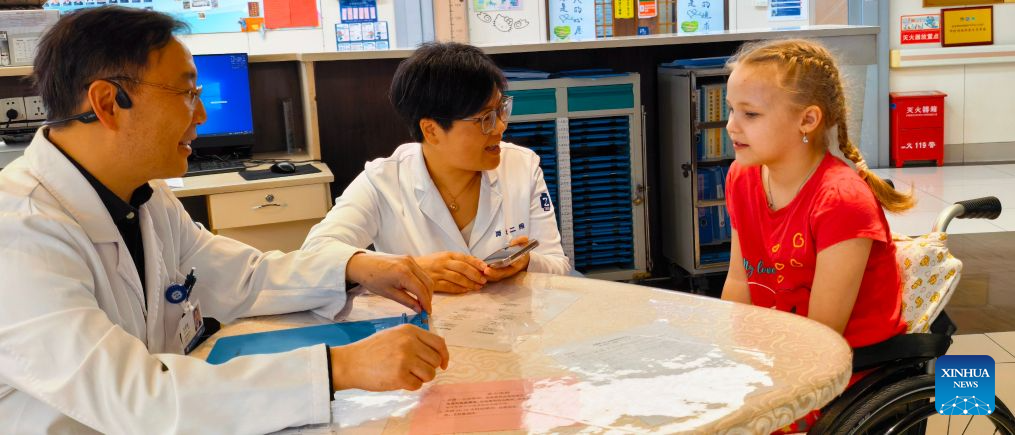
Doctors communicate with Russian girl Vera, a pseudonym, at the Second Affiliated Hospital, Zhejiang University School of Medicine in Hangzhou, east China's Zhejiang Province, April 17, 2026.(Xinhua)
BEIJING, Sept. 8 (Xinhua) -- After multiple attempts to treat paralysis in her lower limbs in her home country, 12-year-old Russian girl Vera, a pseudonym, traveled to Hangzhou in east China's Zhejiang Province with help from the Russian Embassy in China.
There, doctors implanted a domestically developed closed-loop spinal cord neural interface, which amplifies the brain's weak motor signals, helping them bypass the damaged section of the spinal cord and reactivate the muscles needed for walking. After three months of personalized rehabilitation, Vera was able to take assisted steps.
"I like the feeling of walking," said Vera, who had been confined to her wheelchair for more than a year since she suffered a severe spinal cord injury in a traffic accident in June 2025 and lost motor function in her lower limbs.
She also became the first overseas patient with such an injury to regain assisted walking in China after receiving the neural interface implant, according to doctors who developed the procedure at the Second Affiliated Hospital, Zhejiang University School of Medicine.
Vera's experience is part of a broader trend of foreign patients seeking medical care in China for advanced medicines, therapies and procedures.
According to figures from China's National Health Commission, major hospitals in China recorded about 1.28 million visits by international patients in 2025, up 73.6 percent from three years earlier, with the number of patients from Europe and the United States doubling.
Officials from several hospitals told Xinhua that, although foreign patients still make up a small share of total hospital visits, their numbers keep growing. Hospitals in different parts of the country have reported a steady increase in foreign patients.
China's expanding medical capabilities in oncology, cell therapy, and other cutting-edge treatments, along with its rich clinical experience, have become an important draw.
According to data released by the National Medical Products Administration (NMPA), China approved 76 innovative drugs and 76 innovative medical devices for marketing in 2025, both record highs. By the end of 2025, China had 4,751 innovative drugs under development, accounting for 33.7 percent of the global total and making it the world's largest country in terms of innovative drugs under development.
In June, the NMPA approved the world's first CAR-T cell therapy for treating solid tumors. The treatment works by genetically modifying a patient's own immune cells to attack gastric cancer.
China's Caijing magazine reported that 59-year-old New Zealander Josh became the first foreign patient in China to receive the therapy. After completing a 1.5-month course of tumor treatment, he returned to New Zealand in mid-August.
Just months earlier, doctors in New Zealand had told him that his cancer treatment had failed. Unable to eat, Josh relied on enteral nutrition to stay alive. After receiving the therapy, he is now trying different soups and ice creams as he works on returning to a normal diet.
"China is currently one of the world's leaders in cell and gene therapy," said Renat Badaev, a hematologist at Moscow City Clinical Hospital 52. "The level of medical care is very high, and it is clear that enormous efforts have been invested in the development of cutting-edge technologies."
During his visit to a Chinese hospital in late July, Badaev said he was impressed by the results of CAR-T therapy and hematopoietic stem cell transplantation.
Another hematologist on the tour, Anastasia Zhernyakova, noted that China has accumulated extensive medical experience, driven by the large number of transplants performed in the country, the substantial volume of CAR-T products manufactured and the large number of patients receiving such therapy.
Chen Gao, director of neurosurgery at the Second Affiliated Hospital, Zhejiang University School of Medicine, said Vera's case demonstrated how advances in Chinese medical technology can benefit patients beyond the country's borders.
He noted that China's progress in neurosurgery and brain-computer interface technology is moving from laboratory research toward more standardized clinical applications, adding that international medical cooperation can help more patients benefit directly from advances in diagnosis and treatment.
"Chinese medical solutions should benefit not only people in China, but patients around the world. Medical progress should transcend national borders," Chen said. ■
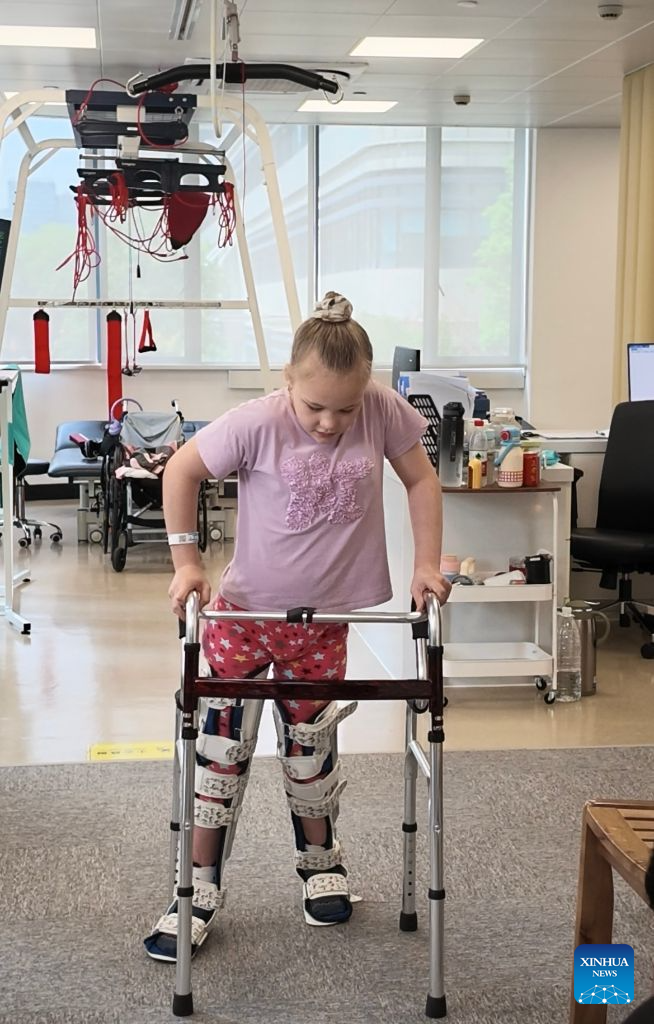
Russian girl Vera, a pseudonym, conducts rehabilitation exercises at a rehabilitation training room of the Second Affiliated Hospital, Zhejiang University School of Medicine in Hangzhou, east China's Zhejiang Province, Sept 1, 2026. (Xinhua)


