
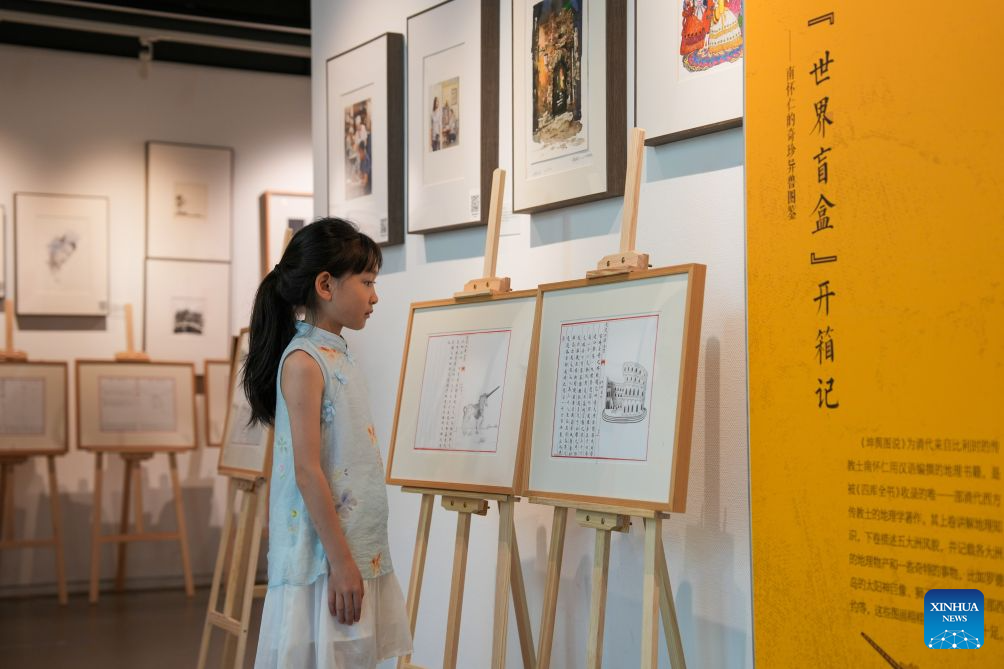
A girl views an image at an exhibition featuring the digital version of the Siku Quanshu, or The Complete Library of the Four Treasuries, in Lanzhou, northwest China's Gansu Province, Aug. 25, 2026. (Xinhua/Lang Bingbing)
LANZHOU, Sept. 5 (Xinhua) -- An art gallery in Lanzhou, capital of northwest China's Gansu Province, has turned a colossal ancient encyclopedia into something anyone can enjoy.
Instead of displaying dense classical Chinese that only scholars can master, it exhibits 122 images from this seldom-presented 18th-century compendium, such as a sketch of an ancient Indian unicorn, a star map nearly a millennium old, and the private scribbles of a stern, diligent emperor.
These images form part of a years-long project to digitize a copy of the Siku Quanshu, which translates as the Complete Library of the Four Treasuries, one of the most comprehensive collections of Chinese classical works in Chinese history.
Compiled during the Qing Dynasty (1644-1911), the book runs to nearly 800 million characters across thousands of volumes, covering everything from Confucian philosophy to farming techniques. Seven copies were originally produced, but only three and a half survive today, preserved in Beijing, Taipei and Lanzhou, respectively.
For decades, this massive treasured book was locked away. To better preserve its copy, Lanzhou built a dedicated library in an underground repository with constant temperature and humidity. In 2021, a project was launched to digitize it.
By the end of May 2022, the scanning work of the text was finished, and the project moved into data processing. A team of young editors then spent more than two years checking the data page by page, and along the way, they discovered something unexpected: the playful side of the massive and complex text.
"Most people think such a book would be too difficult to read," said Zhang Yang, deputy director of the digital publishing center at Duzhe Publishing & Media, the project's lead. "But as we went page by page, we found plenty of vivid images that could spark modern readers' curiosity."
What started as a routine check soon turned into a curatorial mission. The team selected 122 of the most striking images and organized them into twelve sections, covering tea culture, astronomy, architecture, medicine, costume, and even weapon-making. The editors gave the sections funny titles such as "Ancient Gardening Know-How" and "Ancient Stargazing Guide," bridging the gap between centuries-old social life and the modern day.
One section is called "World Mystery Box," featuring images from geographical works by Western missionaries during the Qing Dynasty. These images depict the Colosseum in Rome, the Colossus of Rhodes, and exotic and mythical creatures, such as lions and mermaids.
"We had long heard of the Siku Quanshu by name, but this is our first time seeing it up close," said Liang Tao, a visitor from Xi'an. "It's both fun and awe-inspiring."
That reaction echoes the goal of the exhibition. Song Xuejuan, who heads the digitization project, said the exhibition "transforms 'static preservation' into 'dynamic sharing', and turns an academic treasure into a public experience."
For a long time, there was a disconnect between traditional culture and younger generations. In recent years, however, new technologies, fresh perspectives, and innovative storytelling have helped connect ancient heritage with contemporary trends.
The Mogao Caves, a UNESCO World Heritage Site dating back to the 4th century, also in Gansu, are an example. In the 1980s, local researchers began exploring digital documentation. Today, they have completed high-precision digital capture of 323 caves. The images rendered on screen are now even clearer than what the naked eye can see on site, revealing details that once required climbing ladders to inspect.
Another example is the immersive interactive digital exhibition of oracle bone inscriptions, held in Tianjin in April. Using artificial intelligence and mixed reality technologies, it allowed visitors to experience the ancient ritual of oracle bone divination.
The Lanzhou gallery said it had previously received only a few hundred visitors per day on average. But since this new image exhibition launched, it has seen attendance surge to over 3,000 on peak days. Among the crowds were many children accompanied by parents.
For Song's team, they were no longer editors merely checking for data errors, but rather communicators sharing the treasures with the public.
"I used to think the Siku Quanshu was unreachable," said Song Jia'ni, a 34-year-old editor on the team. "But once you get into it, you will realize you don't have to begin with big history. One picture, or one detail, is enough to hook you." ■
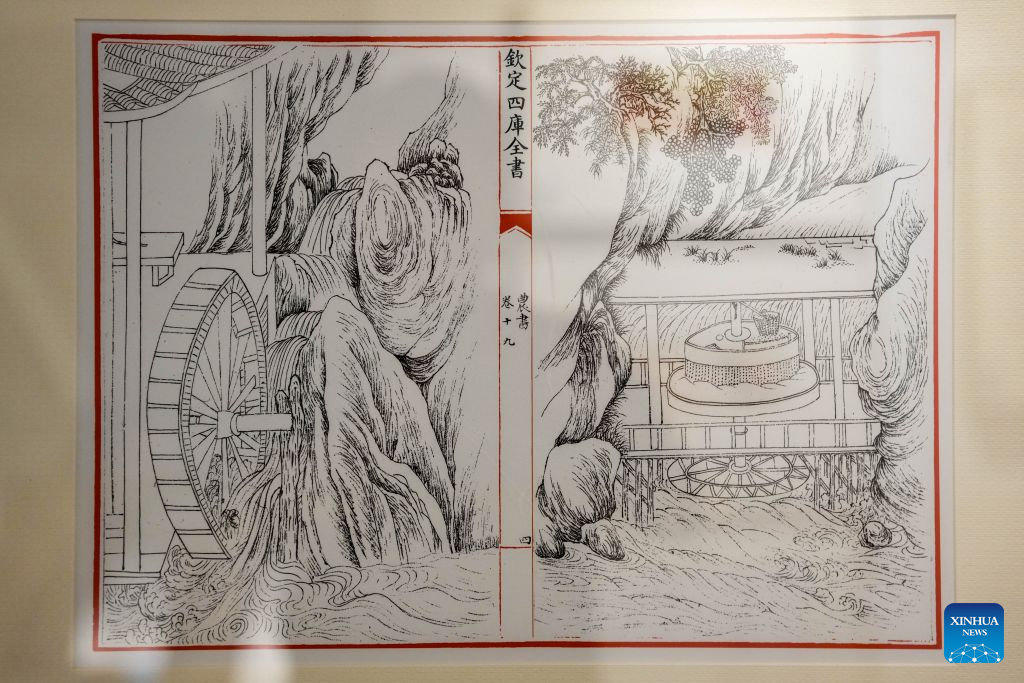
A combo image depicting an ancient waterwheel and an ancient mill is on display at an exhibition featuring the digital version of the Siku Quanshu, or The Complete Library of the Four Treasuries, in Lanzhou, northwest China's Gansu Province, Aug. 25, 2026. (Xinhua/Lang Bingbing)
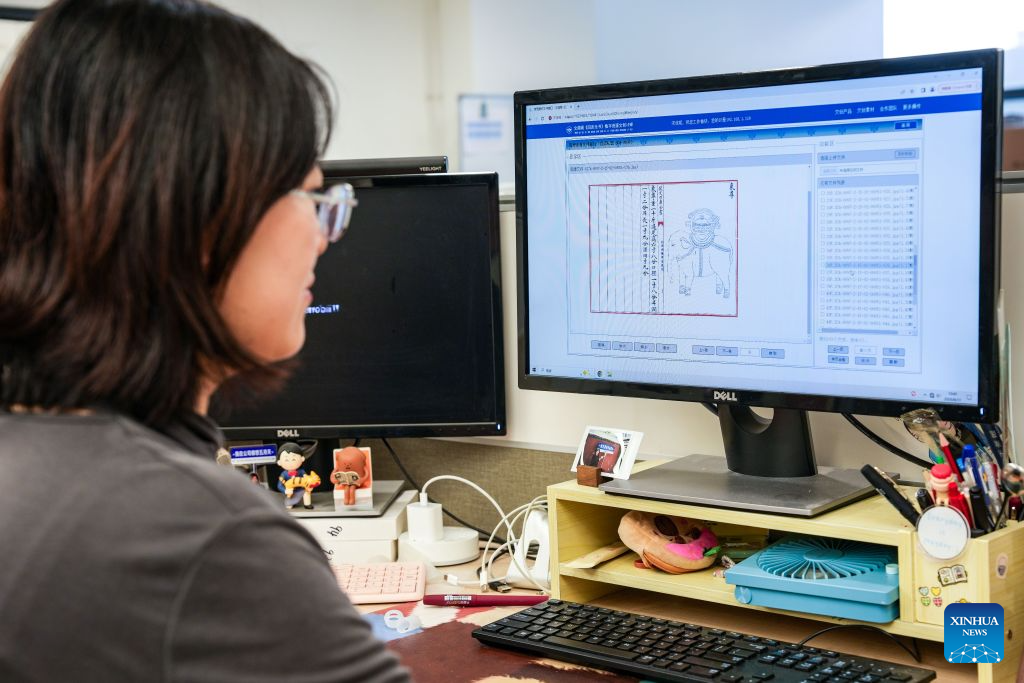
Editor Song Jia'ni reviews a digital copy of the Siku Quanshu, or The Complete Library of the Four Treasuries, in Lanzhou, northwest China's Gansu Province, Sept. 2, 2026. (Xinhua/Lang Bingbing)


