
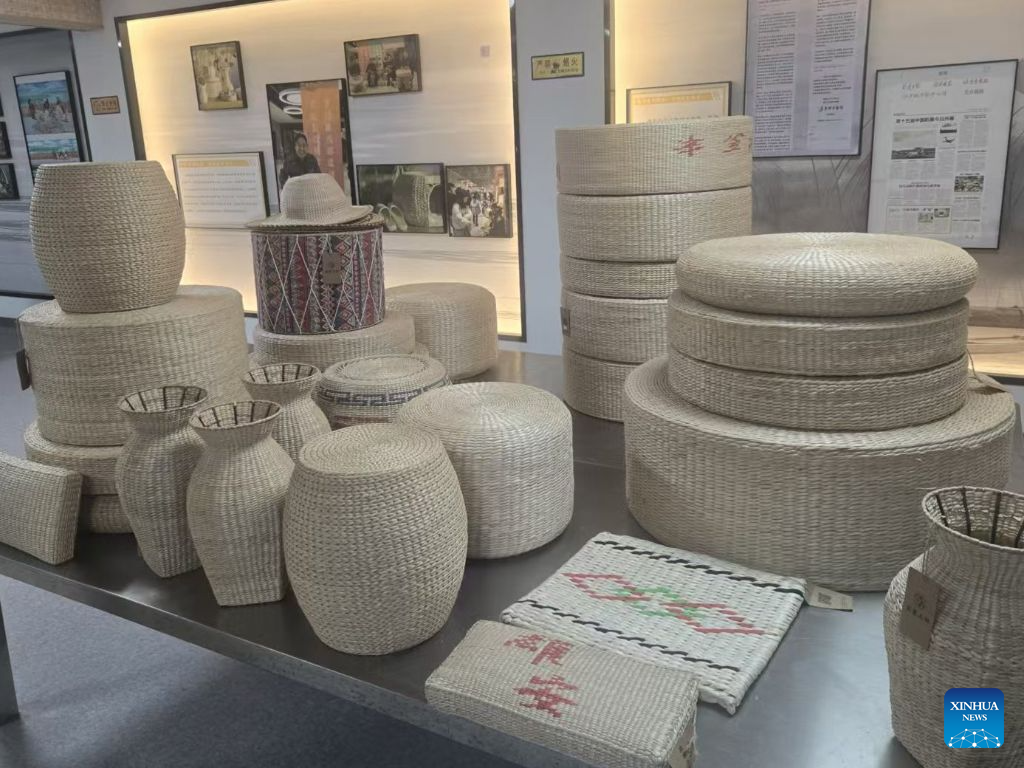
This photo taken on Aug. 17, 2026 shows cattail-weaving products at Yangzhuangzi Village of Xiong'an New Area, north China's Hebei Province. (Xinhua)
SHIJIAZHUANG, Sept. 2 (Xinhua) -- On a calm autumn evening, families paddled across Huizhi Lake in Xiong'an New Area's central green valley park, where waterbirds skimmed over reeds and trees lined the shore.
The lake lies within the Baiyangdian wetland in north China's Hebei Province. Once known as the "Pearl of North China" for its vast waterways, the area is now becoming an integral part of a modern city taking shape nearby.
"In many cities, paddleboarding is usually offered on the outskirts, because suitable waters are hard to find in the urban core," said Li Nan, head of a local paddleboarding club. "Here, people can enjoy nature right on their doorstep."
The club opened at Huizhi Lake in June. On peak weekend days, it receives more than 100 visitors, drawn by the sport's low entry barrier and the chance to get close to nature without leaving the city.
The central green valley is also just a short walk from the headquarters of several centrally administered state-owned enterprises. For their employees, the water offers an easy escape from the office.
"Paddleboarding is becoming a new way for some Xiong'an residents to relax and socialize," said Li.
For Xiong'an, often dubbed a "city of the future" being built from the ground up, such easy access to clean water and greenery is more than just a recreational amenity. It reflects an approach to urban development that places the natural landscape at the heart of the city's design.
On April 1, 2017, China announced plans to establish Xiong'an New Area to relieve Beijing of functions non-essential to its role as the national capital and advance the coordinated development of the Beijing-Tianjin-Hebei region.
The master plan for Xiong'an calls for green development, controlled development intensity and systematic ecological restoration, with Baiyangdian a key focus. Waterways, wetlands and green spaces are being woven into the urban fabric from the outset.
Since the establishment of Xiong'an New Area, Baiyangdian has undergone the largest systematic ecological restoration in its history, bringing a major leap forward in water quality.
In 2021, Baiyangdian's water quality improved to Grade III under China's national surface-water quality standards, a level it has maintained for five consecutive years. The wetland is now among China's lakes classified as having good overall water quality.
The restored landscape also opens new opportunities for local industries and breathes new life into cultural traditions.
Cattails, once abundant in Baiyangdian, had come to be seen as a nuisance. They could overgrow waterways and required labor-intensive removal, while the traditional craft of weaving cattails had gradually declined.
In 2024, Yangzhuangzi Village in Anxin County opened a workshop offering free cattail-weaving training to villagers. The initiative has helped turn a once-neglected craft into a source of employment and income.
"Water quality has improved in Baiyangdian in recent years, and the cattails have grown stronger and more resilient, making them better suited for handicrafts," said Yang Zhiliang, Party chief of Yangzhuangzi Village.
After visiting other regions to learn from their experience, the village decided to revive this craft.
Zhao Fengrong, 61, was among the workshop's first trainees. In her hands, ordinary cattails are transformed into baskets and other objects of various shapes.
"We used to weave cattails for our own use. We never imagined we could make money from the craft," Zhao said.
The workshop has helped more than 2,000 people in the village and surrounding areas find employment.
Xiong'an is also developing local brands around its cattail and reed weaving handicrafts, while short-video platforms, livestreaming and online stores are helping traditional products reach customers far beyond the wetland.
Revival, however, is not limited to livelihoods.
For generations, Baiyangdian has also inspired Chinese writers and poets. Its waterways, villages and wetlands have left a distinctive mark on local culture and helped nurture a notable community of poets.
At the Baiyangdian Poetry Culture Park in Anxin County, modern buildings blend with pathways and landscaped spaces. Poems are engraved on walls, steps and walkways, turning the park into an open-air cultural landscape.
In May, an exhibition hall for local poetry opened at the park, providing a venue for exhibitions, reading and cultural exchanges.
"Ecological restoration has given culture the soil it needs to thrive," said Ling Zhiqing, director of the exhibition hall and a native of the area.
Poet Lin Mang said the ecological environment of Baiyangdian has helped nurture the local poetry community. Since the establishment of Xiong'an New Area, he said, the landscape had undergone significant changes.
"Urban development and ecological protection can reinforce each other, allowing local culture, the spirit of poetry and the heritage of the water town to live on and flourish," Lin added. ■
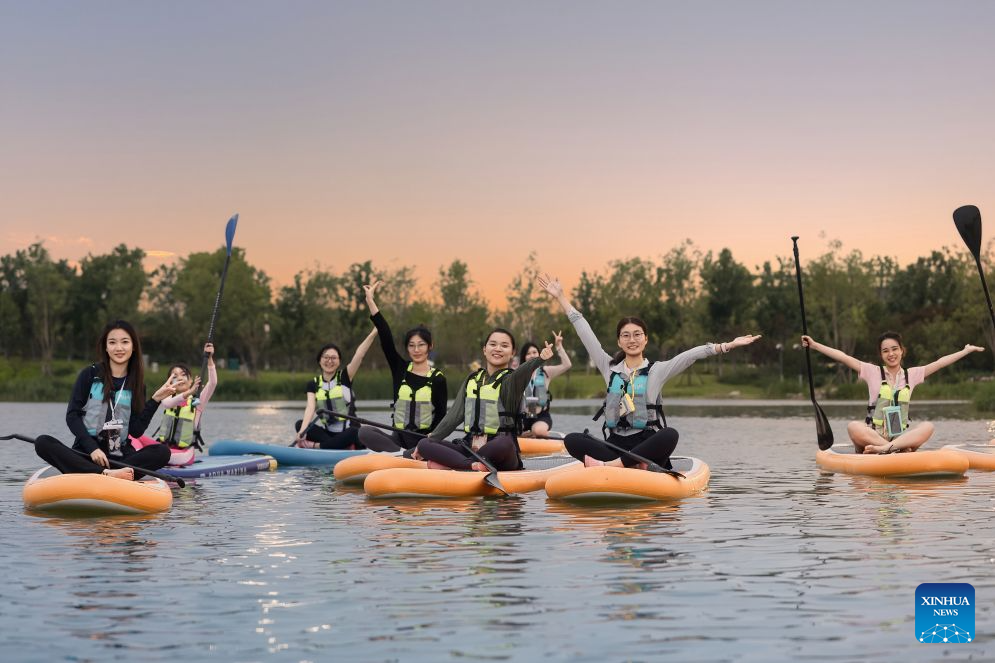
Citizens enjoy paddleboarding at central green valley park in Xiong'an New Area, north China's Hebei Province, June 12, 2026. (Xinhua)


