BEIJING, Sept. 2 (Xinhua) -- In a gallery of golden wheat fields on canvas, Wang Yaoyao in a pale pink qipao is a quiet contrast. The academically trained painter now embraces the unruliness of farmer painting -- a typical Chinese naive art.
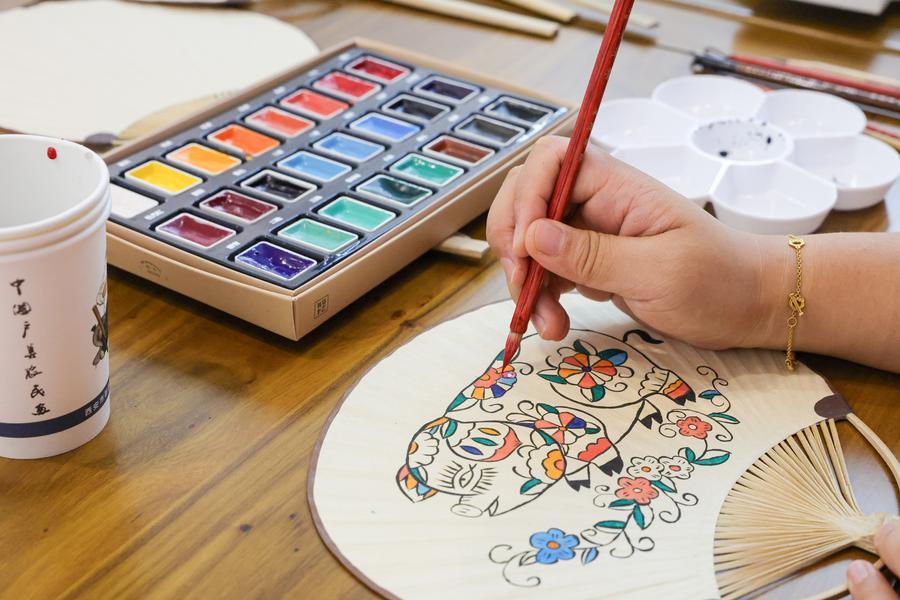
At the exhibition hall in the financial hub of Beijing, under Wang's brush, a traditional paper-cutting-style piglet leaps onto a palette, and dives deep into a kaleidoscope of vibrant colors.
"Creating farmer paintings is about pursuing freedom," said the young artist, who studied traditional Chinese painting before joining a district-level workshop in northwest China's Xi'an city in 2021.
Emerging in Huxian County, now Huyi District of Xi'an, in 1958, farmer painting was but villagers' simple strokes on paper during slack farming seasons, before it gained a national audience, like the Chinese version of the legend of Grandma Moses.
At first sight, Wang was captivated by the art's bold use of color and exaggerated, uninhibited forms. A leaf can be blue or red, she said, and creativity can fly free of any conventional rules.
"Take the painting 'Endless Corn Cobs,' for example. The corn, a symbol of a bumper harvest, is depicted as huge as the locomotive carrying it. The artist's yearning for a good harvest is vividly expressed," Wang said. "I really love this kind of free expression."
For Wang, this sense of freedom represents a shared connection among farmer painters across generations, nourishing renewed vitality for their artistic spirits and works.
"Many young people are drawn to farmer painting because of its unconventional styles and the creativity of earlier generations of artists. They come together to learn and carry on the tradition of Huxian farmer painting," she said.
That tradition is never a one-way inheritance.
One of the artists Wang admires most is an 83-year-old painter, who still goes to the studio every day to paint. His style retains the simplicity characteristic of the 1970s and 1980s, while he also makes an effort to learn new approaches to composition from younger artists.
"While he learns from us, we also learn from him," Wang said.
Today's farmer paintings are no longer confined to traditional depictions of rural life.
High-speed trains racing across the landscape, electric vehicles on the roads, mechanized irrigation systems, and major industrial equipment have all entered the artists' field of vision as elements of contemporary China.
"China-Europe Railway Express: The Steel Camel Caravan" is one of Wang's latest creations. In her painting, the locomotive that once carried enormous corn has been transformed into the China-Europe freight trains carrying Chinese new energy vehicles from Xi'an to distant markets.
"The rapid development of our hometown is an inexhaustible source of inspiration, and it has also brought more visions of the future into our works," said the artist.
The paintings, in turn, are giving back to the land where their creators took root.
In Huyi, many farmer painters have turned their backyards into studios and galleries. Chinese and overseas visitors come to appreciate and purchase paintings and experience the creative process, bringing tangible income to the artists.
There are now more than 2,300 farmer painting artists in Huyi, with nearly 10,000 works having been exhibited in 88 countries and regions.
From Aug. 25 to Sept. 3, an exhibition of such paintings is being held at the Xinhua News Agency Art Museum in downtown Beijing, showcasing 120 selected works by 53 farmers from Huyi.
Huyi's stories resonated with China's push to advance all-round rural revitalization. The outline of China's 15th Five-Year Plan (2026-2030) calls for protecting and passing on rural cultural heritage to promote and develop rural culture.
"Each painting is both a vivid record of changes in rural society and a lively artistic testimony to the evolving face of China's urban and rural areas," said Wang Wenji, director of the Huyi District Farmer Painting Museum.
Huxian farmer painting represents an aesthetic tradition that has grown up from the soil, said Ma Fenghui, vice chairman of the China Artists Association.
Grandma Moses is merely a legend, yet art was her life's calling. For Wang Yaoyao, similar silhouettes at Huyi inspired her to imagine whether she, too, will still be holding a paintbrush in her 80s.
"We are using our brushes to record the changes brought about by rural revitalization, while extending our artistic vision beyond the fields and villages to a much broader world," Wang said. ■