HARBIN, Sept. 2 (Xinhua) -- Across the fertile black soil of northeast China's Heilongjiang Province, data and technology are helping farmers anticipate weather and growing conditions with unprecedented precision, reshaping how food is grown in the country's agricultural heartland.
For 16 consecutive years, the province has ranked first in the country in total grain output. Behind its sustained productivity is a highly mechanized farming system, with the comprehensive mechanization rate for plowing, sowing and harvesting reaching 99.28 percent.
Now, the province is taking the next step toward smarter farming. From AI-powered crop monitoring and drones to upgraded agricultural machinery, technologies are helping farmers make more precise decisions and boost efficiency.
Heilongjiang's transformation offers a glimpse into China's broader efforts to harness technology to safeguard national food security while advancing rural revitalization.
DIGITAL TECH
Inside Beidahuang Information Company in Harbin, the provincial capital, a massive digital map covering 48 million mu (about 3.2 million hectares) of arable land dominates the wall.
Across the screen, data on soil, crop growth and tractor movements updates in real time, as satellite remote sensing, Internet of Things (IoT) and AI are gradually integrated into every stage of farming, from sowing to harvesting.
"Previously, a farmer could inspect only about 200 mu a day on foot. Now, drones and remote sensing allow us to monitor vast areas and update crop data for the entire reclamation area every five days," said Wang Hao, deputy general manager of the company's market operation center.
Wang noted that such data is now helping shape decisions from field scouting and fertilization to pest control.
The company has developed more than 60 digital systems for farm management. Built on years of agricultural data, its cold-region crop AI model analyzes soil, weather and crop-growth information to generate planting plans and variable fertilization prescriptions.
"Our agricultural service app has improved service efficiency and cut management costs for farmers," Wang said, noting that the app has facilitated online transactions worth over 100 billion yuan (around 14.74 billion U.S. dollars).
"Smart agriculture is moving from validation to acceptance, but large-scale rollout still faces multiple challenges in data, technology fit and adaptability," said Wang, adding that AI models need ample on-site data and repeated verification to overcome environmental variability to actually serve farm production.
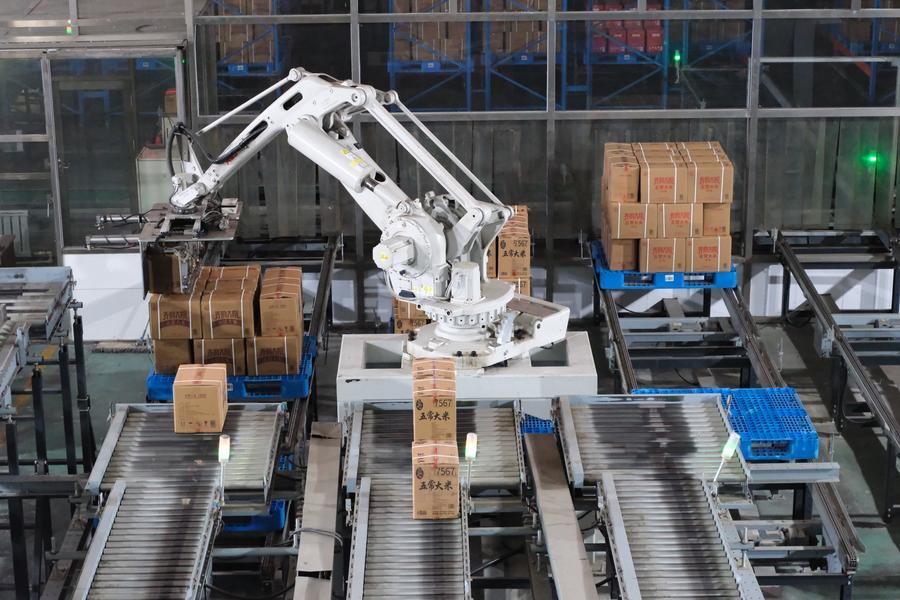
In Wuchang, a renowned rice-producing area in Harbin, digital technology is also reshaping the entire production chain.
At Qiaofu Dayuan Agricultural Co., Ltd., robots stack packaged rice for shipment. Qiao Wenzhi, head of the company, said QR codes on the products provide information such as the production base and nutritional content, allowing consumers to choose rice tailored to their needs.
SMART GEAR
At a planting base in Heilongjiang, a four-wheel laser weeding robot glides along the crop rows. Multi-spectral cameras and sensors on the robots scan the ground, and algorithms instantly distinguish crops from weeds, directing laser beams to precisely eliminate the weeds.
"Weeding used to rely on manual labor or chemicals, which were either costly or harmful to the soil," said Li Yongwei, deputy general manager of Harbin Huagong Zhiyun Technology Co., Ltd. "Laser weeding is a purely physical, chemical-free method."
Li added that this technology, which achieves a weed removal rate of over 95 percent and a crop damage rate of less than 0.1 percent, cuts weeding costs by up to 70 percent compared with manual labor.
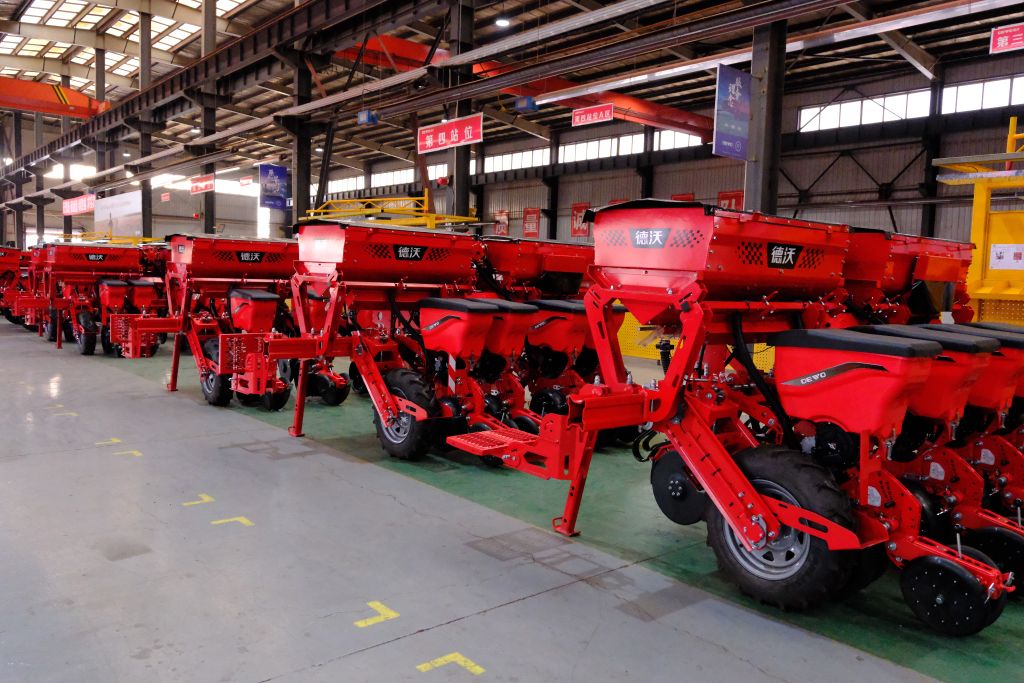
Agricultural machinery is also upgrading toward intelligence. At Heilongjiang Dewo Technology Development Co., Ltd., rows of electric-drive precision seeders are lined up on its square. Air pressure and seed spacing, notably, can be monitored and adjusted in real time via smart terminals.
"The system makes adjustments more convenient and can reduce seed damage," said Du Mujun, chief engineer at Dewo, revealing that the seeder operates approximately 50 percent faster than traditional mechanical seeders.
Currently, Dewo's equipment accounts for more than 60 percent of domestic high-end electric-drive seeder sales. The company has also begun exporting its products overseas, helping extend China's intelligent farming tools to global markets.
"Domestic agricultural machinery manufacturing has improved to the point where it can compete with international brands, offering targeted designs at prices roughly one-third lower than comparable foreign products," said He Chunling, international sales manager at Dewo.
Since launching overseas operations in 2019, the company has exported potato mechanization equipment to Russia, Kazakhstan, Peru and Zimbabwe, and seeders to the Republic of Korea.
EMBRACE INTELLIGENT FARMING
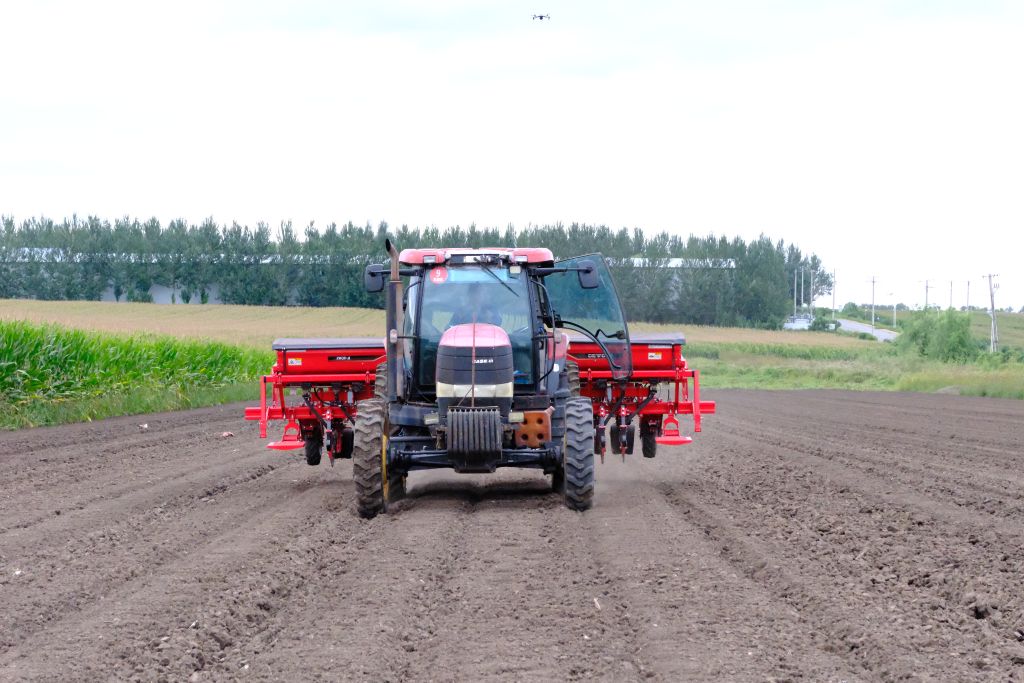
In 2025, Heilongjiang recorded its 22nd consecutive bumper harvest, with grain output reaching a record 82 million tonnes. It also had 676,000 intelligent agricultural machines, ranking first nationwide.
The province's agricultural transformation did not happen overnight.
During the 14th Five-Year Plan period (2021-2025), the province accelerated the upgrading and intelligent transformation of agricultural machinery, its governor Liang Huiling said earlier this year.
During the 15th Five-Year Plan period (2026-2030), the province plans to foster industrial clusters focused on agricultural robots, intelligent farming equipment and low-altitude economy, Liang said.
In August, construction began on a national AI application pilot base for crop planting, aimed at tackling common technological bottlenecks and developing scalable applications.
Heilongjiang's technological quest aligns with China's broader plans for agricultural modernization.
The country's 15th Five-Year Plan calls for improving agricultural efficiency through a combination of high-quality land, superior seeds, advanced machinery and effective methods, while a document issued in February pledged to advance agricultural and rural modernization and promote all-around rural revitalization, expanding the use of drones, IoT and robots in agriculture and rural areas.
"Relying solely on manual labor and farming the land the way our ancestors did is no longer realistic," said Hu Jinyou, a professor at China Agricultural University, noting that while smart agriculture is still being optimized, the deep integration of AI and agriculture is an irreversible trend.
As a new generation of well-educated farmers enters the fields, Hu said, digital management will gradually become the norm. ■