
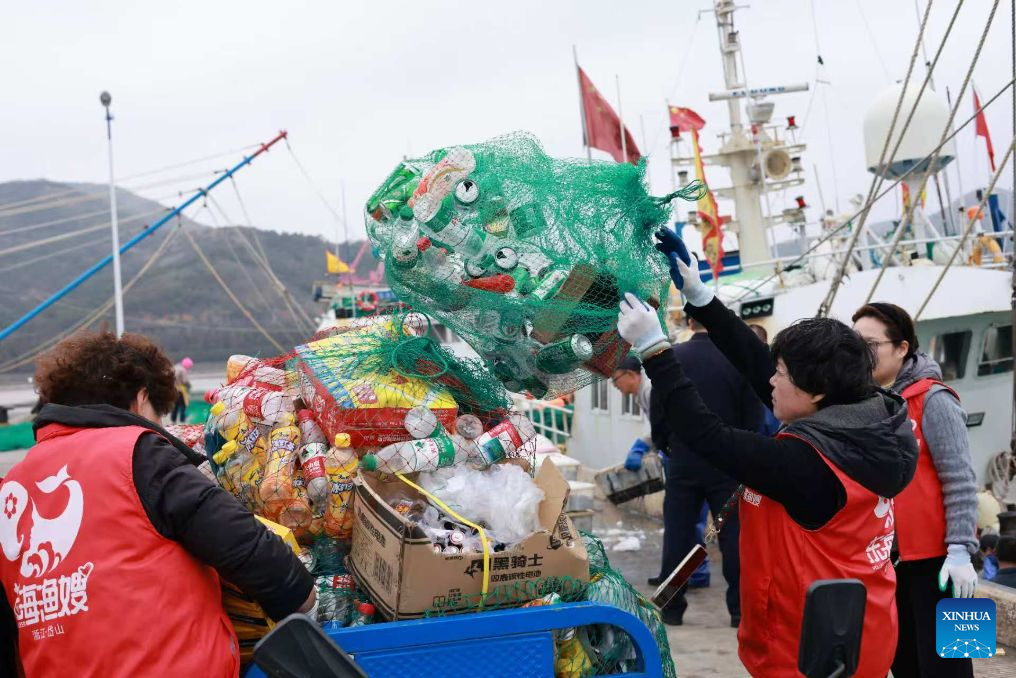
Environmental volunteers collect marine plastic waste in Zhoushan City, east China's Zhejiang Province, Feb. 3, 2026. (Xinhua)
HANGZHOU, Aug. 31 (Xinhua) -- As the sea glimmers under the first dawn light, a cluster of women in red vests spread out along the shoreline of Changtu, a small island in east China, harvesting not shells but plastic bottles, discarded foam, and other debris tide‑washed in overnight.
For years, these once stay‑at‑home wives and mothers, now environmental volunteers, have waged a quiet but persistent campaign against marine plastic pollution, driven by love, faith and a sustainable business model.
"We used to think our duty was just waiting at home while men ventured out to the sea," said Hu Songsu, 66, founder of the "Gold and Silver Island Association of Fishermen's Wives," at the town, known for rich in large yellow croaker and hairtail herring, in Zhejiang Province.
In 2017, Hu, together with a group of like‑minded women, launched the association, initially focusing on fishing safety. "When a wife tells her husband 'come home early and stay safe,' the husband listens," Hu explained.
But over time, Hu noticed a troubling change: the sea was becoming choked with trash. Discarded fishing nets tangled propellers, while used dry-cell batteries were dumped into the sea -- a scene unimaginable back in her childhood.
"The sea feeds our families. We can do more," Hu said.
The association quickly rolled out a "Blue Sea Rescue" project. Starting with 19 boats whose captains were respected village leaders, they persuaded fishermen to bring their waste back ashore.
For those who balked at the extra hassle, their wives appealed to their beliefs: "You pray for safe voyages every year. But prayers alone aren't enough. Bringing back waste is your real merit."
Even more compelling was the practical argument: polluted waters mean fewer fish. "How can fish survive in a polluted sea? Where will our livelihoods go?" Hu said.
To boost incentives, the association set up a transfer station where marine waste is sorted and sold to recycling companies.
Part of the profits goes to impoverished fishing families, while the station's managers -- most of them fishermen's wives -- also receive monthly pay of 1,000 yuan (about 147 U.S. dollars) to 1,500 yuan.
Fishermen can redeem recycling points earned from handed‑in waste for rice, cooking oil and other daily necessities, or purchase new batteries at subsidized prices when they return old ones.
Evolving from gentle persuasion into a well‑run operational model, the association has recovered over 350 tonnes of marine debris, including 75,000 used batteries.
In 2025, the association won the national March 8th Red Banner Collective award, one of the highest honors conferred by the All‑China Women's Federation. Their work also contributed to the Blue Circle project, which claimed the United Nations' Champions of the Earth award.
This year, Hu was named one of the country's top 10 ecological and environmental volunteers by the Ministry of Ecology and Environment.
What began as a small circle of fishermen's wives has grown into a group with 235 registered volunteers, now widely known as the "East China Sea Daughters."
Researchers and university students visit the island, some shadowing fishermen and their wives at docks, on boats and at the sorting station. "They come to see how ordinary women are changing the ocean," Hu said.
Hu is never alone. Across China, the spirit of these "sea daughters" resonates with volunteer groups operating in vastly different landscapes.
In south China's Shenzhen, "eco‑sentinels" patrol the city's streets and waterways, addressing environmental complaints before they escalate. In northwest China's Qinghai Province, volunteers on horseback travel to summer pastures to collect plastic waste along the shores of Qinghai Lake.
This August marks China's first ecological and environmental volunteer service month. According to the Ministry of Ecology and Environment, 30 provincial‑level regions have rolled out action plans, mobilizing some 38,000 volunteers for more than 650 activities.
For the fishermen's wives in Changtu, August is also the busiest time of year. They repair fishing gear and stock supplies as the peak fishing season is approaching.
Still, Hu never misses her dawn patrol along the shore.
"For us, a healthy ocean is our real wealth," she said. ■


