
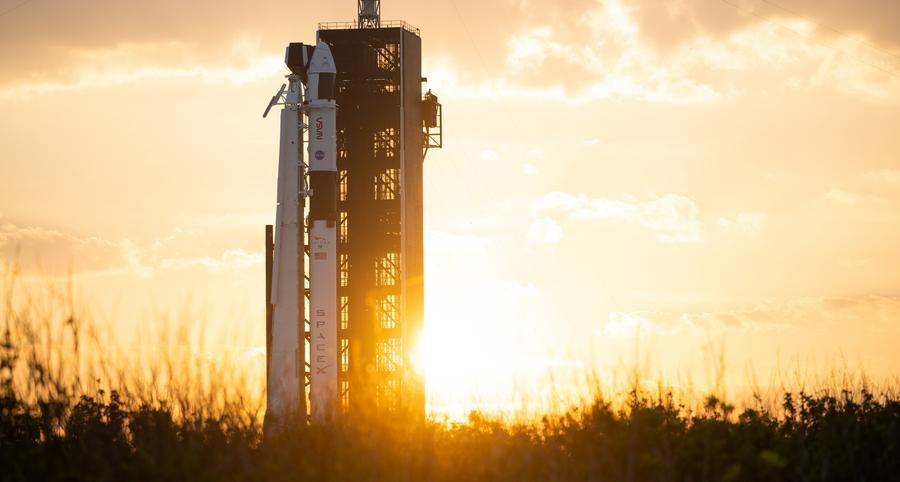
LOS ANGELES, Aug. 30 (Xinhua) -- NASA's Nancy Grace Roman Space Telescope launched into space on Sunday, beginning an approximately three-month journey to its final orbit, where it will study dark energy, dark matter and planets beyond the solar system.
The mission lifted off at 7:26 a.m. Eastern Time (1126 GMT) aboard a SpaceX Falcon Heavy rocket from NASA's Kennedy Space Center in Florida.
The ground control team at NASA's Goddard Space Flight Center in Greenbelt, Maryland, began receiving telemetry data from Roman seven minutes after launch.
The Falcon Heavy rocket performed as expected, separating from the observatory 31 minutes into the flight. After separating from the center core, the rocket's boosters safely returned to the launch site for refurbishment, NASA said.
The mission team confirmed the successful deployment of the observatory's solar panels and lower instrument sun shade one hour and 23 minutes after launch.
Within the coming days, Roman's high-gain antenna and visor-like deployable aperture cover will be deployed, ground controllers will initiate the first of two mid-course corrections, and the Coronagraph Instrument will be powered on, according to NASA.
Throughout Roman's three-month commissioning period, scientists will conduct a series of calibrations and tests on its instruments. NASA anticipates releasing Roman's first images by early 2027.
Roman will send back 1.4 terabytes of data every day, the highest data rate of any NASA astrophysics mission so far, according to the agency. Machine learning, artificial intelligence and citizen scientists will help sift through the data and flag significant findings for astronomers to study.
This flagship mission will help astronomers explore dark matter, dark energy and worlds outside of our solar system, known as exoplanets. Its surveys will support a broad range of research extending far beyond the mission's main science goals, according to NASA.
"Roman will be a discovery machine that will bring us closer than ever before to answering humanity's most profound questions about our cosmic history," said Nicky Fox, associate administrator for the Science Mission Directorate at NASA Headquarters in Washington. "With its large field of view and fast survey speeds, Roman will usher us into a new era of discovery and make the invisible visible, setting the foundation for humanity's search for life beyond our solar system." ■