
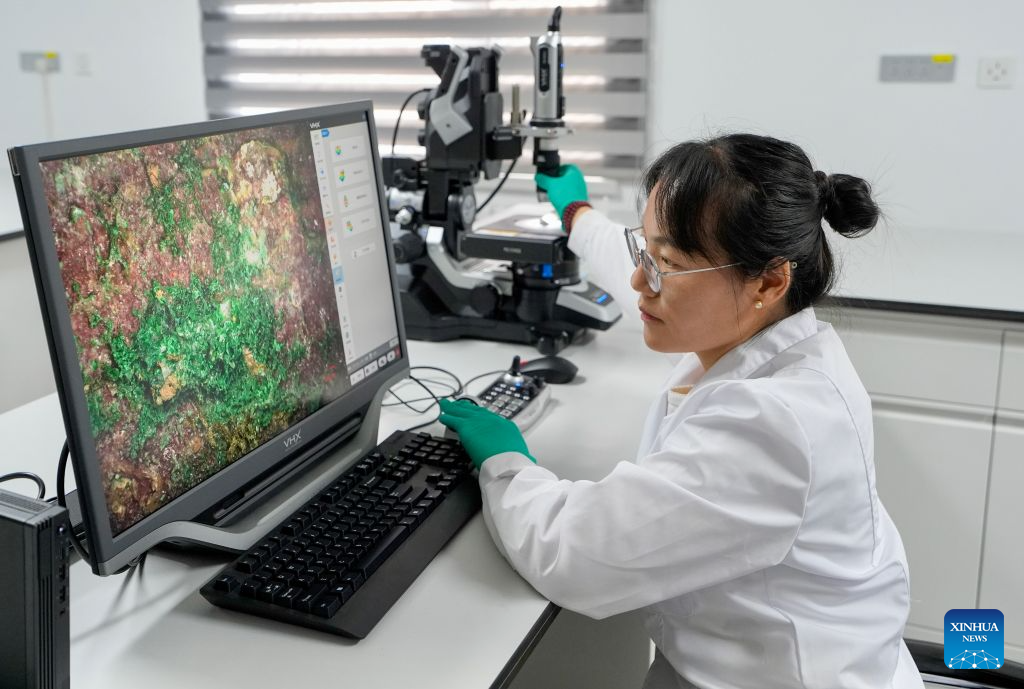
A researcher observes a bronze ware specimen via a microscope at the Ningxia Institute of Cultural Relics and Archaeology in Yinchuan, northwest China's Ningxia Hui Autonomous Region, Aug. 10, 2026. (Xinhua/Yang Zhisen)
YINCHUAN, Aug. 27 (Xinhua) -- What did ancient people seal in a bronze pot 2,000 years ago? Chinese archaeologists and scientists have jointly confirmed the liquid residue as grain wine of millet and barley from the Warring States Period (475 BC-221 BC), uncovering the mystery quest via cutting-edge technologies.
A well-preserved bronze garlic-head-shaped pot with liquid preserved caught archaeologists' attention. It was unearthed from a tomb at the Shanjiabu cemetery of the Qin State of the Warring States Period in the city of Guyuan, northwest China's Ningxia Hui Autonomous Region.
The cemetery is located near the Great Wall built by the Qin State during the Warring States Period, with 183 tombs excavated as of 2024.
Though it lacked a cap, the pot's interior was sealed with textile fabric, and its exterior was coated in a layer of mud blended with organic matter--an ancient double seal that somehow kept a large volume of liquid intact for more than two thousand years.
Using sterile scalpels and tweezers, archaeologists carefully peeled away these seals, collecting roughly 3,740 milliliters of clear, pale bluish-green, odorless liquid and a minor amount of sediment.
The bronze garlic-head pot is a type of representative artifact of Qin culture, normally regarded as a wine vessel. As this pot was placed as a funerary object inside the tomb chamber, archaeologists preliminarily speculated that the liquid might be Qin wine from around two thousand years ago. However, they could not draw a conclusion without scientific testing.
To reach a more accurate conclusion, the Ningxia Institute of Cultural Relics and Archaeology and the School of Cultural Heritage at Northwest University jointly conducted a multidisciplinary analysis of the ancient liquid in the bronze pot.
Wen Rui, a professor at the School of Cultural Heritage at Northwest University, led a study team to analyze the liquid using infrared spectroscopy, ultra-high-performance liquid chromatography-mass spectrometry, and other high-precision testing techniques, along with microfossil analysis.
The results showed that more than 2,000 small-molecule compounds were detected in the ancient liquid, belonging to 24 compound categories, including organic acids and their derivatives, amino acids and their derivatives, and carbohydrates.
Notably, the distribution pattern of organic acids matched artificially aged yellow rice wine, a typical beverage of east China, confirming the liquid as grain wine.
Researchers also detected large quantities of starch grains from wheat and barley in the unearthed samples, as well as large quantities of yeast and some phytoliths from the wheat tribe, indicating that the ancient wine's brewing raw materials were wheat and barley.
The discovery provides physical evidence of the sophistication of ancient Chinese grain fermentation and offers valuable clues for studying agriculture, food culture and craftsmanship during the pre-Qin period, which refers to the period before the Qin Dynasty (221 BC-207 BC) was established.
Rather than relying on general historical texts or documents, this archaeological study provides strong evidence of Qin brewing practices, revealing practical fermentation skills, varied grain use, and sealing methods.
The scientific analysis provides key evidence and new perspectives for research on brewing practices in the late Warring States period, enriching understanding of traditional Chinese brewing craftsmanship.
This multi-dimensional, collaborative archaeological analysis has clearly reconstructed the picture of brewing during the Warring States period. It not only corroborates China's long-standing grain-based brewing civilization, but also provides new, authoritative physical evidence for studying pre-Qin agricultural development, ancient dietary culture and the evolution of craft techniques, according to the study team.
In fact, the discovery is also part of new explorations in the archaeological sector, giving voice to "silent" unearthed discoveries through modern technologies.
"Ever since the founding of modern archaeology, there is a lasting principle -- to maximize extraction of buried data in archaeological sites," said Li Yulong, deputy director of the Ningxia Institute of Cultural Relics and Archaeology.
"Our tools in hand have evolved dramatically -- ranging from tape measures, steel rulers and pencils to nowadays' drone filming, RTK (real-time kinematic) surveying, total station mapping and laptops," Li added.
As for the newly confirmed grain wine of millet and barley from the Warring States Period, he noted that, before scientific testing, experts could only speculate it was wine, which could invite skepticism that it might be water or something else. Now modern technologies not only confirmed that it's wine, but what's in it and how it was made. "The data is richer and more accurate," Li said.
This transformation stems from the country's steady support for the archaeological science sector, a broad field covering chronology, environmental archaeology, human-bone archaeology, animal archaeology, isotope analysis, ceramics, metallurgy, and more.
"Today, the collaboration of archaeologists and scientific researchers is a popular practice in the sector of archaeological science, enabling 'silent' cultural relics to 'speak,' thus continuously cracking long-standing puzzles and curiosity for archaeologists and the public," said Zhang Hongying, deputy director of the Ningxia Institute of Cultural Relics and Archaeology. ■
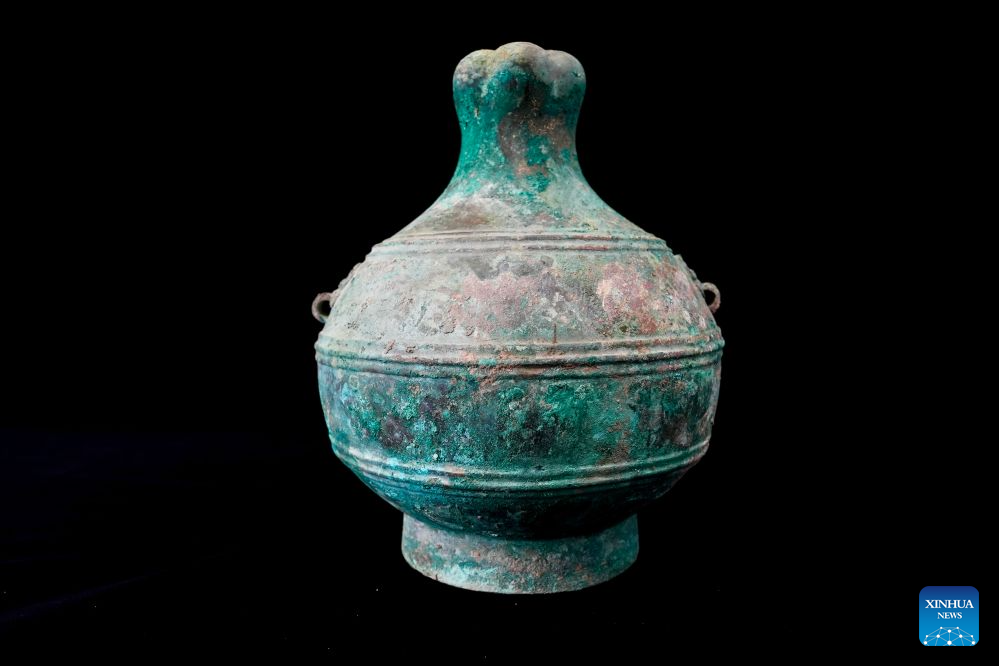
This photo taken on Aug. 5, 2026 shows a bronze garlic-head-shaped pot in Guyuan, northwest China's Ningxia Hui Autonomous Region. (Xinhua/Yang Zhisen)
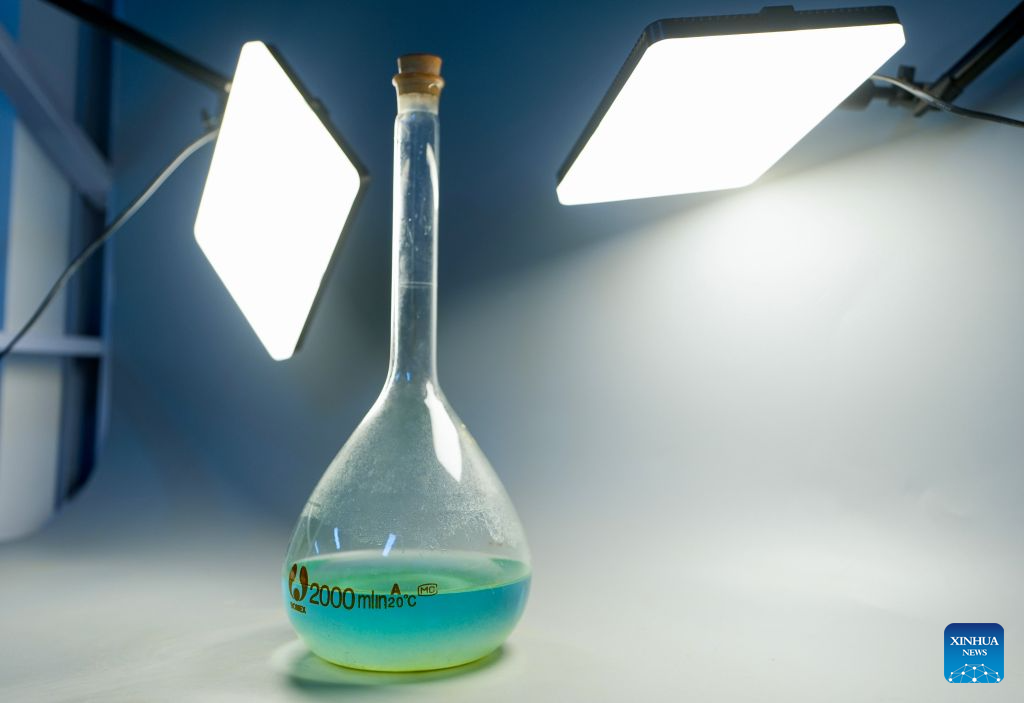
This photo taken on Aug. 10, 2026 shows a liquid sample collected from a bronze pot at the Ningxia Institute of Cultural Relics and Archaeology in Yinchuan, northwest China's Ningxia Hui Autonomous Region. (Xinhua/Yang Zhisen)
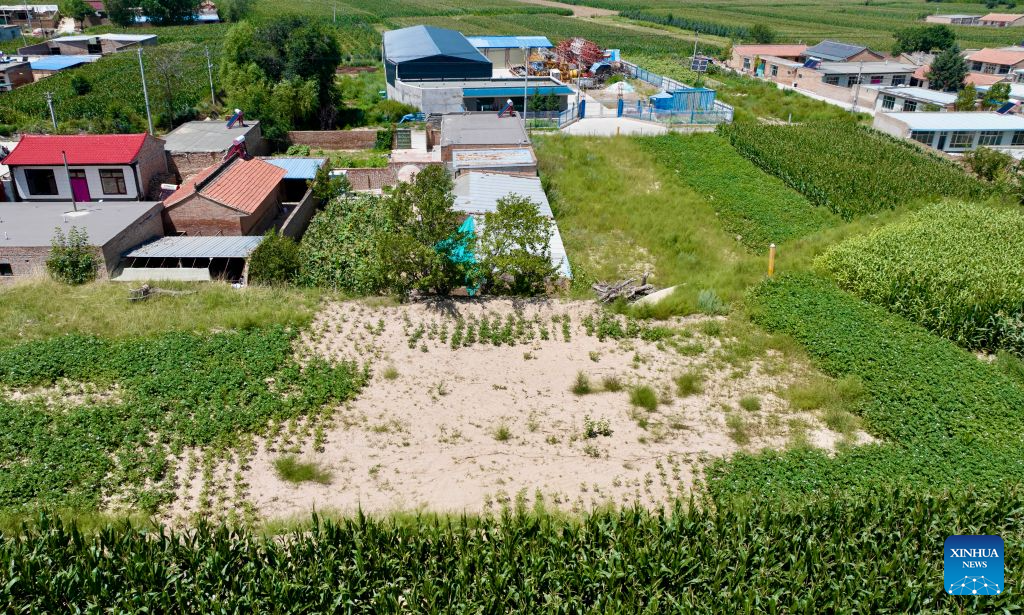
A drone photo shows an archaeological excavation site in Shanjiabu Village of Guyuan City, northwest China's Ningxia Hui Autonomous Region, Aug. 5, 2026. (Xinhua/Yang Zhisen)


