ULAN BATOR, Aug. 26 (Xinhua) -- A giant panda sculpture welcomes visitors to the "China Pavilion" at the ongoing 17th session of the Conference of the Parties to the United Nations Convention to Combat Desertification (UNCCD) in Ulan Bator, Mongolia's capital.
Inside, photographs, videos and exhibits tell a story that stretches far beyond the pavilion -- how China has been battling desertification at home and is now sharing that experience with countries facing similar challenges.
From restoring degraded grasslands to curbing desert expansion, China's experience is drawing growing international attention, while its technologies, expertise and approaches are finding applications across borders.
CHINA'S DESERTIFICATION BATTLE
One of the countries most severely affected by desertification, China has vast arid heartlands spanning the northwest, north, and northeast, leading Beijing to launch the "Three-North" Shelterbelt Forest Program in 1978 to curb the spread of deserts and restore degraded land.
Since the launch of the program, forest and grass coverage across project areas has reached 40.76 percent, and 67.82 percent of treatable sandy land has been brought under control.
Since 2021, China has restored over 15 million hectares of degraded grassland, and close to 81 million hectares of grassland have recovered through grazing bans and enclosure measures.
Moreover, China's desertification-control efforts in multiple regions have delivered both ecological benefits and tangible gains, including economic returns, for local people in recent years.
Since launching a critical-phase battle to advance the "Three-North" program in 2023, through work-for-relief programs, some 1.526 million farmers and herdsmen have secured jobs close to their homes. A total of 100 projects integrating ecological conservation and industrial development have been carried out. The total output value of forest and grass industries in project areas has exceeded 800 billion yuan (about 119.04 billion U.S. dollars).
Some 3,528 kilometers of desert-crossing highways have been built, bringing 6.8 million mu (about 453,333 hectares) of desert land under control and opening up roads for local farmers and herdsmen to pursue development and prosperity.
In just a few decades, China has evolved from a recipient of international green aid into a major global provider of land restoration expertise, becoming the world's first country to reverse land degradation and shrink its desert footprint.
"China is among the most successful nations in desertification control over the past four decades," said Mishal Al-Fawaz, director of the Environment Protection Directorate of Zarqa Governorate, Jordan, citing the "Three-North" Shelterbelt Forest Program.
Yasmine Fouad, the UNCCD executive secretary who visited China in July, said: "China has become one of the clearest large-scale examples of how land degradation can be reversed."

LESSONS FOR THE WORLD
Nasser Bouchiba, president of the Africa-China Cooperation Association for Development in Morocco, said China's achievements in desertification control reflect not only its technological innovation capacity, but also its governance philosophy of harmony between humanity and nature, balancing ecological protection with economic development.
"Our biggest source of confidence in desertification prevention and control comes from the people-centered philosophy. This approach constitutes our most fundamental advantage," said Jia Xiaoxia, deputy director of the desertification prevention and control department at China's National Forestry and Grassland Administration.
Jia said the advantage has three dimensions: sustained and stable funding to ensure uninterrupted restoration work, long-term holistic planning that enables consistent efforts across generations, and an integrated governance approach that takes into account mountains, rivers, forests, farmlands, lakes, grasslands and sand lands, rather than pursuing isolated, single-track measures.
"Jordan can draw lessons from China's experience in long-term planning, community participation, integrating environmental protection with economic development, leveraging technology and scientific research, and sustained government support," said Al-Fawaz.
"China's experience demonstrates that when restoration is integrated into broader development planning, environmental action becomes an investment in people and prosperity," Fouad said.
"As we move toward COP17, the priority is to translate practical experience like this into stronger cooperation, greater investment and faster implementation, because the scale of land degradation and drought today requires stronger and more coordinated action," she said ahead of the conference.
TAKING CHINA'S EXPERIENCE GLOBAL
Chinese expertise is empowering desertification-control work in many parts of the world. The country's international cooperation framework on desertification now covers policy and governance experience transfer, talent training and capacity-building, technical cooperation, scientific research innovation, and global governance, among others, said Jia.
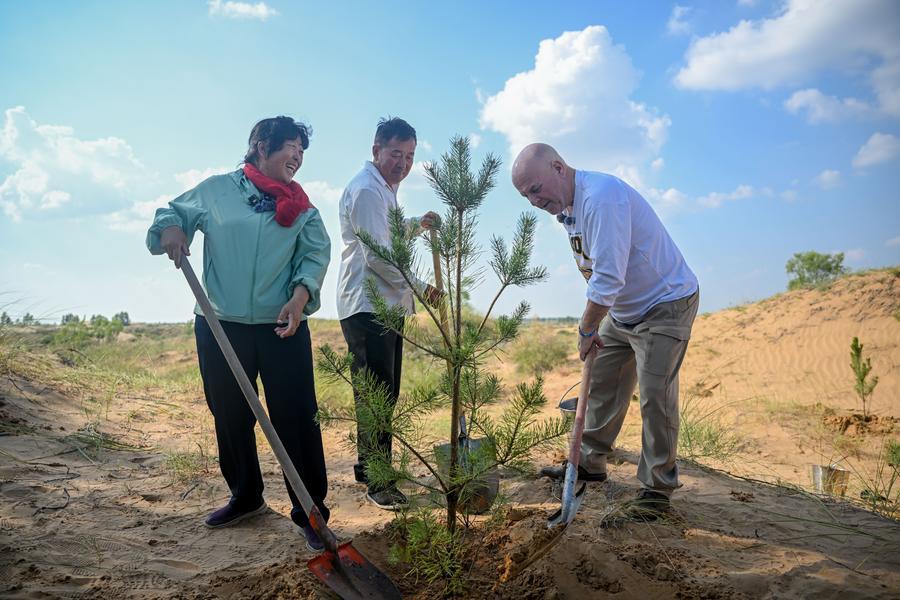
In Mongolia, China has established ecological restoration demonstration zones, shared practical techniques for planting trees and controlling sand, provided support for saplings, monitored sand and dust, and exchanged knowledge to enhance Mongolia's land rehabilitation efforts.
Meanwhile, China runs international workshops to train desert-control professionals for other nations. It has set up cooperation platforms for China-Arab, China-Mongolia and China-Central Asia anti-desertification work, as well as the Northeast Asia network on desertification, land degradation and drought.
In July, the UNCCD launched the Business for Land China Hub with the China National Sand Control and Desert Industry Society in Beijing, which will help mobilize Chinese enterprises to engage in global land restoration efforts and share China's desertification-control experience.
Sheradil Baktygulov, director of the Institute of World Politics of Kyrgyzstan, noted that China's desertification-control assistance is no empty rhetoric but delivers tangible outcomes.
Chinese technologies, including drip irrigation, irrigation channel water storage and tree cultivation, are spreading across Central Asia and help curb desert spread, said Baktygulov.■