
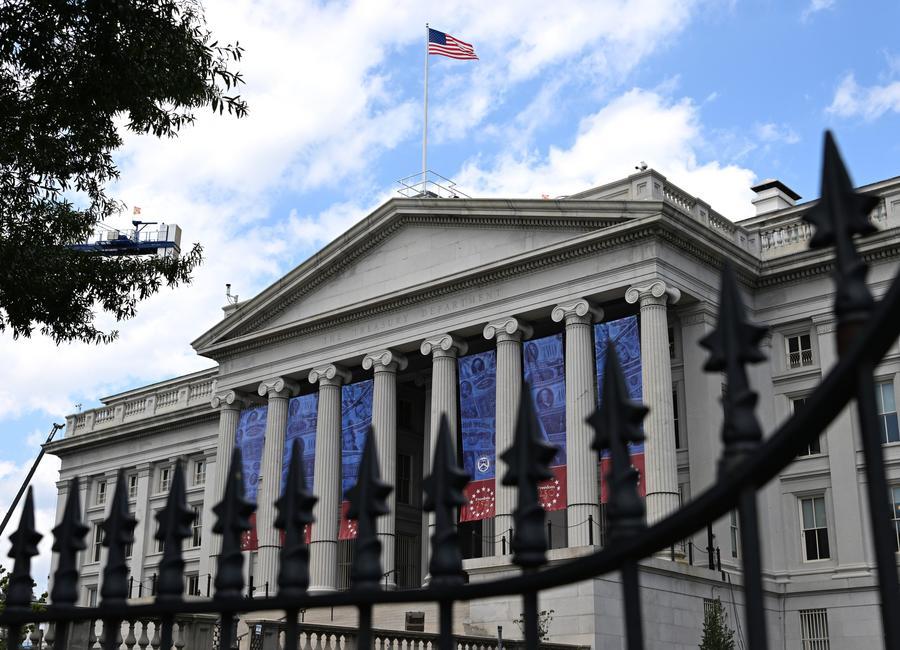
WASHINGTON/TEHRAN, Aug. 25 (Xinhua) -- U.S. Treasury Secretary Scott Bessent on Monday unveiled fresh sanctions on Iran and warned countries maintaining economic ties with Tehran of possible secondary sanctions.
The campaign amounts to an "Economic D-Day" targeting Iran's global financial links, designed to sever its economic lifelines and push the country toward "complete global isolation and a subsistence economy," according to Bessent.
The measures came amid a stalemate after the 60-day negotiating window under a U.S.-Iran memorandum of understanding signed in June expired without a final deal or an extension of the temporary ceasefire.
With diplomacy stalled, Washington is betting that renewed economic pressure can produce a different outcome. But can greater economic pressure force Tehran to make strategic concessions?
A BROADER SQUEEZE
In a press release issued on Monday, the U.S. Treasury Department said it had expanded the reach of potential secondary sanctions to five additional sectors -- digital assets, technology, gold, aviation and shipping -- which Washington says Iran relies on to sustain its economy.
It also sanctioned nearly 60 entities, individuals and vessels across several jurisdictions over their alleged links to Iran's nuclear and missile procurement, cyber operations and oil-revenue networks.
Bessent warned that countries maintaining business ties with Iran could ultimately be forced to choose between those ties and access to the dollar-based financial system, while refusing to identify potential targets or say when penalties might take effect.
"We are witnessing a shift from a policy of imposing sanctions on Iran to an attempt to target the network of economic relationships that allows Iran to remain within the global economy for as long as possible," Raad Al-Tal, a professor of economics at the University of Jordan, told Xinhua.
Iran has endured U.S. sanctions for decades. But Washington appears to believe that nearly six months of war and a naval blockade have changed the equation.
Richard Goldberg, who coordinated efforts to put diplomatic pressure on Iran during Trump's first term, said the combined pressure had created a "perfect storm for capitulation" that had not previously existed.
The economic push also offers Washington an alternative to immediate military escalation.
Bessent said Thursday the new U.S. policy of "maximum economic pressure" on Iran makes a "large-scale" war less likely.
Economics Professor Ying Chen at the New School for Social Research pointed to depleted munitions stockpiles and the approaching midterm elections as two commonly cited reasons for the timing.
"If military coercion can't be sustained, economic coercion becomes the natural fallback," she said.
WHAT PRESSURE CAN BUY
Analysts say a tougher squeeze on Iran's oil exports and financial channels could inflict significant economic damage.
Raad Al-Tal said tighter restrictions on oil exports could cut Iran's most important source of revenue. Combined with pressure on the currency, they could raise import costs and inflation, erode purchasing power and place further strain on households, the state budget and the broader economy.
Muawiya Al-Toum, a Sudanese expert in diplomacy and international relations, said sustained reductions in oil revenue and access to foreign currency could also constrain Tehran's ability to finance its military and security institutions.
But economic damage does not automatically translate into strategic concessions.
Abdulaziz Alshaabani, a Saudi researcher at Al Riyadh Center for Political and Strategic Studies, said that economic pressure could push Tehran toward negotiations.
Forcing Iran to abandon what it considers "core security interests," however, would be much harder and could be viewed as "strategic surrender rather than compromise," Alshaabani told Xinhua.
Jumaa Mohammed, a politics professor at Iraq's Tikrit University, also said that full dismantlement of Iran's nuclear infrastructure would be seen in Tehran as an "outright strategic defeat" that no Iranian leadership was likely to accept.
"Nuclear and military decisions aren't calculated purely in economic terms," he further explained, adding that ideological and existential considerations also carry substantial weight.
If Iran concludes that Washington's ultimate objective is to eliminate its ability to deter threats or exercise regional influence, Al-Toum said, it may consider enduring sanctions as less dangerous than accepting the proposed settlement.
"Whatever the cost of the American sanctions on Iran, this is an existential war for Iran," said Ezzat Saad, director of the Egyptian Council for Foreign Affairs.■