HOHHOT, Aug. 22 (Xinhua) -- North China's Inner Mongolia Autonomous Region is stepping up efforts to expand its green computing industry and explore new ways of taking AI services global, with fresh projects and initiatives unveiled Saturday.
A total of 12 projects with a planned investment of 186.46 billion yuan (about 27.49 billion U.S. dollars) were signed at the 2026 Green Computing Power (Artificial Intelligence) Conference in Hohhot, capital of Inner Mongolia.
The projects involve leading companies including Volcano Engine -- ByteDance's cloud service platform, Cambricon Technologies, and China Telecom, covering green intelligent computing centers, token factories, and computing-power and electricity equipment manufacturing.
Also at the conference, construction officially began on a comprehensive service platform for digital services going global in the Hohhot Area of the China (Inner Mongolia) Pilot Free Trade Zone.
The platform will connect overseas developers with China's AI models and green computing resources while helping domestic AI companies expand overseas. It offers services including compliance assessment, computing-power scheduling, token measurement, cross-border settlement and developer support.
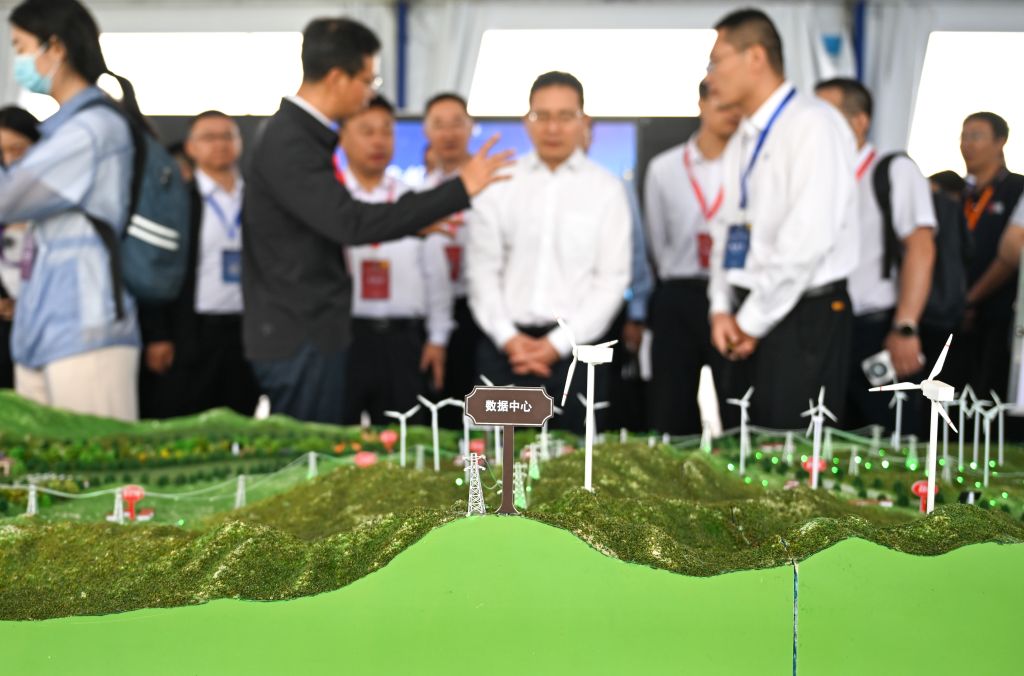
Inner Mongolia is leveraging its abundant wind and solar resources to build a large-scale green computing base. Horinger New Area in Hohhot has 62 computing centers with a total computing capacity of 150,000 PFlops, including 143,000 PFlops of intelligent computing capacity, according to local authorities.
PFlops (petaflops) is a unit used to measure computing speed for AI and data-intensive tasks, where 1 PFlop equals one quadrillion calculations per second.
In neighboring Ulanqab, operational computing capacity has reached 172,000 PFlops, with intelligent computing accounting for more than 95 percent.
The push comes as China's demand for AI computing continues to surge. Official data showed daily token calls in China rose from about 100 billion in early 2024 to 140 trillion in March 2026.
The new platform marks an effort to shift from exporting computing hardware and infrastructure to providing AI capabilities as digital services, linking China's green computing resources with the global AI market. ■