
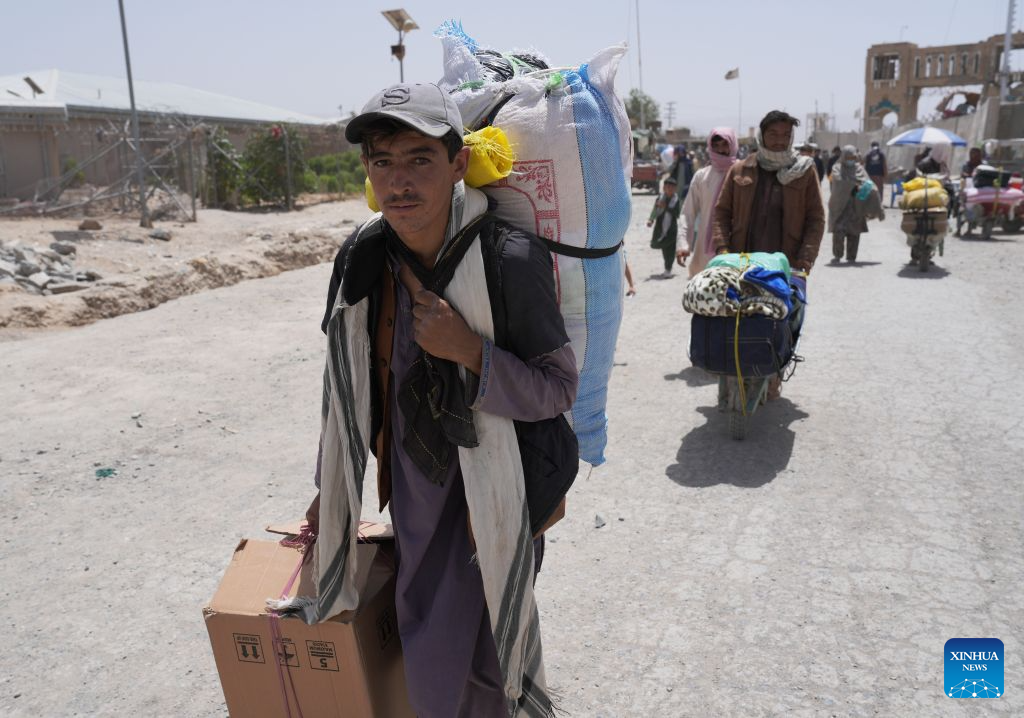
Afghan refugees are seen carrying their belongings at the Spin Boldak border crossing in Kandahar province, Afghanistan, Aug. 7, 2026. (Photo by Saifurahman Safi/Xinhua)
KABUL, Aug. 20 (Xinhua) -- With suitcases in hand and weary, anxious faces all around, passenger vehicles line up to collect travelers, while cargo trucks laden with imported and exported goods wait at Herat's Islam Qala border crossing, one of Afghanistan's key gateways, through which thousands of people and a substantial volume of trade with Iran pass each day.
Located around 120 kilometers from Herat city, Islam Qala is western Afghanistan's major land crossing with Iran. It serves as a vital commercial and transit artery, facilitating the daily movement of thousands of passengers and consignments of goods between the two countries.
Nazir Ahmad, a veteran money dealer who has worked at the Islam Qala crossing for more than 15 years and has closely observed the economic conditions and movement of people in the area, said the conflict between the United States and Iran has adversely affected trade and cross-border movement.
When there is a conflict between the United States and Iran, the flow of goods declines, the movement of people decreases, and this situation has a significant impact on people's lives, Ahmad told Xinhua.
According to Ahmad, since the conflict began, the prices of food commodities that were previously imported into Afghanistan in large quantities from Iran have risen, placing additional pressure on ordinary people.
"The prices of gas, fuel, rice and cooking oil have increased, and this has affected the prices of all goods. Earlier, a 16-liter container of cooking oil cost 1,200 afghanis (about 18.4 U.S. dollars); now it has risen to 1,600 afghanis," he said.
He describes the conflict as a destructive and undesirable phenomenon, noting that its consequences are not confined to the countries directly involved but also extend to neighboring states, which bear the economic and social repercussions.
Mowzan works at the Islam Qala border crossing, where he transports passengers' belongings and luggage. He said the closure of the Afghanistan-Pakistan border crossings has increased the volume of commercial trade at Islam Qala, yet the conflict between Iran and the United States has also harmed his livelihood and that of other workers at the border.
Like many other Afghans, he is calling for more manufacturing plants to be established and greater employment opportunities to be created, urging the authorities to expand access to jobs and livelihoods. "People need more work and employment opportunities."
Mawlawi Sayed Hazratullah Zaeem Agha, commissioner of the Islam Qala border crossing, said around 1,200 cargo trucks carrying commercial goods pass through the crossing each day, transporting Afghan exports to various destinations around the world and bringing imports into Afghanistan via Iran.
Speaking to a Xinhua correspondent near the border crossing, Zaeem Agha affirmed that cross-border movement of migrants is currently proceeding in full compliance with legal protocols.
Meanwhile, at the Spin Boldak border crossing in southern Afghanistan's Kandahar province, which has remained closed for several months amid escalating border tensions between Afghanistan and Pakistan, commercial activity has been severely disrupted.
The prolonged shutdown has left traders facing a sustained downturn and unsettled the livelihoods of local communities whose lives and incomes have long been closely intertwined with trade and cross-border movement at the crossing.
Fazal Mohammad Watan Dost, a trader at the Spin Boldak border crossing, said his business has been completely paralyzed for nearly 10 months. The continued closure has left large numbers of traders, shopkeepers, and laborers without work and inflicted severe economic losses on the local community.
"Since the crossing was closed, traders, particularly those dealing in fresh produce, have suffered substantial losses," Watan Dost told Xinhua while standing amidst the largely shuttered storefronts of the Spin Boldak bazaar.
According to him, the ongoing closure is costing traders millions of dollars in losses each day, with the economic fallout extending well beyond business owners to workers and families whose livelihoods depend on activity at the border. "Last year, between 50 and 60 people were working for me, but now all of them are unemployed," he said.
Watan Dost added that a major market in the area, which previously provided employment to more than 500 people, has also been forced to shut down following the closure of the border.
He urged authorities on both sides to take immediate steps to reopen the Spin Boldak crossing, warning that continued closure would inflict further losses on traders, businesses, workers, and residents. "Our appeal is for the border to be reopened." ■
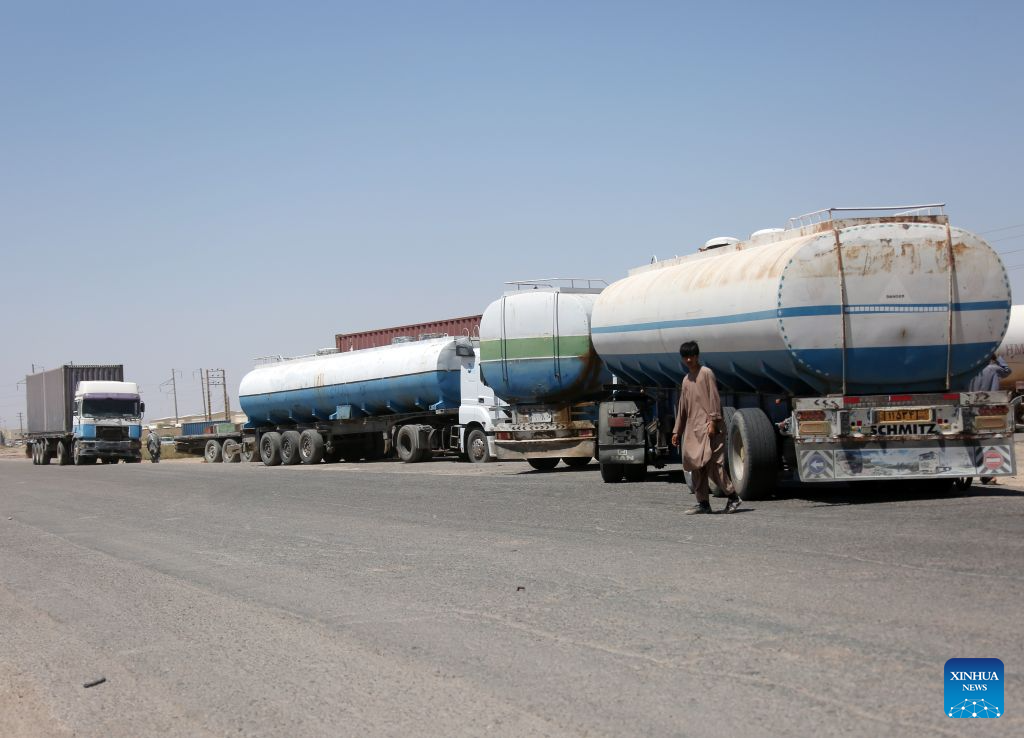
Commercial tanker trucks are seen at Herat's Islam Qala border crossing in Afghanistan, Aug. 10, 2026. (Photo by Saifurahman Safi/Xinhua)


