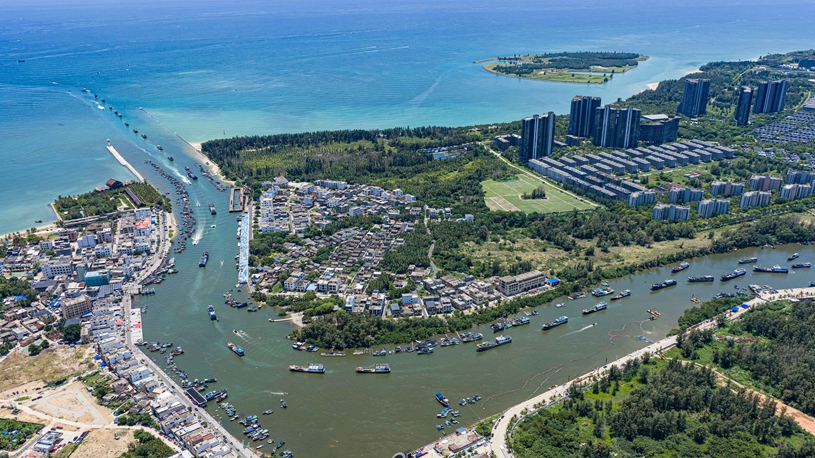
HAIKOU, Aug. 19 (Xinhua) -- When the tide retreats at Tanmen, people go after it.
During the fishing town's summer beachcombing season, visitors spread across the exposed shore. Locals call the activity ganhai -- literally, going out to "catch the sea." This year's festival features a beachcombing treasure hunt, a fishermen's market, a long seafood dinner and intangible cultural heritage performances, turning traditions of an old fishing community into experiences visitors can join.
A tourist surnamed Hu from east China's Jiangsu Province had been traveling with her family in Sanya when she heard about the festival and made a detour to Tanmen. "It was my first time watching the fishing fleet set out. It was spectacular," she said, adding that she planned to take her child ganhai and then visit the China (Hainan) Museum of the South China Sea.
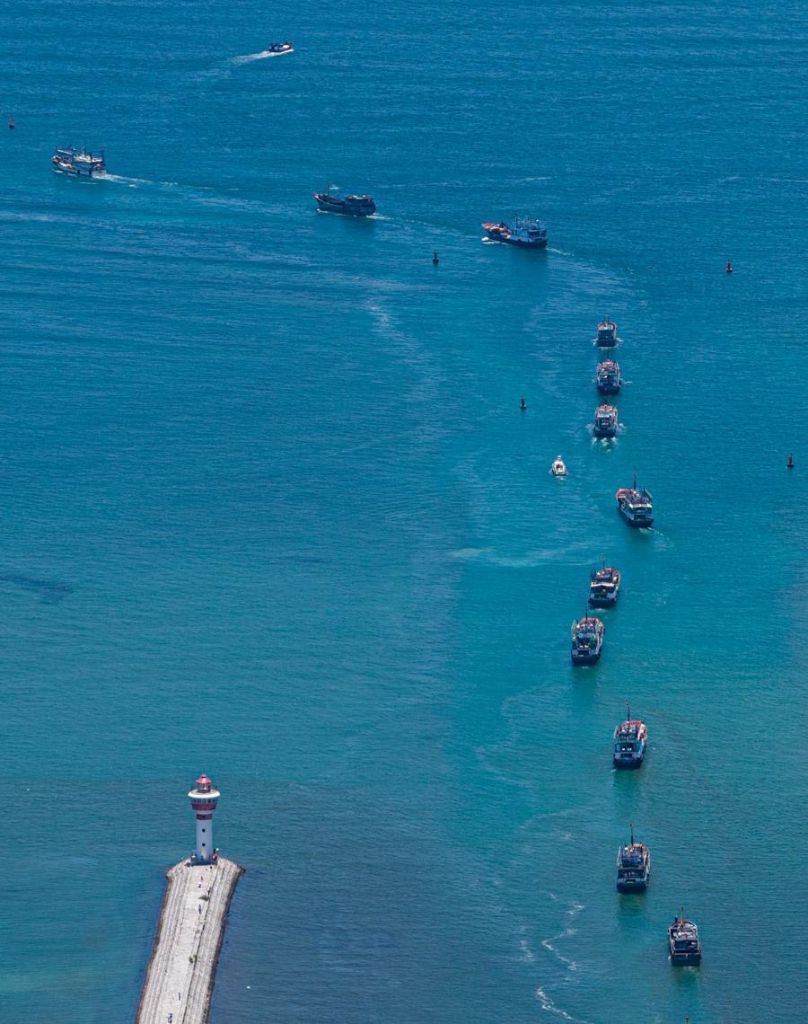
The fleet she came to see belongs to a much less leisurely world. Tanmen is home to 86 medium and large fishing vessels, most in the 400- to 500-tonne range. At noon on Aug. 16, when the summer fishing moratorium ended, firecrackers sounded over the harbor and hundreds of boats streamed toward the South China Sea.
For generations, fishing families preserved route knowledge in handwritten sailing manuals called Geng Lu Bu. The books recorded routes, island and reef features, positions and bearings; a geng was roughly 10 nautical miles. They turned hard-earned experience into a practical guide for long voyages.
For three and a half months each summer, however, much of the fishing stops. This year's summer moratorium in designated South China Sea waters ran from noon on May 1 to noon on Aug. 16.
Seasonal closures are also part of the region's fisheries-management toolkit. In its Thailand country profile, the Food and Agriculture Organization of the United Nations (FAO) describes area and seasonal closures in the Gulf of Thailand imposed mainly for the recovery of Indo-Pacific mackerel, with restrictions on trawlers and purse seiners during designated periods.
The larger boats' return to sea is only one part of Tanmen's fishing economy. Closer to shore, a recreational-fishing pier serves smaller leisure vessels.
This summer, tourists have flocked to Tanmen Port and nearby fishing villages for ganhai and waterside sightseeing. Visitors have also stopped in Paigang Village beside the harbor and visited the Geng Lu Bu museum, where sailing knowledge passed down through generations of fishermen is preserved.
The shift is also showing up in local livelihoods. More than 500 traditional fishermen in Tanmen have moved into leisure- and tourism-related work. More than 400 fishermen have formed five recreational-fishing cooperatives, and the town's recreational-fishery output value topped 100 million yuan in 2025.
Paigang Village now has 13 fishermen's homestays, along with businesses offering sea angling, snorkeling and beachcombing. At the harbor, a 310-meter wharf dedicated to recreational fishing can accommodate 19 leisure fishing boats at a time.
Li Zhi, Party chief of Tanmen Town, said the harbor upgrade is intended to serve both traditional fishing and the growing recreational sector, with leisure boats used for sightseeing and sea angling.
The result is a waterfront where commercial fishing and recreational activities increasingly sit side by side, widening the ways local residents make a living from the sea.
Fishing life also reaches shore through food and ritual. Tanmen's catches include Spanish mackerel, grouper, squid, sea cucumber and conch. This year's beachcombing season -- the town's 12th -- brings local traditions together with performances ranging from Hainan's carp-lantern performance to 24 Festive Drums, Indonesian folk songs and Thai finger dancing.
Before long voyages, another tradition comes into view: a ceremony honoring the Xiongdi Gong, also known as the "108 Brothers." Dating back to the Ming Dynasty, the ritual was traditionally performed by Hainan fishermen before long-distance fishing and trading voyages in the South China Sea.
It was included in the fifth batch of China's national list of representative items of intangible cultural heritage in 2021. The official heritage record says its community of practitioners later expanded beyond fishermen to include Hainanese living in Southeast Asia and elsewhere around the world.
Tanmen's changes reflect broader stakes for fishing communities across the region. The FAO says small-scale fisheries support the livelihoods of about 46 million people in Asia and contribute nearly half of the region's total fish catch. It also highlights their importance to food and nutrition security, cultural heritage, biodiversity conservation and climate resilience.
Hainan itself is opening wider. This is the island's first summer since the Hainan Free Trade Port began island-wide special customs operations on Dec. 18, 2025. In the first half of 2026, Hainan recorded 1.603 million inbound and outbound passenger trips, including 883,000 by foreign nationals.
Local officials say foreign guests visiting nearby Boao for the Boao Forum for Asia Annual Conference also make their way to Tanmen, where volunteers provide foreign-language services at major visitor sites during the forum.
Inside Tanmen's Geng Lu Bu museum, handwritten manuals preserve old sailing knowledge. Outside, commercial boats leave for fishing grounds, families head to the shore for ganhai, and smaller boats take visitors out with rods. The water is the same; there are simply more ways now to know it -- and to make a living from it. ■