* China-Africa medical cooperation saves lives while building local medical capacity.
* Six decades of cooperation have fostered deep trust between Chinese doctors and African communities.
by Xinhua writers Chen Chen, Hua Hongli, Liu Jie
NAIROBI, Aug. 19 (Xinhua) -- For three years, Seif Amour Rajab could barely open his mouth.
Seif was 16 when he fell from a mango tree and fractured his jaw. On Tanzania's remote Pemba Island, the hospital could do little. The jaw slowly locked shut; eating became a struggle, then speech. The once-active teenager withdrew into silence.
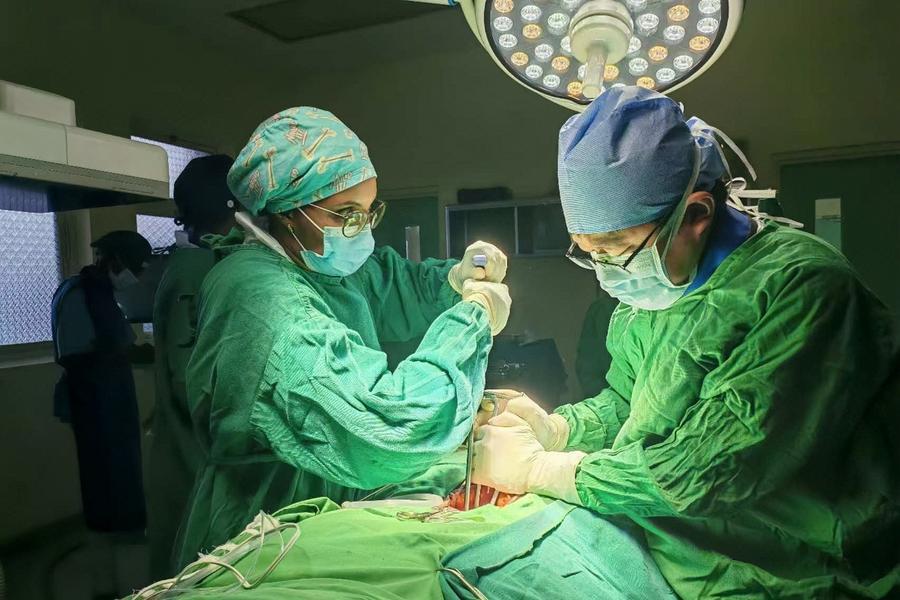
It was not until last December, after a four-hour operation by Chinese doctors, that Seif could finally open his mouth and speak with ease again. "Thank you, Chinese doctors!" he said.
The surgeons who treated Seif belong to a mission now in its seventh decade. Since China sent its first medical team abroad in 1963, to Algeria, some 30,000 Chinese medical workers have served in 76 countries and regions, treating about 290 million patients, most of them in Africa.
The cooperation is still expanding. Under the Forum on China-Africa Cooperation Beijing Action Plan (2025-2027), China plans to send 2,000 medical personnel and public health experts to Africa, build joint medical and traditional medicine centers, and support the development of the Africa Center for Disease Control and Prevention headquarters and its sub-regional centers.
LIVES PULLED BACK
Last January, five children aged three to seven underwent congenital heart surgery at the Chinese-built Jakaya Kikwete Cardiac Institute in Dar es Salaam, Tanzania. The operations used a minimally invasive technique pioneered by Chinese doctors, avoiding open-heart surgery or radiation.
When Husna Shabaan Kingwande learned that the operation on her three-year-old son, Ikram, had succeeded, the young mother wept for joy.
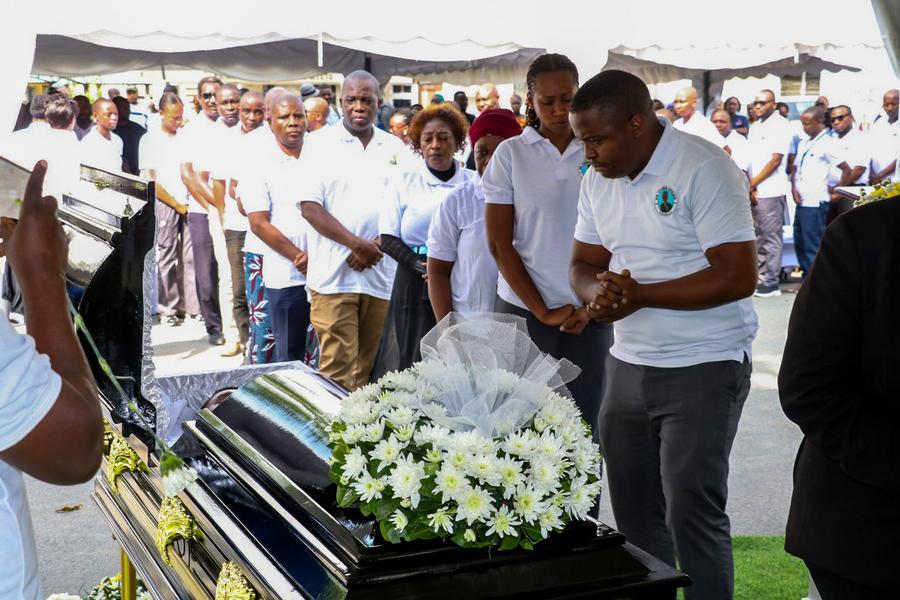
In June that year, the team behind those operations, the 27th Chinese medical team in Tanzania, lost its leader. Anesthesiologist Zhang Junqiao saw a woman drowning off a beach in Dar es Salaam and plunged in without hesitation. He held her above the water and gave her his own life jacket. She made it to safety. Zhang never made it back to shore.
In the six decades of the program, more than 50 members of China's medical teams abroad have, like Zhang, died far from their homeland.
Half a century ago, Mei Gengnian, who led China's first medical team to Ethiopia, was killed in a road accident on his way back from a disaster-relief mission. In the Ethiopian city of Jimma, one family has tended his grave for two generations. Mei's son later joined the Ethiopian teams himself.
SKILLS LEFT BEHIND
Chinese doctors treat patients -- and teach local doctors to treat them. Since 1963, Chinese medical teams have trained more than 100,000 local health workers.
One evening last November, a two-year-old boy was rushed to Abdulla Mzee Hospital on Pemba Island after swallowing a coin more than 48 hours earlier.
Such emergencies once meant a transfer off the island, or a wait for visiting specialists. That evening, local doctor Harun Maisara Mahkum extracted the coin himself for the first time, guided by He Zhilong, an otolaryngologist from the 35th Chinese medical team.
"I was nervous," Mahkum recalled. "But Doctor He trusted me to lead."
Mahkum, now 30, has worked alongside Chinese medical teams for eight years. "Before the Chinese doctors came, we could not perform surgeries like this on our own. We depended on outside specialists," he said. "Now, I can act immediately in emergencies. It is empowering, and it changes the way we serve our community."
In Dar es Salaam, a training session on the technology behind Ikram's heart operation drew about 50 Tanzanian cardiologists. In a country where roughly one in 100 newborns has a congenital heart defect, this is a lifesaving technology, Tanzanian pediatrician Theophylly Ludovick said.
Such teaching now reaches across the continent. On July 27, the China-Africa partnership on minimally invasive medicine was launched in Addis Ababa, where Ethiopian centers for robot-assisted surgery training and for laparoscopic techniques were inaugurated.
"These two training centers are only a starting point," said Liu Longfei, vice president of Xiangya Hospital of Central South University, which leads the program.
HEARTS DRAWN TOGETHER
Over decades of working side by side, trust has grown between the medical teams and the communities.
In Afanoya, a village outside Cameroon's capital Yaounde, Marceline Mbo and her two children were already seated outside the health center by six in the morning. She had come to a free clinic run by the Chinese medical team -- for her toothache and eye problem, and for her children's malaria. By sunrise, the line behind her had grown long.
It was one of nearly 200 free clinics Chinese medical teams have held in Cameroon since 1975. Over 50 years, 24 teams have treated more than 3.3 million patients there.
For some, the care has meant a life restored. Liliane Mfoumou, 72, had suffered back pain for years until a Chinese acupuncturist treated her during a village visit. "Today, I go to the farm regularly and do other activities. I feel no pain," she said.
In Dakar, Senegal, members of the 21st Chinese medical team spent a day off at an orphanage, where a classroom became a clinic. There, 84 children aged 2 to 14 moved between specialists, and each left with a health file of their own.
"The consultation today is not the end," said team head Lan Jinkai. "We will continue to follow the children's health conditions."
"This helps us know whether the children have health problems that we may not have been aware of," said Fatou Ba, a staff member at the orphanage.
Chinese and African hospitals have formed dozens of pairing partnerships and jointly built more than 20 key specialty centers, while free-clinic campaigns such as "Bright Journey" for cataracts have benefited hundreds of thousands of patients.
"China does not simply give; it shares. It does not dictate; it proposes. It does not impose itself; it cooperates," said Cameroonian Health Minister Manaouda Malachie.
Seif, now 20, has found his confidence again. "He is talented in playing football, which he now enjoys again," his guardian Mohamed said with relief, watching him race across the pitch.
(Video reporters: Bao Jiayi, Hua Hongli, Lin Guangyao, Liu Jie, Dai he, You Huiyuan, Chen Chen, Wang Ze, Si Yuan, Zhang Jian; Video editors: Yang Zeyi, Zhu Cong, Hong Yan, Wang Han)■