BEIJING, Aug. 19 (Xinhua) -- Instead of simply directing visitors to a store, a shopping mall sign may be able to detect crowds, warn of potential stampedes, recognize pets, and even adjust its lighting as conditions change.
Such a vision came from an AI-powered guide sign designed by Qin Zi'ang and Wang Hansen, two eighth-graders from east China's Jiangsu Province. The pair made it to the finals of a national youth artificial intelligence innovation challenge, held over the weekend in Wuzhen, a water town in neighboring Zhejiang Province.
Using off-the-shelf sensors and AI hardware, the students are turning a familiar piece of mall infrastructure into something that can respond to its surroundings and help make commercial spaces both safer and smarter.
"What fascinates me about AI is its ability to make the invisible visible," Qin said. "When we first learned to code, we were essentially telling computers what to do, step by step. With AI, we are beginning to teach computers how to learn for themselves."
Wang and Qin were among nearly 8,000 young contestants from across China who took part in the finals, held both online and offline. Roughly 170,000 students signed up for the competition nationwide, according to the organizers.
The figures offer one measure of how quickly AI has made its way into youth competitions in China, as contests proliferate from the national level to local events.
The boom comes amid a broader surge in AI development in China. Developers at companies including DeepSeek, Zhipu AI and Moonshot AI are building increasingly capable and accessible language models, helping bring the technology into a growing range of real-world applications.
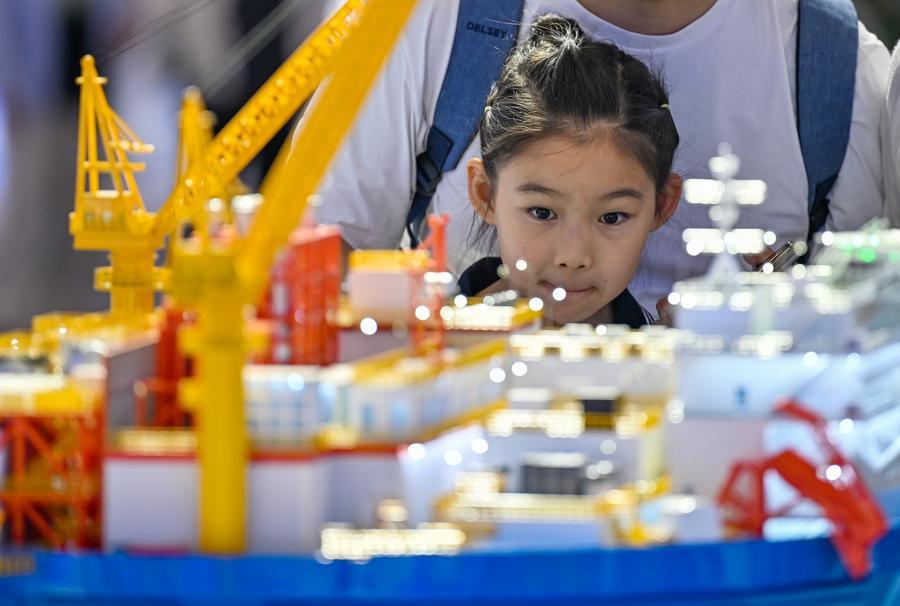
ASPIRATIONS FOR TECHNOLOGY
The enthusiasm did not start with AI. The experience of falling behind in the world's Industrial Revolution, as well as the humiliations and upheavals that followed, helped foster a strong emphasis on science and technology in Chinese society.
A popular saying decades ago captured the sentiment: "Master math, physics and chemistry, and you can make your way anywhere in the world." When computers and the internet transformed everyday life in the 1980s, another slogan took hold: "The popularization of computers should start with children."
Bill Gates and Steve Jobs were household names in China. More recently, Mark Zuckerberg and Elon Musk have joined them, with their careers offering a glimpse of the possibilities that technology can bring.
Over the past decade, programming has increasingly joined mathematics and English in the early-education landscape, alongside sports, art, music and dance -- activities that many families see as part of a well-rounded education.
At tutoring centers in shopping malls and neighborhoods across China, children move from hands-on building with LEGO kits to basic robotics and visual programming, using platforms such as Scratch to create games and animations. Some parents go a step further, hiring private tutors to teach older children Python.
Wang, who helped develop the smart shopping mall guide system, started with Scratch in second grade, moved to Python in fifth grade and took on C++ in middle school.
China had roughly 100 million students in primary schools, 55 million in junior high and more than 30 million in senior high in 2025, according to the National Bureau of Statistics.
Together, different layers of training form a well-developed pipeline, running from after-school coding clubs and robotics classes to school-based programs and competitions in programming and robotics.
At the top end, the strongest performers in informatics Olympiads may gain admission to elite universities such as Tsinghua University and Peking University without taking the national college entrance exam.
When the generative-AI boom came, children who had spent years learning to code or build robots suddenly felt AI was close at hand. It was something being built by people not much older than themselves, rather than another technology imported from distant Silicon Valley.
Liang Wenfeng of DeepSeek and Yang Zhilin of Moonshot AI, along with Wang Xingxing of Unitree Robotics, have become new role models for technology.
During the 2026 summer vacation, AI-themed study tours are gaining ground on the English-language and military-themed camps that once dominated the market, with bookings up 370 percent year on year, according to online travel platform Ctrip.
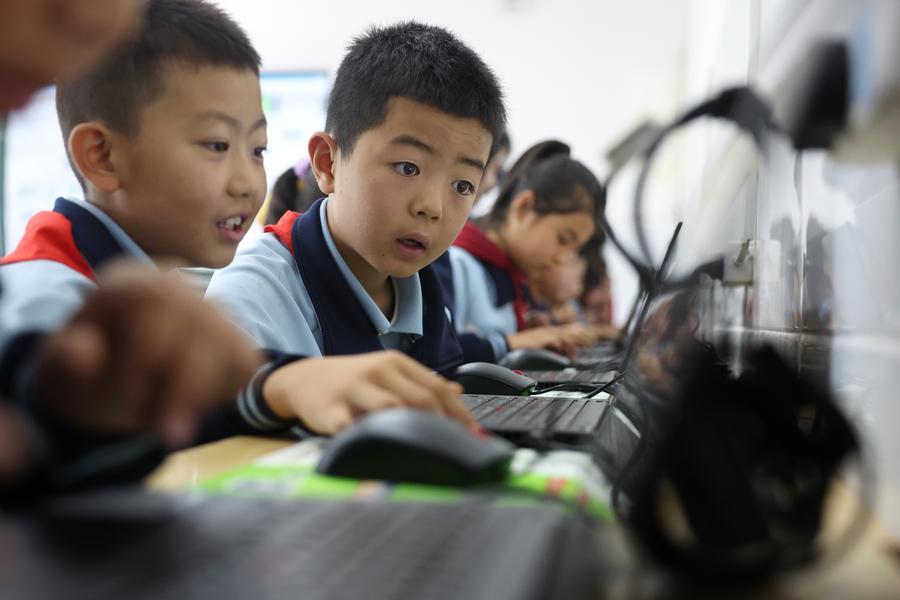
FROM AFTER-SCHOOL TO CLASSROOM
The story does not end with after-school clubs and competitions, though. An action plan released in April calls for AI courses to be introduced across all levels of education, from primary schools to universities.
The aim is to prepare children for the society they will grow up in, said Xiong Zhang, a computer science professor at Beihang University who heads an expert panel responsible for developing information technology curriculum standards for compulsory education.
"If they are to adapt to the future, they need to start learning about AI, understanding it and learning how to work with it from an early age," he said.
This idea is not unique to China. Fei-Fei Li, a Stanford professor often dubbed the "Godmother of AI," has stressed the importance of public AI education. She has likened the skill of asking AI the right questions to Socrates' method of seeking truth through questioning, arguing that the quality of the questions can shape the quality of the answers.
Some parts of China have already moved ahead. Schools in Beijing, for example, began offering general AI education from primary through senior high in the fall semester of 2025.
As in many countries in Europe and North America, however, AI is evolving so quickly that schools vary in teacher expertise, curriculum development and access to computing infrastructure and other hardware.
China is therefore encouraging schools to take an interdisciplinary approach -- one that makes particular sense given that AI draws on fields including mathematics, linguistics, psychology and biology.
"This is both a practical way to get AI literacy education off the ground and an important foundation for deepening it in the years ahead," said Guan Bo, a researcher at a center studying the digital transformation of education in south China's Guangxi Zhuang Autonomous Region.
The approach evolves as students grow older. For younger children, a national guide released in 2025 calls for games and hands-on activities. By junior high school, students are encouraged to connect AI with their regular subjects -- building, for example, a small autonomous vehicle in physics and learning how sensors and controllers turn perception into action.
By senior high, AI education becomes more research-oriented, with students tackling projects that require them to identify problems, design and test solutions, and present their findings.
That approach is already visible in the competitions. At the AI-agent contest in Wuzhen, Shi Jiaxing, an 11th-grader from southwest China's Sichuan Province, presented a system designed to spot signs of emotional distress in young people and provide online mental health support.
The system uses multiple AI agents and safety guardrails to reduce the risk of hallucinations. A lightweight training method allows it to run on basic devices, potentially making AI-powered mental health support more accessible to adolescents in rural areas.
iResearch, a research and consulting firm focused on China's new economy, estimated in February that spending on informationization and digital transformation of education in China reached 551.5 billion yuan (around 81.3 billion U.S. dollars) in 2025.
Some experts, however, warn against another extreme: allowing students to outsource memorization, calculation, reading, writing and basic reasoning to AI while retaining little more than "creativity" and "judgment."
Xiao Yanghua, a professor at Fudan University's College of Computer Science and Artificial Intelligence, said this is another pitfall that education reform must guard against.
"Without a solid foundation in core cognition, it is difficult to develop reliable higher-order thinking," Xiao said. "Students without a well-structured body of knowledge may not be able to recognize where AI has gone wrong."
In a document released last year on the use of generative AI in primary and secondary education, China outlined typical use cases and warned against students simply copying AI-generated content in their schoolwork or relying too heavily on generative AI for assignments that call for creative or personal expression.
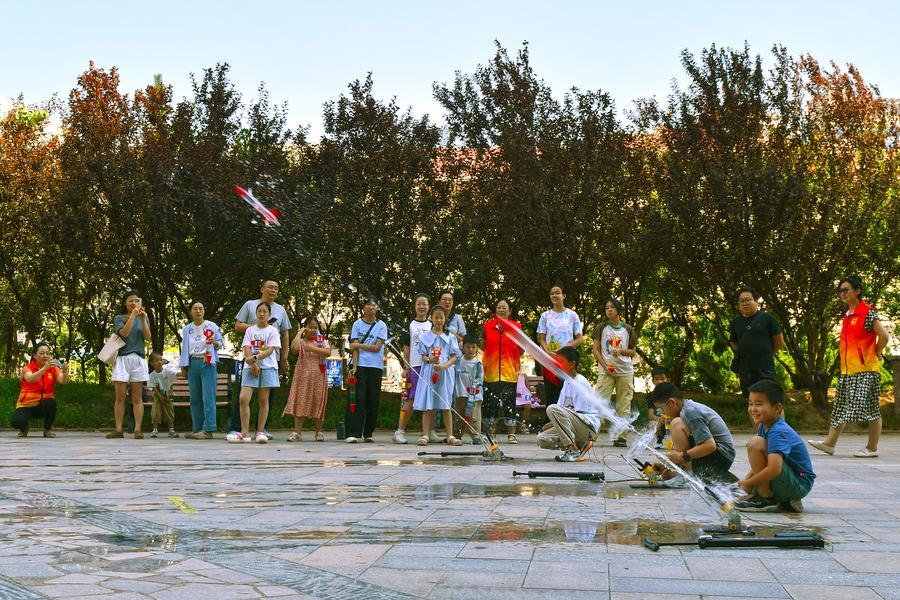
SCIENCE CLASS REBUILT
In the meantime, China is not framing AI as something that should crowd out everything else in a child's education.
In its education planning through 2030, the country continues to prioritize character development and students' well-being, including a health-first approach to schooling. AI education is seen as part of a broader effort to develop students' abilities and skills, rather than as an end in itself.
In fact, AI's growing role in knowledge production is prompting a broader rethink of how science should be taught in China.
This autumn, schools nationwide will launch an initiative called "learning through doing," which experts say could reshape science classes in China's compulsory education system.
Students in grades 4 through 9 will be required to complete at least one inquiry-based, hands-on project each semester, with each project spanning at least four class periods.
"Trial and error is at the heart of science," said Fang Yu, a chemist and an academician at the Chinese Academy of Sciences.
In the age of AI, when information is increasingly easy to access and standard answers can be generated in an instant, science education, he said, can no longer center on memorizing facts and following prescribed procedures. It must return to the fundamentals: asking questions, learning from failure and exploring what is not yet known.
Consider a familiar classroom experiment: producing carbon dioxide. Traditionally, Chinese students might follow a prescribed sequence of steps toward a predetermined conclusion.
Under the new approach, they might test different combinations of acid concentrations and carbonate amounts, observe how gas output changes, troubleshoot leaks in the apparatus and work out why their results differ.
"The shift goes beyond teaching methods. It points to a fundamental change in what education is meant to cultivate," Fang said. ■