
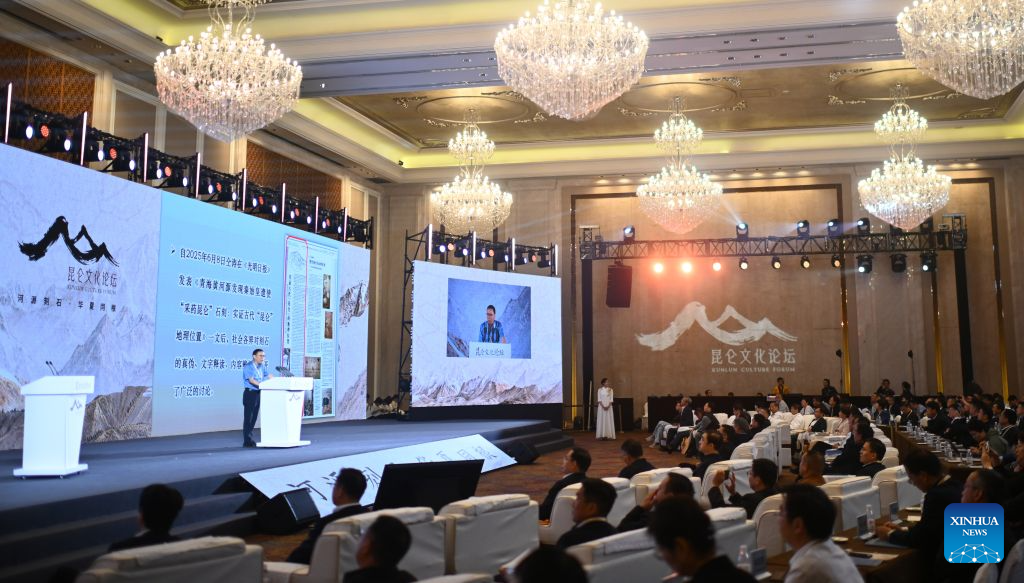
This photo taken on Aug. 19, 2026 shows a view of the Kunlun Culture Forum held in Xining, northwest China's Qinghai Province. A forum exploring the preservation and promotion of Kunlun culture, centering around a celestial peak in the shared mythology and collective memories of various Chinese ethnic groups, took place Wednesday in northwest China's Qinghai Province. The Kunlun Culture Forum, being hosted in Xining, capital of Qinghai, is dedicated to exploring the historical roots, spiritual connotations and contemporary relevance of Kunlun culture. (Xinhua/Zhang Hongxiang)
XINING, Aug. 19 (Xinhua) -- A forum exploring the preservation and promotion of Kunlun culture, centering around a celestial peak in the shared mythology and collective memories of various Chinese ethnic groups, took place Wednesday in northwest China's Qinghai Province.
The Kunlun Culture Forum, being hosted in Xining, capital of Qinghai, is dedicated to exploring the historical roots, spiritual connotations and contemporary relevance of Kunlun culture.
During the forum, the Chinese and English versions of a think tank report examining the historical origins, spiritual essence, and contemporary value of Kunlun culture were released.
The report, compiled by the National High-Level Think Tank of Xinhua News Agency, describes Kunlun culture as an important origin of Chinese civilization and a vital spiritual emblem of the Chinese nation. It said the culture offers both theoretical and practical guidance for carrying forward fine traditional Chinese culture, forging a strong sense of community for the Chinese nation, and advancing exchanges and mutual learning among civilizations.
Stretching over 2,500 km across western China with an average elevation surpassing 5,000 meters, the towering Kunlun Mountains have long been revered as "the ancestor of all mountains and the source of all waters."
In Chinese mythology, Kunlun is a sacred peak where the Queen Mother of the West resides and where the Yellow Emperor, the cultural progenitor of the Chinese nation, built palaces to inaugurate the civilization of ritual and music, according to the report.
At least 20 ethnic groups, including the Qiang, Yi and Jingpo, trace their ancestry to the foot of the Kunlun Mountains. Since modern times, Kunlun has been a spiritual homeland for the Chinese, often eulogized to invigorate the national spirit in times of national peril.
Zhao Zongfu, former president of the Qinghai Academy of Social Sciences, said that Kunlun culture transcends geographical, ethnic, and linguistic boundaries to become a shared cultural bond and spiritual homeland for the Chinese nation.
Such broad cultural recognition has strengthened the cohesion and solidarity of the Chinese nation, added Zhao, an advisory expert for the think tank report project.
Hu Yu, a professor at Tsinghua University's School of Journalism and Communication, noted that Kunlun culture carries the shared historical memory of multiple ethnic groups across regions and eras, embodying both the ancient cosmological wisdom of early ancestors and the emotional bonds and historical and cultural roots shared by various ethnic groups.
The report also noted that the Kunlun Mountains, which stretch across the hinterland of the Eurasian continent, have been a natural hub connecting East and West. A millennium before the Silk Road took shape, the Jade Road, formed through the circulation of Kunlun jade, facilitated both internal cultural integration within China and early civilizational exchange across Eurasia.
Wu Xinhua, a researcher at the Chinese Academy of Social Sciences, said Kunlun culture played the role of a bridge for civilizational exchange historically.
The wisdom it embodies -- "harmony within diversity" and "openness and inclusiveness" -- provides important historical references and intellectual resources for promoting inter-civilizational dialogue for mutual learning and advocating peaceful development today, Wu added.
The event was co-hosted by the publicity department of the Qinghai Provincial Committee of the Communist Party of China and the Qinghai Branch of Xinhua News Agency.
The forum is expected to serve as a new starting point to work with experts and scholars to better interpret the meaning and value of Kunlun culture and to better tell the stories of Kunlun in the new era, said Luo Dongchuan, governor of Qinghai Province.
Liu Jian, vice president of Xinhua, said the news agency will continue to deepen think tank research, strengthen communication empowerment, and build exchange platforms to contribute to the inheritance and development of Kunlun culture and the modernization of Qinghai. ■
China think tank releases report on Kunlun culture


