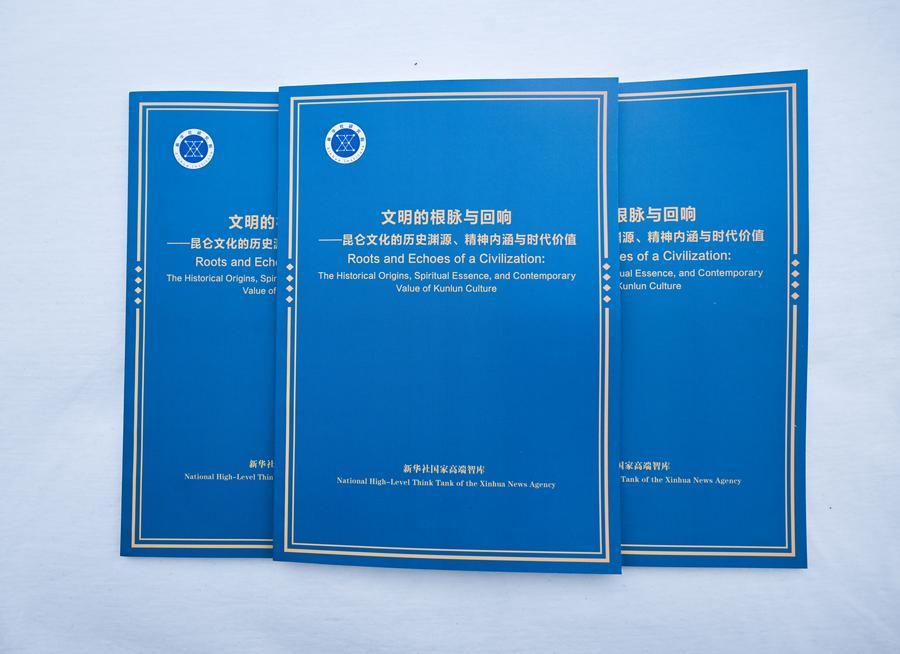
XINING, Aug. 19 (Xinhua) -- A think tank affiliated with Xinhua News Agency released on Wednesday a report examining the historical origins, spiritual essence, and contemporary value of Kunlun culture.
The National High-Level Think Tank of the Xinhua News Agency unveiled the Chinese and English versions of the report at the Kunlun Culture Forum in Xining, capital of northwest China's Qinghai Province.
The report describes Kunlun culture as an important origin of Chinese civilization and a vital spiritual emblem of the Chinese nation. It said the culture offers both theoretical and practical guidance for carrying forward fine traditional Chinese culture, forging a strong sense of community for the Chinese nation, and advancing exchanges and mutual learning among civilizations.
Stretching over 2,500 km across western China with an average elevation surpassing 5,000 meters, the towering Kunlun Mountains have long been revered as "the ancestor of all mountains and the source of all waters."
Drawing on archaeological evidence and historical records, the report said Kunlun culture carries the historical memory of shared origins and symbiosis among ethnic groups in three dimensions: the cosmic cognition of early Chinese people, the spiritual homeland of the Chinese nation, and the territorial symbol of ancient China. It also confirmed the unity in diversity and inclusiveness of Chinese civilization.
The report summarizes five core values of Kunlun culture: harmony between man and nature, great unity, vigorous self-improvement, cherishing life and caring for the people, and all under heaven as one family.
Rooted in millennia of cultural inheritance and ethnic integration, these values have shaped the cosmological view, the state view, the ethos of great resolve and perseverance, the people-centered view, and the worldview of Chinese civilization.
In the new era, Kunlun culture has undergone creative transformation and innovative development.
Local regions have tapped into Kunlun cultural resources and made coordinated efforts to advance cultural inheritance, ethnic unity, ecological conservation and industrial development, said the report.
Through initiatives such as themed study tours, folk performances, and integrated cultural and tourism development, the regions are achieving cultural inheritance, the continuity of national ethos, and the improvement of people's incomes and well-being.
"Exploring the wisdom embedded in Kunlun culture can provide a temperate yet profound Chinese approach to dissolving antagonism among civilizations and resolving development dilemmas," the report noted.
It added that the concepts of "harmony between man and nature" and "all under heaven as one family" in Kunlun culture offer precious oriental wisdom for resolving ecological challenges, civilizational estrangement, and geopolitical antagonism, and for advancing the building of a community with a shared future for humanity.
In Chinese mythology, Kunlun is a sacred peak where the Queen Mother of the West resides and where the Yellow Emperor, the cultural progenitor of the Chinese nation, built palaces to inaugurate the civilization of ritual and music.
At least nearly 20 ethnic groups, including the Qiang, Yi, Jingpo and Pumi, trace their ancestry to the foot of the Kunlun Mountains. Since modern times, Kunlun has been a spiritual homeland for the Chinese, often eulogized to invigorate the national spirit in times of national peril. ■