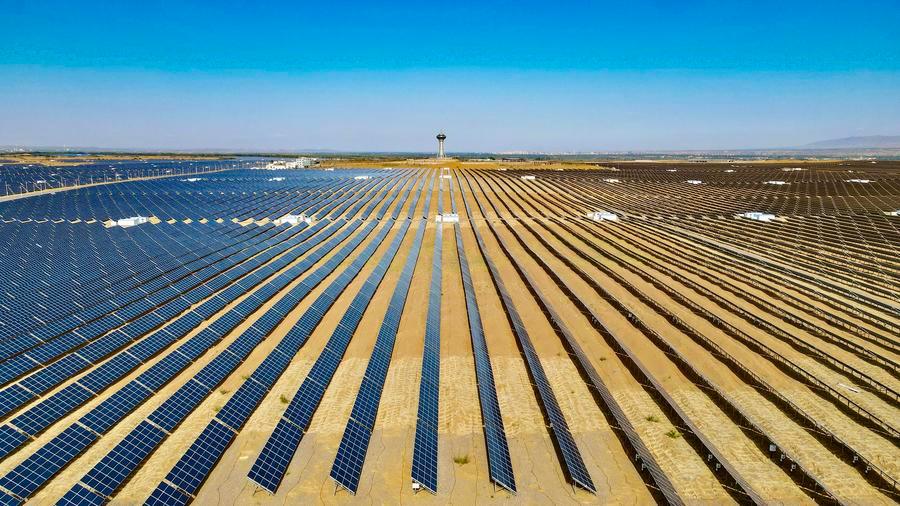
* The solar farm in renewable-energy-rich Ningxia is one of China's earliest projects to supply green power directly to data centers. About 40 kilometers south, a 1.5-gigawatt wind farm is under construction and is scheduled to be connected to the grid in September. The wind power will complement solar generation at night, helping supply data centers with green power around the clock.
* The move comes as China seeks to bring its growing computing capacity closer to the renewable energy resources needed to power it.
* Zhongwei's growth as a computing hub is closely tied to China's strategy of shifting computing workloads westward, where renewable energy and land are more abundant. Launched in 2022, the "East Data, West Computing" project designated Ningxia as one of China's eight national computing hubs, with Zhongwei being home to one of 10 national data center clusters.
YINCHUAN, Aug. 18 (Xinhua) -- As the sun beats down on the edge of the Tengger Desert on a summer day, rows of photovoltaic panels stretch across the dunes, turning intense desert light into electricity.
Nearby, the steady hum of servers fills a data center run by telecom giant China Mobile in the city of Zhongwei, northwest China's Ningxia Hui Autonomous Region. In May, one of the center's data facilities began receiving electricity directly from the solar power station, powering computing capacity for AI model training, inference and other applications.
Green power now accounts for over 80 percent of the electricity consumed by the facility, according to Zhang Xu, a computing operation and maintenance engineer at China Mobile's Ningxia branch.
The solar farm in renewable-energy-rich Ningxia is one of China's earliest projects to supply green power directly to data centers. The move comes as China seeks to bring its growing computing capacity closer to the renewable energy resources needed to power it.
The 500-megawatt solar farm is only part of the equation.
About 40 kilometers south, a 1.5-gigawatt wind farm is under construction and is scheduled to be connected to the grid in September. The wind power will complement solar generation at night, helping supply data centers with green power around the clock.
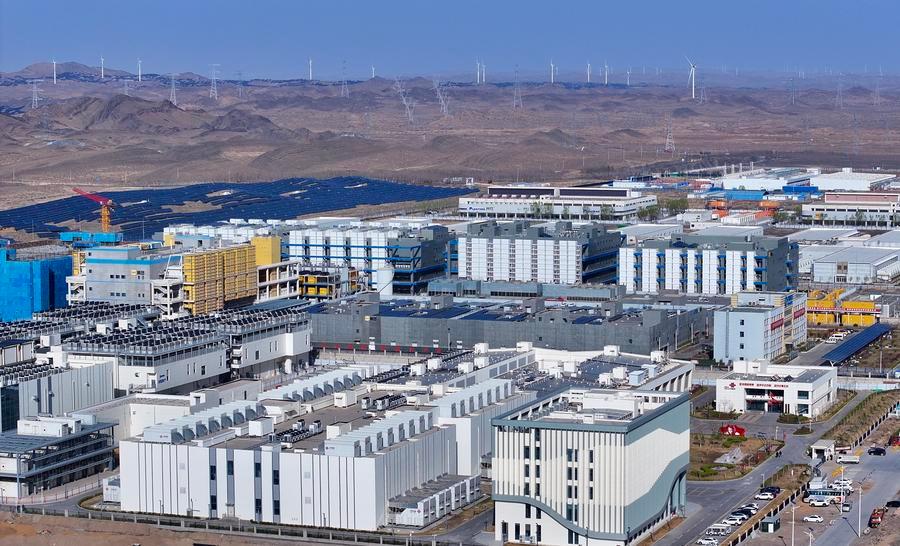
Once fully operational, the solar and wind projects will be able to meet the annual electricity demand of about 2.29 billion kilowatt-hours from existing and to-be-added data center cluster in Zhongwei, according to the Zhongwei subsidiary of China Datang Corporation Renewable Power Co., Ltd., which operates the projects.
That demand comes from a fast-growing computing cluster. The Zhongwei cluster now has 10 large data center parks. Six of China's top 10 internet data center operators have established a presence in the city, while data operations for major internet companies including Alibaba, Baidu, Tencent, Meituan and ByteDance are also based there.
POWERING COMPUTING BOOM
For data centers that run around the clock, electricity needs to be stable, reliable and affordable.
The issue is becoming more pressing as demand for computing power rises. Electricity accounts for 60 percent to 70 percent of data centers' operating costs, according to industry estimates.
Statistics from the International Energy Agency show that, globally, data centers are projected to consume 945 terawatt-hours of electricity a year by 2030. In China, electricity consumption by data centers doubled from 82.4 terawatt-hours in 2019 to 166 terawatt-hours in 2024, according to the China Academy of Information and Communications Technology.
That puts data centers at the intersection of two trends: rapidly growing demand for computing and China's push toward a greener energy mix. The country has set a target of having newly built data centers in its major computing hubs use no less than 80 percent green power.
Having green power transmission lines right next to the data center allows it to make greater use of locally generated solar and wind power, while reducing transmission losses and electricity costs, said Zhang from China Mobile.
Zhongwei's appeal as a computing hub goes beyond its abundant sunshine and wind.
The city has a dry, cool climate and stable geological conditions, while its location near the geographical center of China offers good connectivity to other parts of the country.
Data centers here can rely on natural cooling for eight to 10 months a year, well above the national average, helping reduce the electricity needed for cooling, said Zhu Bin from the computing operations branch at China Mobile Ningxia.
NATIONAL PUSH
Zhongwei's growth as a computing hub is closely tied to China's strategy of shifting computing workloads westward, where renewable energy and land are more abundant.
Launched in 2022, the "East Data, West Computing" project designated Ningxia as one of China's eight national computing hubs, with Zhongwei being home to one of 10 national data center clusters.
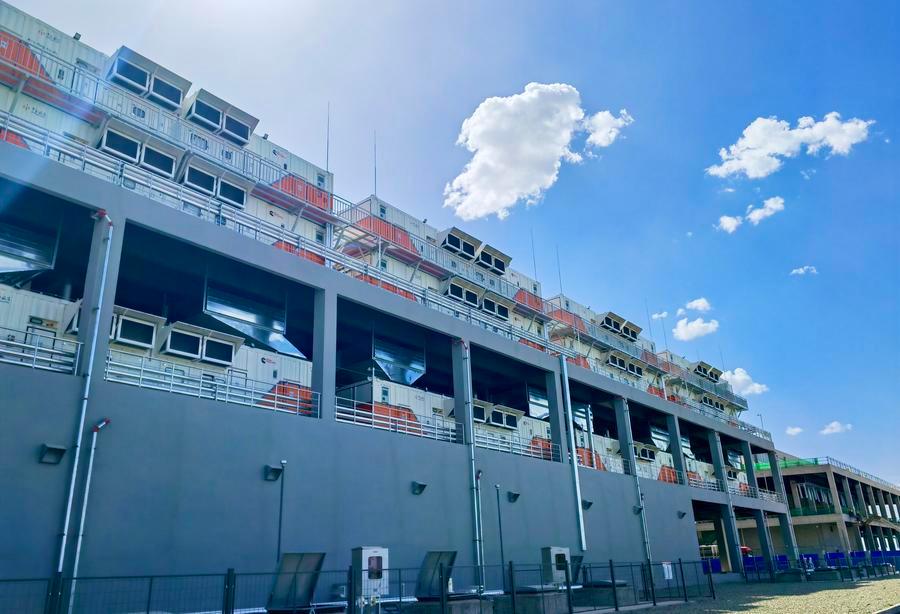
In 2025, Zhongwei ranked fifth among 302 Chinese cities on a city-level computing power index. Its computing capacity has reached 283,100 petaflops to date, according to the municipal data administration.
Computing facilities in Zhongwei support the training and inference of 13 large AI models and provide services to more than 4,900 companies, including Xiaomi and Xiaohongshu, according to Meng Fanzhen, an official with the administration.
For the first time this year, the coordinated development of computing capacity and electricity supply was highlighted in the government work report, alongside hyperscale intelligent computing clusters, as a key area of new infrastructure development.
China's 2026-2030 development blueprint also calls for further advancing the "East Data, West Computing" project and expanding its integrated computing network.
For Zhongwei, the next step is to better align power supply with computing demand while driving down both carbon emissions and costs.
"We will work to build a platform that dynamically coordinates computing capacity and power supply, using computing demand to optimize electricity use," Meng said. ■