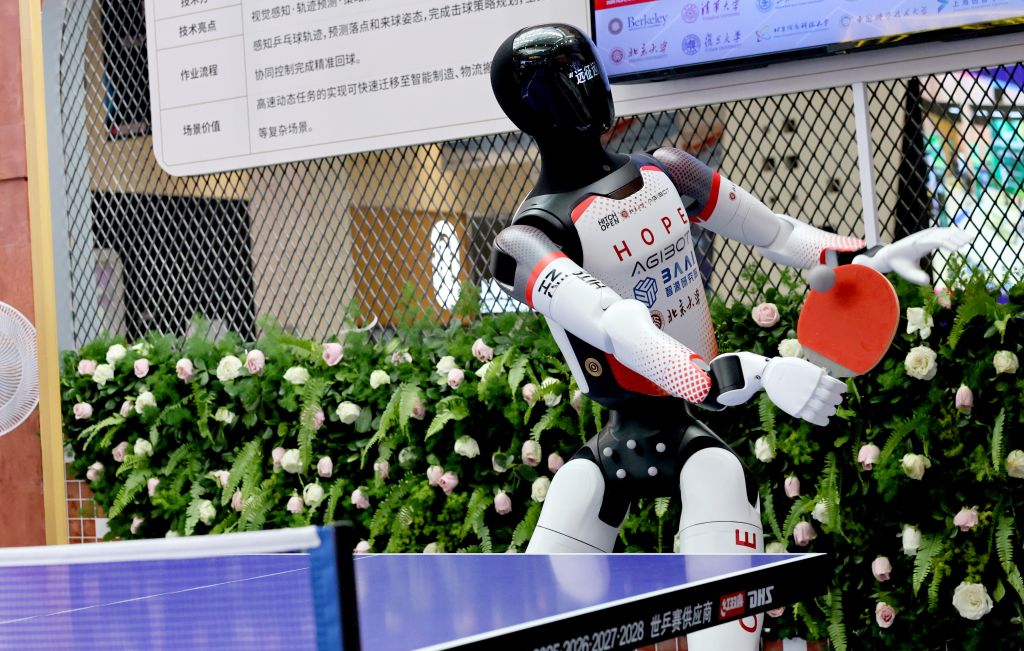
BEIJING, Aug. 17 (Xinhua) -- China is leveraging nationwide capabilities to forge a locally tailored but nationally coordinated AI industry landscape to generate fresh momentum for broader commercial deployment.
The latest economic data from the 31 provincial-level regions presents an overall artificial intelligence sector featuring the surging demand for AI terminal applications with a tiered development layout based on regional advantages.
"The driving role of AI wave is becoming increasingly pronounced in emerging industries such as integrated circuits and industrial robots across regions," said Xiao Hongwei, a researcher at the State Information Center under the National Development and Reform Commission, China's top economic planner.
"AI is accelerating its transformation from a technical concept into tangible productivity gains in China," Xiao added.
FIRST-TIER AI HUBS
China's intelligent computing capacity had risen 177 percent year on year to reach 2,185 EFLOPS by the end of June this year, reflecting the country's rapid expansion of AI infrastructure. The overall utilization rate of computing facilities nationwide stood at 71.4 percent, according to the Ministry of Industry and Information Technology.
EFLOPS, or ExaFLOPS, refers to a unit measuring computing performance, with each unit representing 1 quintillion floating-point operations per second.
According to Xiao, regions across the country are adapting to their conditions and utilizing their respective strengths to achieve the development pattern characterized by complementary advantages and collaborative progress.
"With their advantages in technology, talent and industrial chains, Beijing, Shanghai and Guangdong Province are taking the lead in building indigenous AI industrial ecosystems and continuing to drive full-chain efforts in integrated circuit manufacturing, industrial robots and other areas," Xiao said.
The three places have all targeted "global AI competitiveness" in their five-year plans for the 2026-2030 period, aiming to take comprehensive leadership in AI technology, industrial ecosystems and application scenarios.
Beijing is striving to build a global AI innovation hub. As of July 23, the Chinese capital completed filings for 259 large models and registrations for 195 AI products, covering general-purpose large models, industry vertical models and on-device mobile models, according to the municipal cyberspace administration.
As of the end of June this year, 169 large AI models in Shanghai passed filing approval. The city's 394 above-scale AI enterprises achieved an industry output of over 637 billion yuan (93.85 billion U.S. dollars) in 2025. Meanwhile, the core AI industry scale in the southern province of Guangdong surpassed 300 billion yuan last year.
DIVERSIFIED TRACKS WITH UNIQUE ADVANTAGES
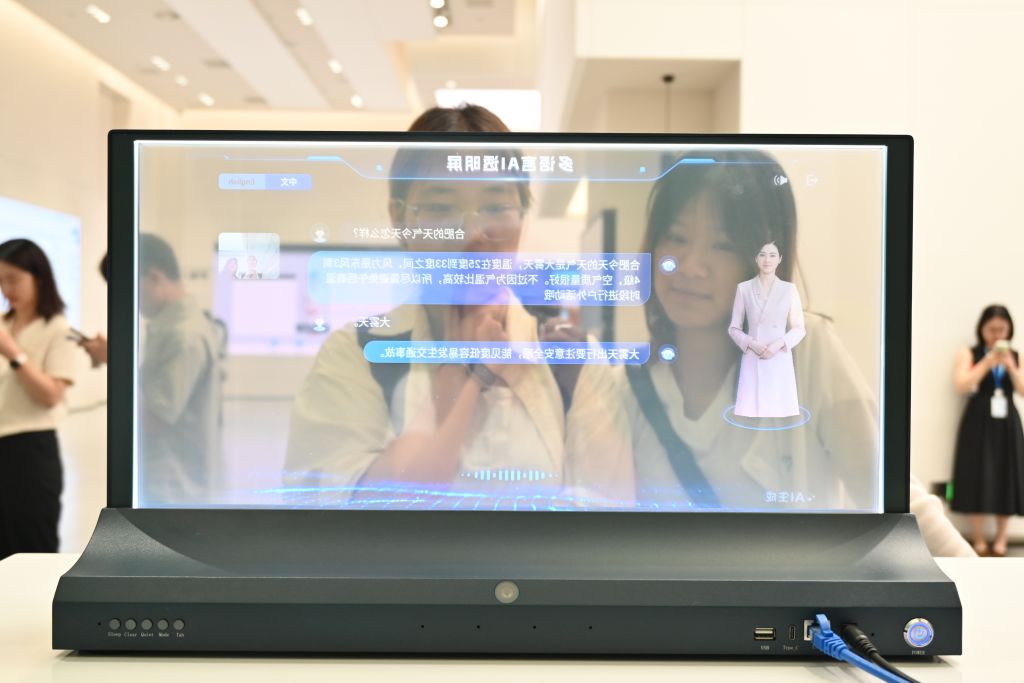
Other regions across the country are also exploiting their unique resource endowments to deeply cultivate niche tracks and carve out differentiated paths.
East China's Anhui Province is accelerating its strategic push into the AI chip sector and racking up continued breakthroughs. Nexchip, the province's first 12-inch wafer foundry, made its Hong Kong Stock Exchange debut in July, achieving an A-share/H-share dual listing. Its fourth-phase project, backed by a 35.5-billion-yuan investment, is slated to begin production in the fourth quarter of this year.
ChangXin Memory Technologies, a memory chipmaker based in Anhui's capital Hefei, also went public at the end of July, becoming the most valuable company on the A-share market.
Central China's Hubei Province has significant advantages in the optoelectronics industry, and its capital city of Wuhan is home to the Optics Valley of China. Capitalizing on surging demand for AI computing power, the province has formed a globally leading full industrial chain spanning optical communications, chips, displays, terminals and networks.
Also in central China, Henan Province has been the heart of the country's transportation network. The AI industry is now powering its transformation from a "railway heart" to a "computing power hub."
In April this year, the country's largest scientific intelligent computing cluster was put into operation at the core node of the national supercomputing network in Zhengzhou, capital of Henan. It marked a key breakthrough in China's computing infrastructure for AI-driven scientific research and industrial AI application.
In addition, regions including Xinjiang, Inner Mongolia and Guizhou are drawing on their clean energy resources to become key locations for intelligent computing centers.
COMPUTING CENTER IN MOUNTAINS
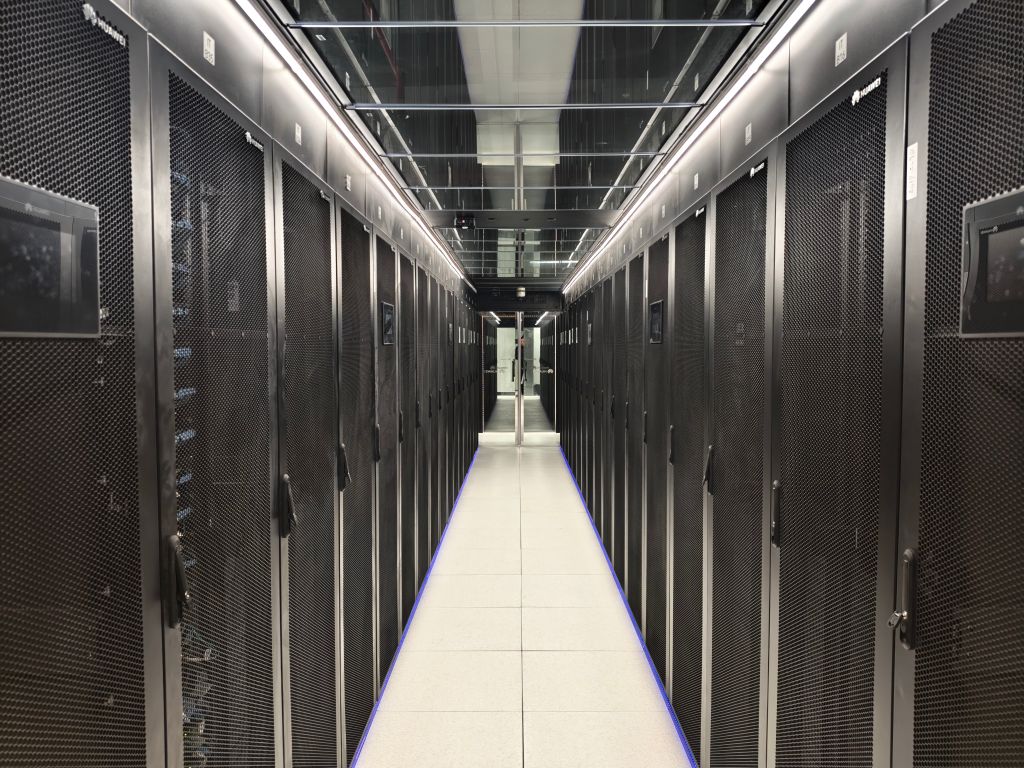
Nestled within the Wuling Mountains in Hubei's Lichuan City, the Lichuan AI Computing Center showcases how geographical advantages and natural resources, even pleasant weather and clean air, are transformed into local strengths for AI development.
Lichuan is not endowed with abundant scientific or educational resources, yet its cool climate and rich hydropower resources make it an ideal location for a computing center with relatively low electricity costs.
Housing rows of black server cabinets, each about two meters tall with indicator lights flickering rapidly, the center offers about 150 PFLOPS of computing power, with utilization exceeding 80 percent. PFLOPS, or petaflops, is a unit to measure computing speed for AI and data-intensive tasks, where 1 PFLOP equals 1 quadrillion calculations per second. Now, the center's services have covered culture and tourism, government affairs and aerospace information.

In Liangwu Township of Lichuan, a satellite ground receiving station has been built by GEOVIS Raywin Technology Co., Ltd. It allows instant access to computing power from the adjacent AI computing center when receiving and processing satellite data.
"The site is surrounded by mountains yet offers expansive views, with a pristine electromagnetic environment and a mild, stable climate. These natural endowments make it an ideal location," said Gao Kui, the company's general manager of operations.
"Moreover, the station's proximity to the computing center enhances the operational efficiency, convenience, and cost-effectiveness," Gao added.
Beyond serving external computing demand, surplus AI computing capacity also fuels local industries. Every year, over 20 million tourists pour into Lichuan for summer retreat and wellness, generating massive data from their dining, accommodation, transportation, sightseeing, shopping and entertainment.
These data streams have sustained the incubation of a domestic large model for culture and tourism services, greatly enhancing the visitor experience through AI-powered smart guides and services.
Collaborating with other departments, the Ministry of Industry and Information Technology has been promoting high-quality computing infrastructure development. It has been speeding up the coordinated deployment of hub, regional and edge computing facilities, as well as establishing a national integrated automated monitoring system for computing power situational awareness. ■