
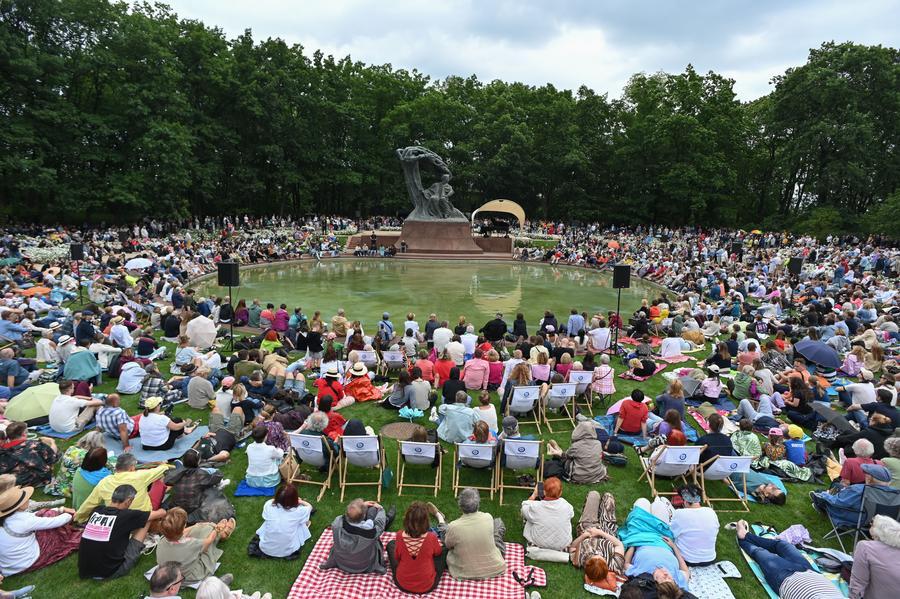
For more than six decades, free open-air Chopin concerts have been a fixture of summer in Warsaw. First held in 1959, the recitals now take place every Sunday beside the Chopin Monument in the city's Royal Baths Park, featuring acclaimed pianists from Poland and around the world.
WARSAW, Aug. 16 (Xinhua) -- Coffee in hand, 56-year-old Jarek Kowalski sat on the grass, leaning against a tree as he waited for an open-air Chopin concert to begin.
This has been part of his summer Sundays for around 20 years.
"I love the idea of open-air concerts. You can just chill out and enjoy performances by great pianists, sitting on a bench or stretching out on the grass," Kowalski told Xinhua.
For more than six decades, free open-air Chopin concerts have been a fixture of summer in Warsaw. First held in 1959, the recitals now take place every Sunday beside the Chopin Monument in the city's Royal Baths Park, featuring acclaimed pianists from Poland and around the world.
The tradition is deeply intertwined with Poland's wartime history. During the Nazi occupation of Poland in World War II, performances of Chopin's music were restricted, while his monument in the park was destroyed in 1940.
Reconstructed after the war, the monument returned to the park in 1958. A year later, Chopin's music returned to its side.
"It is not only about Chopin, but also about the history of Poland," said Piotr Pawlak, a Polish pianist who has performed at the open-air concerts several times over the years.
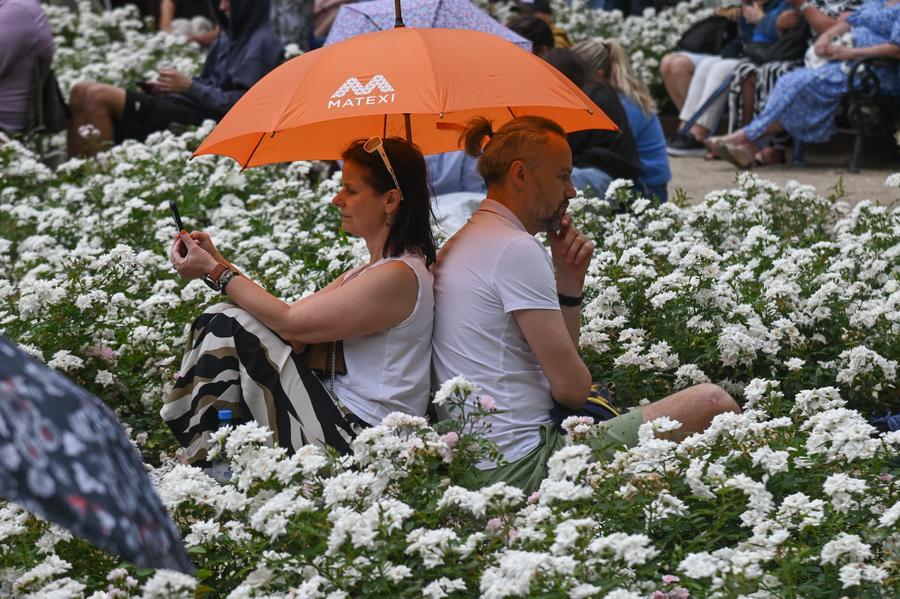
For Pawlak, playing outdoors is a very different experience from performing in a concert hall. "It is never really quiet outdoors, so you have to think about the repertoire," he told Xinhua.
"But the sounds around me, like the wind, always bring me new inspiration, and they become part of the concert," he added.
The outdoor concerts also make classical music more approachable. A philharmonic hall can feel intimidating to someone unfamiliar with classical music, Pawlak said. In the park, that barrier almost disappears.
"They can listen to a single piece and then leave," Pawlak said. "They don't need to dress or behave in a certain way. It's really easy for them to come and simply listen."
Among the audience was 29-year-old Dominika Rekut, who came to the concert for the first time with a friend. Seated on a picnic mat on the grass, she read a book while listening to the performance.
"With the beautiful weather, it was just amazing. I want to come again," Rekut told Xinhua after the recital ended.
Over the 20 years he has been coming to the concerts, Kowalski has noticed changes in the audience. Years ago, he recalled, most listeners were Polish. Today, he sees more visitors from around the world, drawn by Chopin's music as well as by the culture and history surrounding it.
As the final notes faded into the summer afternoon, the concert concluded with prolonged applause. Kowalski stood up, mounted his bicycle, and rode home. Another Sunday with Chopin had come to an end, with the next one still to come. ■