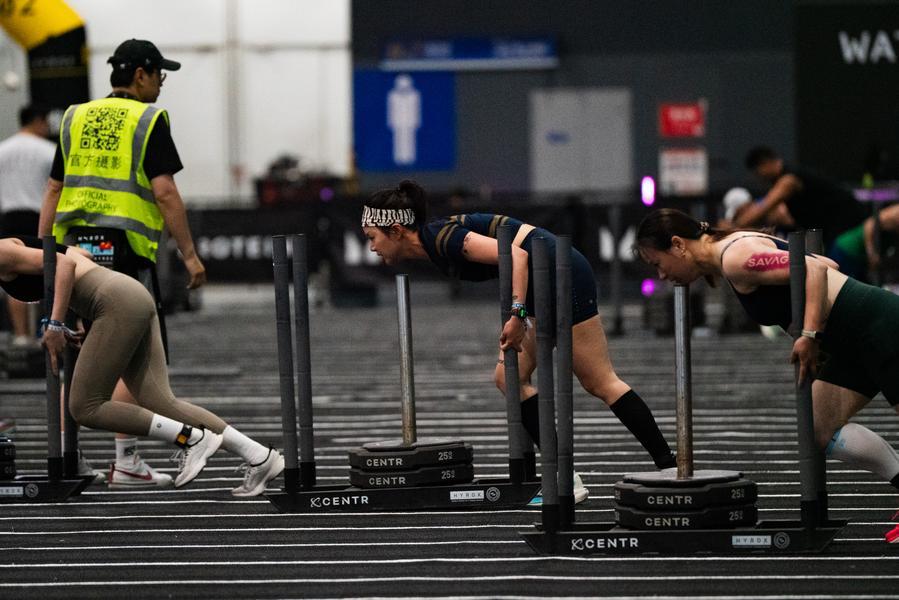
Hyrox, a fitness racing format that combines eight one-kilometer runs with eight functional workout stations, is gaining momentum in China due to its strong social attributes. Since entering the Chinese market in 2024, the sport has seen a surge in the number of participants and affiliated gyms in the Chinese mainland.
by sportswriters Liu Yang, Gao Meng and Li Li
BEIJING, Aug. 15 (Xinhua) -- At 7:30 p.m., Wang Kai finishes his workday with a two-hour training session including sled pushes, indoor rowing and running.
"I used to go home and watch shows or short videos on my phone," the 31-year-old finance professional said. "Now I train almost every day."
In major Chinese cities, a growing number of young people are swapping the couch for the gym, obsessed with Hyrox, a fitness racing format originating in Germany that combines eight one-kilometer runs with eight functional workout stations.
FROM LOCAL EVENT TO GLOBAL COMPETITION
Hyrox was to create a fitness competition that would appeal to gym-goers. The first event in Hamburg in 2017 attracted 650 participants. Hyrox has experienced remarkable growth in Europe and the United States, with some events seeing over 50,000 athletes and 35,000 spectators.
Competitors take the identical course under identical rules, producing results that can be compared around the globe.
According to Forbes report, Hyrox generated 130 million U.S. dollars in revenue from more than 80 events worldwide in 2025, with projections exceeding 220 million U.S. dollars in 2026.
SOCIAL CONNECTION
Hyrox offers something that traditional gym memberships cannot: measurable progress and social belonging.
Zhang Lin, a 27-year-old IT professional in Shanghai, said she initially signed up to join the fun. What kept her coming back was the training group.
"Our professions are different, but we train together, talk about races and have meals on weekends. It's hard to make new friends after graduating from university, but it happens naturally here," she said.
"Pay to suffer", a popular Chinese social media hashtag, has become a rallying cry for Hyrox participants. It captures a paradox: young people are willingly spending hundreds of dollars on entry fees, training camps and travel, to put themselves through what many describe as the most physically demanding hour of their lives.
For many, the race is less about winning but more about emotional catharsis. The structure - eight 1km runs interspersed with sled pushes, burpees, farmers' carries and wall balls - leaves little room for rumination.
Hyrox coach Xia Yu noted that the typical Chinese participants are young, urban and employed in high-stakes sectors like IT, AI and finance.
"The higher the pressure at work, the more they need the release that comes from intense exercise," he said.
Yuan Fang, head of Hyrox China, emphasized the importance of the sport's global ranking system.
"A fitness enthusiast can see exactly where they stand in the world, maybe ranked in hundreds of thousands, but for personal growth, that still means something," he said. "The core of sports is faster, higher, stronger, but first you need to know how fast, how high and how strong you actually are."
SURGE IN CHINA
Hyrox entered the Chinese market in 2024, with the number of affiliated gyms in the Chinese mainland surging to more than 500 by now. The Shanghai event in May drew more than 10,000 athletes, compared to fewer than 1,700 at the inaugural Beijing event.
Participation nearly tripled from the previous Shanghai event held in April 2025, which attracted about 3,600 competitors. Despite entry fees exceeding 600 yuan (89 U.S. dollars), popular race slots sell out almost instantly.
Each race features thumping music, food stalls, photographers and a signature finishing moment. On Chinese lifestyle platform Rednote, videos of finishers have gone viral.
"The cheering crowd at the finishing line and the powerful race photos are highly shareable," said Wang Zhe, a lecturer at Beijing Sport University.
Teng Fan, manager of sports and entertainment department at Meituan, a major online lifestyle platform in China, said that sports-related business on the platform has sustained triple-digit growth for three consecutive years. Users aged 25 and under represent the fastest-growing segment, with participation growth exceeding 200 percent.
According to China's National Bureau of Statistics, nearly 40 percent of the country's population exercised regularly by the end of 2025.
"People who love sports rarely stick to just one," Teng said. "Tennis players take up swimming; climbers add strength training. Different sports feed into each other and has become part of lifestyle." ■