
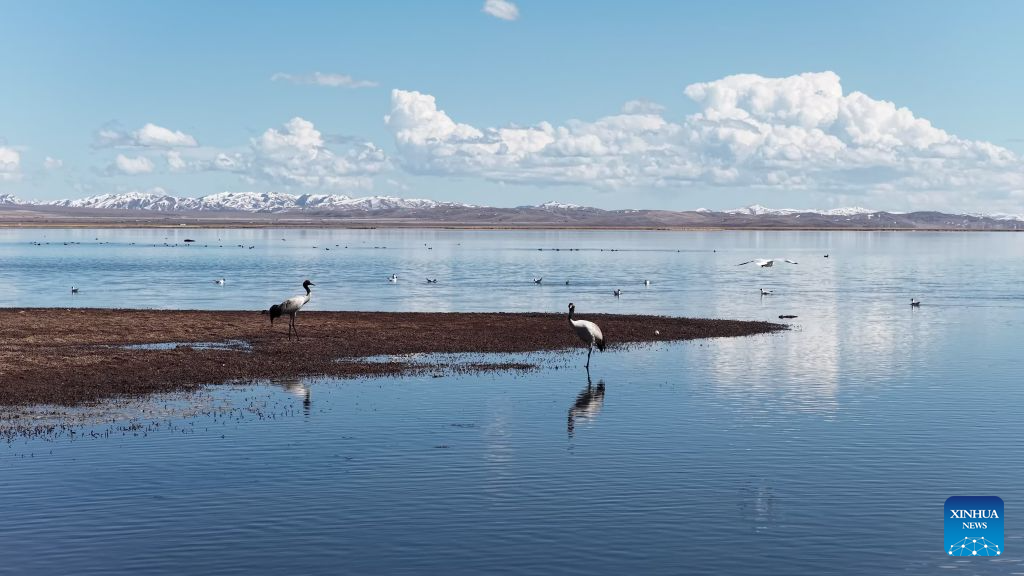
This photo taken on March 27, 2026 shows black-necked cranes at the Zoige Wetland National Nature Reserve, southwest China's Sichuan Province. (Xinhua)
CHENGDU, Aug. 15 (Xinhua) -- On a monitor in his office, Sonam Dorchi watched a family of black-necked cranes move slowly through the shallow water of Zoige Wetland.
The chick had grown tall, much of its down already gone. In another two or three months, it would learn to fly and follow the flock south for winter.
Nineteen years ago, Sonam Dorchi would have had to walk or ride for a long time across marshland to see the same scene.
Sonam Dorchi, an ethnic Tibetan, joined the administration of the Zoige Wetland National Nature Reserve in southwest China's Sichuan Province in 2007 after working as an elementary school teacher. A fresh hand in wildlife conservation, he began by following experts into the fields, studying plant samples by day and comparing them with illustrated guides at night.
He rode along the edges of marshes, marking wetlands and nesting sites on hand-drawn maps. Years of fieldwork eventually made him so familiar with the reserve that colleagues came to regard him as a "living map."
In 2019, monitoring cameras were installed. When black-necked cranes return to nest in April, Sonam Dorchi no longer has to head into the field every day. Once a nesting site is spotted, he alerts local herders hired as rangers, asking them to keep people and livestock away.
Yet technology has not replaced fieldwork.
Every June, Sonam Dorchi and two younger colleagues spend five days surveying 90 sites along four routes, crouching in the grass to count adult cranes and chicks and check which nests have produced twins.
The reserve covers more than 166,000 hectares, too vast for the administration's several dozen staff members to patrol on their own. Around 200 local herders now serve as rangers across 28 administrative villages, generally two or three in each village, though some have more.
Reserve officials say years of conservation outreach have helped local residents recognize the importance of protecting the grasslands they call home, while the ranger program provides an additional source of income.
Gu Haijun, a nature reserve protection official with the Sichuan provincial forestry and grassland administration, described the black-necked crane as a living indicator of wetland health.
The species has exacting habitat requirements, he said. A decline in its population could signal degradation of the grasslands on which local residents depend, while a stable or growing population indicates that the grassland and wetland remain healthy.
Over the years, the number of nationally protected first-class species in the reserve has risen from nine to 18, while the number of second-class species has increased from 25 to 52. The black-necked crane has also been reclassified from "endangered" to "near threatened."
Asked whether he was disappointed by the change, Sonam Dorchi laughed.
"I'm glad," he said. "It means our work has not been in vain."
His work is increasingly about passing on what he has learned. He taught one of his two younger colleagues to identify waterbirds, telling him that to record changes in the wetland, he first had to know what was in the frame. The apprentice can now identify most of the reserve's waterbirds, and his social-media account is filled with images of wetland wildlife.
Another colleague, the daughter of a local herder, has become so familiar with the terrain that visiting researchers often specifically ask her to guide them during field surveys.
The lessons have reached home, too. Sonam Dorchi's younger son accompanied him into the field as a child, collected fallen crane feathers and learned to draw the birds before starting school. In third grade, he gave his classmates a presentation on Zoige wildlife using photographs taken by his dad.
Each November, the black-necked cranes leave Zoige. Around the same time, whooper swans arrive from Siberia to spend the winter.
"The cranes leave, and the swans come," Sonam Dorchi said. "It is like a changing of the guard."
After 19 years, he too is beginning to pass the torch and leave the watch to others. ■
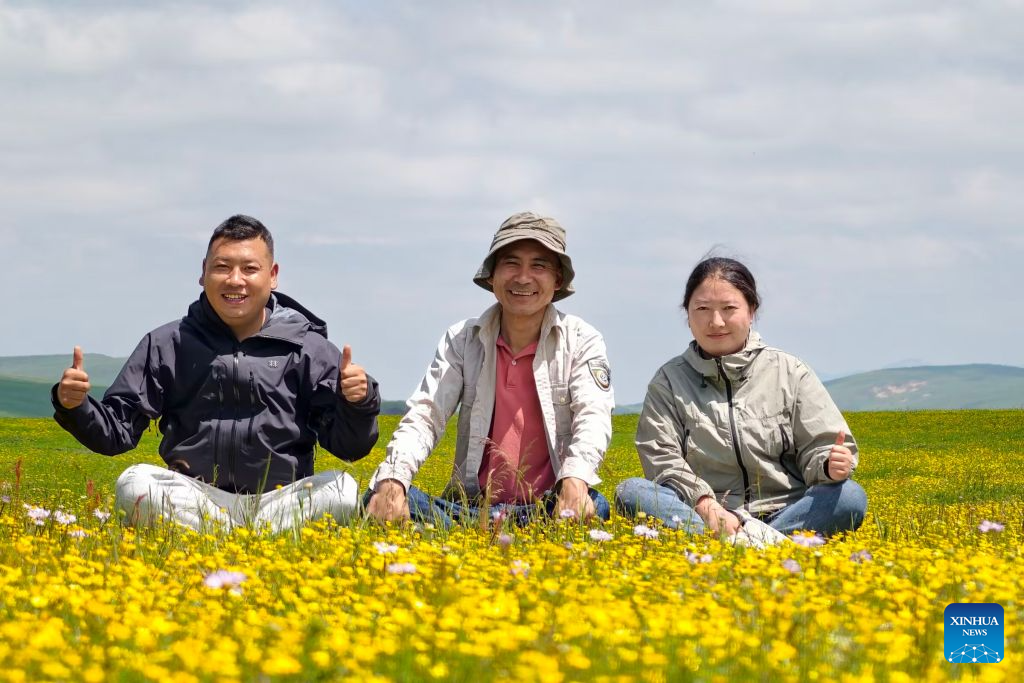
Sonam Dorchi (C) and his colleagues pose for a photo at the Zoige Wetland National Nature Reserve, southwest China's Sichuan Province, June 10, 2025. (Xinhua)


