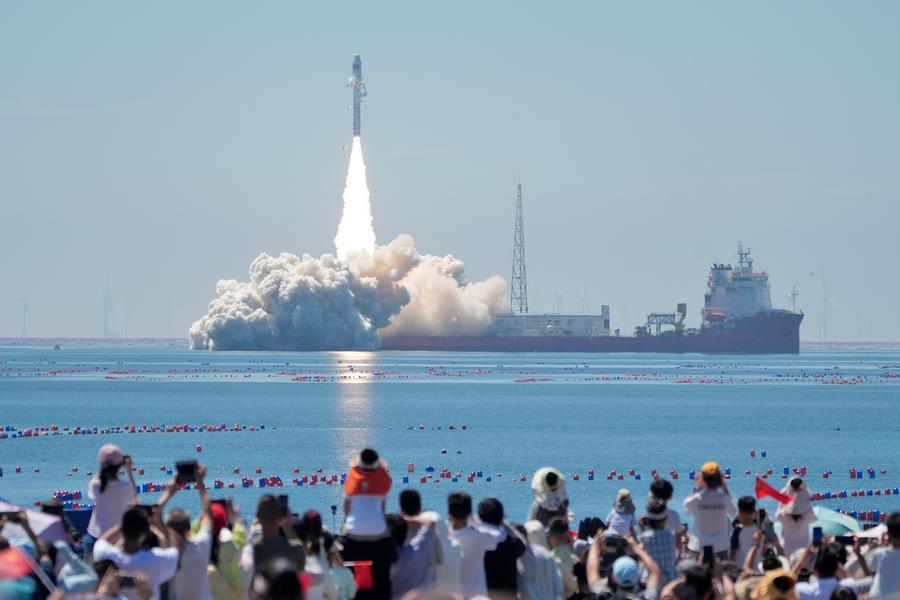
HAIYANG, Shandong, Aug. 14 (Xinhua) -- The successful Aug. 5 launch of a Smart Dragon-3 (SD-3) carrier rocket with two AI hyperspectral satellites from sea waters in east China underscores the country's growing capabilities in maritime space operations, advancing its commercial space industry's push into offshore launch and recovery.
The mission, the 27th sea-based launch from the Haiyang Oriental Spaceport in east China's Shandong Province since 2019, follows two landmark events in quick succession -- the country's first-ever controlled recovery of a rocket via a sea-based net capture system in China's southernmost island province of Hainan on July 10, and the first commercial sea launch from the East China Sea off Shanghai on July 22.
RISING MARITIME SPACEPORT
The SD-3 liftoff from the Yellow Sea, which may have seemed to the public like just another sea launch, is viewed by industry insiders as a quiet milestone. Not because it is exceptional, but because it is no longer exceptional at all.
The SD-3 is a solid-fuel carrier rocket tailored for the commercial space market. With a 500-km sun-synchronous orbit payload capacity of 1.5 tonnes, the rocket was assembled in the factory at the Haiyang Oriental Spaceport, China's only commercial offshore launch home port.
From final assembly to rollout and then to launch vessel integration, the industrial chain in Haiyang is now well established, said Teng Yao, chief engineer of the Oriental Maritime Spaceport (Shandong) Development Group, the launch service provider.
As of August, the Haiyang Oriental Spaceport had supported 27 sea-based rocket launches, sending a total of 166 satellites into their planned orbits with a 100-percent success rate.
It now hosts the country's largest solid-rocket final assembly and testing facility, with an annual capacity to assemble and test 50 rockets and 50 propellant tanks. It has also attracted 30 aerospace projects, with total investment exceeding 32 billion yuan (about 4.74 billion U.S. dollars).
More importantly, the spaceport has evolved from a service provider into a standard setter, said Teng.
Three national standards for sea-based rocket launches, led by the spaceport, covering general environmental requirements, core metadata requirements for infrastructure, and technical requirements for infrastructure platform selection, have recently been approved by the Standardization Administration of China and will take effect in November 2026, according to the chief engineer.
WHY THE OCEAN
Experts view sea-based launch and recovery as a natural fit for China's growing low-orbit constellation plans, which demand high-frequency, responsive launches.
A mobile sea platform can be repositioned to suit specific orbital inclinations, avoid populated areas and reduce weather-related delays. Open waters also provide broader and safer recovery zones, an essential feature as the industry moves toward reusable rockets that require recovery areas far from population centers, said Teng.
The main challenges are the complex sea conditions, such as waves, currents and salinity, which demand robust rocket designs and precise maritime coordination. However, the flexibility and safety gains far outweigh the operational difficulties, making sea-based launch and recovery a strategic choice, he noted.
FROM NEARSHORE TO OPEN SEA
Mobile offshore launch platforms can flexibly select launch points, playing a positive role in improving launch efficiency and diversifying China's space launch layout. Tracing the trajectory of China's commercial sea-based launch evolution, a clear "triple jump" pattern emerges.
In 2019, the Long March-11 achieved the nation's first sea launch in the Yellow Sea, followed by years of nearshore validation off Haiyang.
On July 22 this year, the Gravity-1 Y4 rocket, developed by private firm OrienSpace, blasted off from waters about 170 km east of Shanghai, deploying nine satellites into orbit. This was China's first commercial sea launch from the East China Sea near the Yangtze River Delta.
Unlike previous launches off the coast of Haiyang, this mission deployed the "Oriental Spaceport" launch vessel to open waters with busy shipping lanes, validating the rocket's endurance in a humid, corrosive salt spray environment and its adaptability to complex sea conditions, said Teng.
The SD-3 rocket launch about a week ago, together with future cross-sea missions, signals that the spaceport has achieved all-domain mobile launch capability, he stressed.
NET CAPTURE RECOVERY
If sea-based launch solves the problem of "how to get rockets off the ground," then rocket recovery addresses "how to launch repeatedly at low cost." On this front, China has just delivered an answer that has captured global attention.
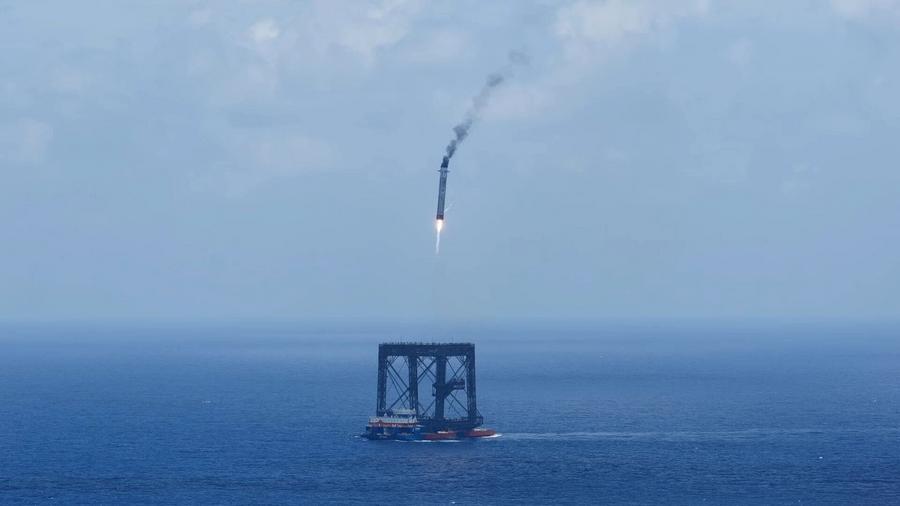
On July 10, the Long March-10B carrier rocket made its maiden flight from the Hainan commercial spacecraft launch site. About six minutes after stage separation, the first stage descended toward a waiting recovery vessel and was caught by a massive net system aboard an offshore platform.
The mission marked China's first successful controlled recovery of a rocket's first stage. The net-based approach eliminates heavy landing legs, reduces structural mass and tolerates larger landing deviations by expanding the effective capture window through coordinated net movement.
The recovery platform, equipped with LiDAR for automatic tracking and dynamic positioning system, is designed to operate reliably in challenging sea states.
Experts say the net capture system will underpin China's path toward low-cost, high-frequency and sustainable space operations.
Notably, private rocket companies are also accelerating their efforts.
OrienSpace's self-developed medium-to-large liquid reusable rocket, Gravity-2, is designed with sea recovery in mind and is expected to be ready for its maiden flight by the end of 2026. iSpace's Hyperbola-3 is also racing through key technology validation to achieve sea recovery on its maiden flight set for late 2026.
POLICY TAILWINDS
The offshore expansion is reinforced by a supportive policy environment. China's 15th Five-Year Plan (2026-2030) includes working faster to boost the country's strength in aerospace as a key national task for the first time.
The 2026 government work report identified aviation and aerospace as an emerging pillar industry, and satellite internet was listed as a standalone category for the first time.
In November 2025, the China National Space Administration (CNSA) released a three-year action plan to promote high-quality and safe development of the commercial space sector, formally integrating it into the national space strategy.
The CNSA's commercial space bureau has been officially established. Key resources, including launch pads, frequency-orbit allocations and tracking networks, are being opened to private enterprises, lowering entry barriers and spurring innovation.
The steady flow of policy measures has provided institutional guarantees and resource support for the commercial space sector's "march to the sea," said Teng.
Each offshore launch adds operational data that refines recovery algorithms, launch scheduling and weather forecasting, which are all essential for scaling up commercial services. With reusable rockets maturing and demand for satellite internet constellations surging, sea-based launch infrastructure is becoming a strategic asset, he said.
"China's commercial space industry has found its sea legs, and is now learning to run," he added. ■