
by Xinhua writers Zhao Jiasong, Yu Aicen
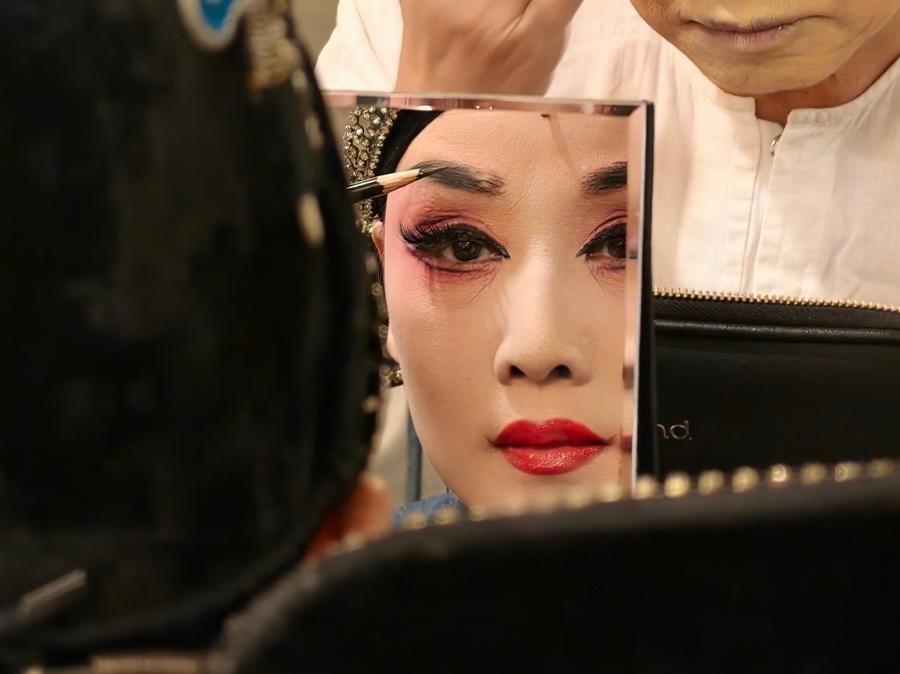
EDINBURGH, Britain, Aug. 13 (Xinhua) -- Minutes before going on stage in Edinburgh, Han Zaifen sat before a dressing-room mirror, humming softly to herself as the final touches were put on her makeup.
Beneath a black embroidered scholar's cap was the face of Feng Suzhen, a young woman Han has played for more than four decades.
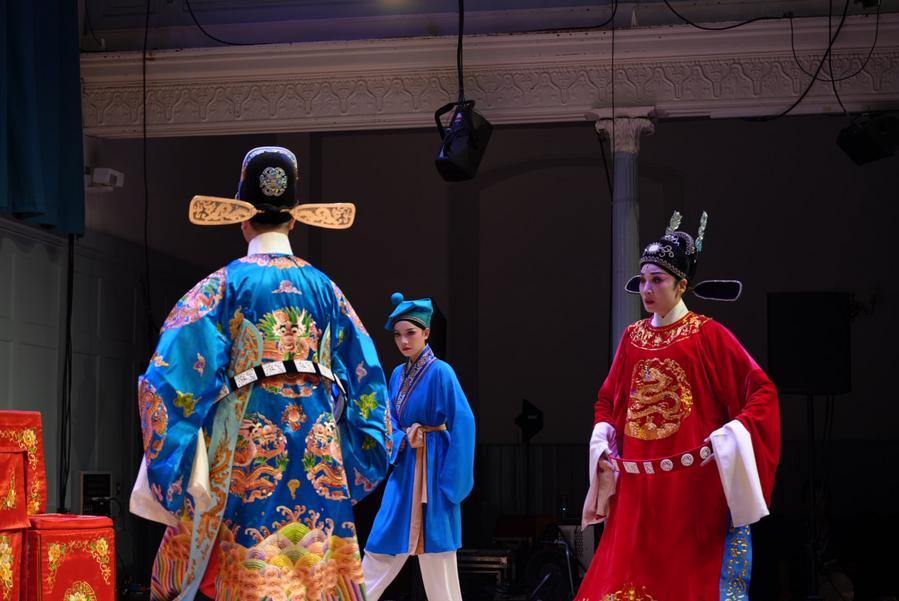
Soon afterward, Han, a winner of the Plum Blossom Award, the highest award for Chinese theatrical art, stepped onto the stage at Queen's Hall in a bright red robe, bringing one of China's best-known traditional opera heroines to Edinburgh audience.
On Wednesday evening, the Anhui Zaifen Huangmei Xiqu Art Theatre, led by its director Han, performed "The Lady Consort Prince" at the Edinburgh Festival Fringe, marking the first appearance of Huangmei xiqu, or Huangmei Opera, at the festival.
"If Huangmei xiqu were an Eastern woman, she would be lively and quick-witted, pure and down-to-earth," Han told Xinhua before the performance. Unlike the stately elegance often associated with Kunqu Opera, she said, Huangmei xiqu has a particular warmth and innocence, as well as a mixture of softness and strength.
"Its melodies come from people's lives and from their sense of happiness," she said.
Huangmei xiqu is a major form of Chinese traditional opera, known for its tuneful singing and lively storytelling. Now, Anqing, a city in east China's Anhui province, serves as an important center for its performance and development.
"The Lady Consort Prince" tells the story of Feng Suzhen, who disguises herself as a man and enters the imperial examination in an effort to save the man she loves. She unexpectedly finishes first and is chosen by the emperor as a husband for his daughter, setting off a series of twists before her true identity is revealed.
The work was adapted from the traditional play Double Rescue and was first staged in 1958. A film version followed in 1959, helping turn the story into one of the most familiar works in Huangmei xiqu.
Feng's disguise recalls other well-known women in Chinese storytelling, including Hua Mulan, the legendary woman warrior who disguised herself as a man, and Zhu Yingtai of "The Butterfly Lovers."
But Han sees something distinctive in Feng.
"She does not spend her time anxiously searching for an identity," Han said. "Through what she does, she keeps redefining who she is. She is taking charge of her own fate."
Saving her husband is the direct reason for Feng's adventure, but the journey also reveals her confidence in her own ability and worth, Han said.
Han added that young women today no longer need to disguise themselves as men to pursue their ambitions, but the courage behind Feng's choice remains relevant.
"Whether you are a young woman or a young man, you need the courage not to retreat when you face difficulty and to fight for the life you want," she said.
That message resonated with Monika Owczarek, a Polish resident of Edinburgh, who said she often watches Chinese opera during the Fringe.
She said she enjoyed the melodies of Huangmei xiqu, while Feng's story reminded her of Mulan. "Both women disguise themselves as men and emerge as strong female protagonists who refuse to accept the limits placed on them," she said.
American audience member Joe Goldblatt described it as the best Chinese opera performance he had seen, adding that he hoped "more productions like it could help bring people from different countries closer together."
Han said the theater made no deliberate attempt to speed up the performance or simplify its style for a Western audience.
The troupe has previously taken Huangmei xiqu to countries including France, the United States, Canada and Russia.
"Good cultural exchange does not mean changing yourself just so you can be understood," Han said.
"For any art form, there is something that cannot be translated because it comes from the culture itself," she said. "It is a people's temperament, even a people's way of breathing."
Han's Edinburgh visit also brought recognition away from the stage. Earlier this week, she received the 2026 Asian Art Ambassador honor at the Asian Art Awards, organized by Asian Art Fund Scotland, a Scottish charity supporting Asian arts.
"Seeing overseas audiences laugh along with the story was deeply moving," said Wu Meilian, a Plum Blossom Award-winning actress who also played Feng Suzhen in the first half of the show.
"We did not share a language, but the humor and emotions still connected us. It made me feel that Huangmei xiqu can touch audiences anywhere." ■