* Europe's experience is one regional expression of a much broader global climate risk.
* The immediate drivers of Europe's extreme summer include persistent high-pressure systems, hot air from North Africa, limited rainfall and accelerated evaporation.
* The growing impact of extreme weather exposes two widening gaps: global emissions are not declining fast enough, and adaptation efforts remain insufficient.
WARSAW, Aug. 13 (Xinhua) -- From the Rhine and Danube rivers to forests and farmland across Europe, prolonged heat, drought and wildfires are testing the infrastructure and systems that support daily life and economic activity.
Water shortages have disrupted households and businesses. Falling river levels have constrained shipping and industrial supply chains, while agriculture and power systems face mounting pressure from scarce water resources and rising cooling demand.
Against a backdrop of intensifying climate risks worldwide and a strong El Nino expected to strengthen, Europe's summer extremes highlight a broader challenge for global climate governance: turning commitments into coordinated action on emissions reduction, climate adaptation, finance and technology.
WEATHER EXTREMES HIT ECONOMIES
The scale of disruption has been reflected in a string of weather records.
France recorded its hottest July since national records began in 1900, with the average temperature reaching 24.9 degrees Celsius, while rainfall was nearly 70 percent below the seasonal average, making it the country's third-driest July on record, according to Meteo-France.
A wildfire that broke out in southwestern France's Gironde department on July 22 burned around 42,000 hectares and forced more than 220,000 people to evacuate, preliminary estimates showed.
The fire hazard has also spread to Portugal, where more than 5,700 rural fires burned about 53,000 hectares in the first seven months of the year, the highest level for the period in four years.
In Britain, extreme dryness has become a defining feature of the summer. Provisional data from the Met Office showed that England and Wales experienced their driest July on record, while nearly three-quarters of England was officially under drought conditions by Aug. 10.
The Netherlands also faced severe drought, with July rainfall averaging only 13 millimeters, far below the long-term average of 78 millimeters. The government raised the national water status from an impending shortage to an actual shortage in mid-July.
Low river levels have triggered economic disruptions across the continent. Vessels have been forced to reduce cargo loads, while some waterways have been closed.
In Belgium, ships on certain rivers had to leave 10 to 20 percent of their cargo on shore, while authorities introduced draft restrictions and coordinated lock operations to save water.
The impact has reached industrial production. German steelmaker Thyssenkrupp cut hot-metal output at its Duisburg plant after low water levels on the Rhine disrupted raw-material deliveries.
The Danube has exposed the link between drought and energy security. At Hungary's Paks nuclear power plant, unusually low river levels limited cooling-water supplies, reducing output to slightly above 10 percent of its normal 2,000-megawatt capacity.
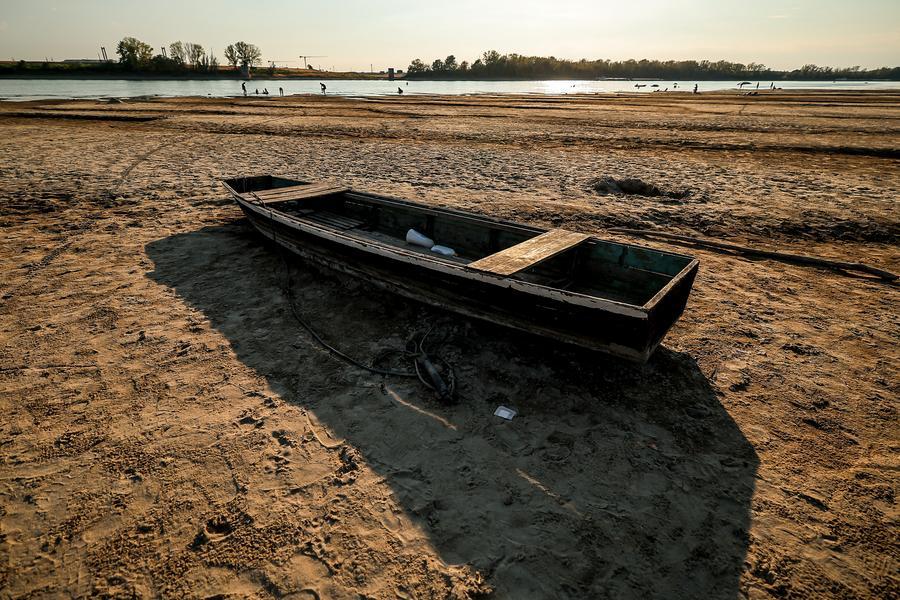
Agriculture has also suffered. Drought has damaged silage corn and open-field vegetables in Bosnia and Herzegovina, where several rivers have partially dried up.
In northern Italy, the Po River basin faces disrupted irrigation, a growing risk of saltwater intrusion and concerns over drinking-water supplies. Heat has also accelerated grape harvests and reduced milk production as livestock suffer from heat stress.
LOCAL EXTREMES, GLOBAL RISKS
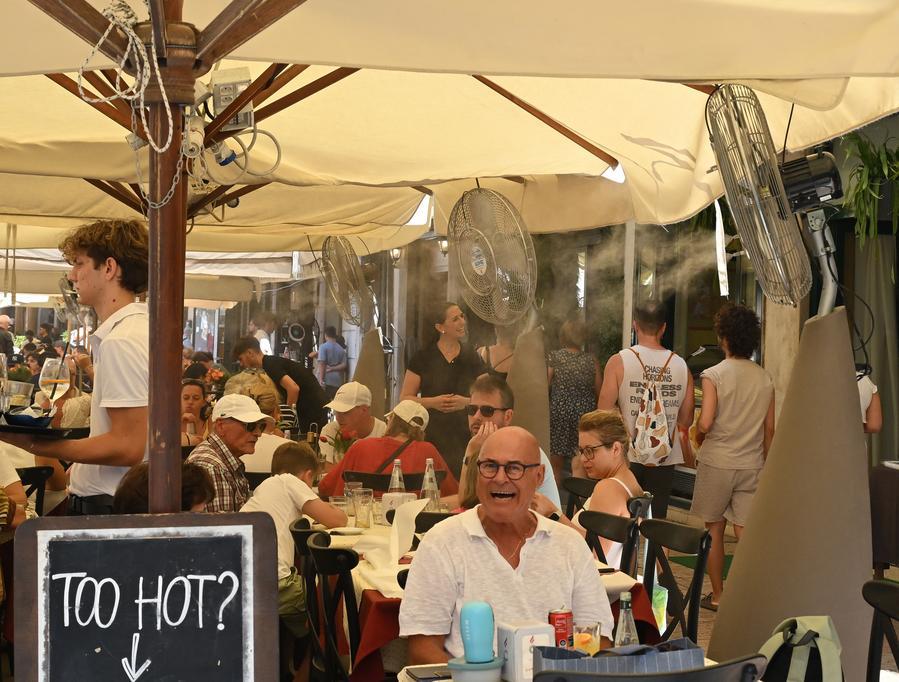
The immediate drivers of Europe's extreme summer include persistent high-pressure systems, hot air from North Africa, limited rainfall and accelerated evaporation. And these effects are being intensified by long-term warming and growing pressure on water resources.
Climate change has made the warm air flowing into Europe from the south considerably hotter than three decades ago, Wim Thiery, a climate science professor at Vrije Universiteit Brussel, told Xinhua, adding that dry soils further reinforce heatwaves and moisture loss.
Human water consumption has added to the pressure, accelerating soil-moisture depletion and contributing to what French hydroclimatologist Florence Habets calls "anthropogenic drought."
Europe's experience is one regional expression of a much broader global climate risk.
The World Meteorological Organization (WMO) said a strong El Nino was developing and expected to intensify between August and October 2026.
Although El Nino is a natural climate pattern with varying regional impacts, its interaction with unusually warm oceans and a likely positive Indian Ocean Dipole could increase risks of drought, floods and wildfires worldwide.
The United Nations has called for greater emphasis on wildfire prevention, risk reduction and ecosystem management, alongside emergency response.
The consequences could extend beyond weather disasters. The World Food Program estimates that the 2026-2027 El Nino could push at least 49 million more people into acute food insecurity by the end of 2027, bringing the total in 45 vulnerable countries to 274 million.
FROM WARNINGS TO ACTION
The growing impact of extreme weather exposes two widening gaps: global emissions are not declining fast enough, and adaptation efforts remain insufficient.
The UN Environment Program estimates that implementing current national climate pledges would still result in 2.3 to 2.5 degrees Celsius of warming this century, while existing policies could lead to a rise of around 2.8 degrees Celsius.
Policy uncertainty has further complicated global efforts. The United States' withdrawal from the Paris Agreement and notification of its withdrawal from the UN Framework Convention on Climate Change risk eroding trust and shifting greater pressure onto other countries.
Experts say mitigation alone is no longer enough. French sustainability expert Guillaume Sainteny argued that adaptation started too late and was long overshadowed by expectations that emissions cuts and technology would solve the problem.
As climate impacts will continue even if emissions stopped immediately, mitigation and adaptation must move forward together. This requires upgrading infrastructure, improving water and energy management, and expanding technologies such as energy storage.
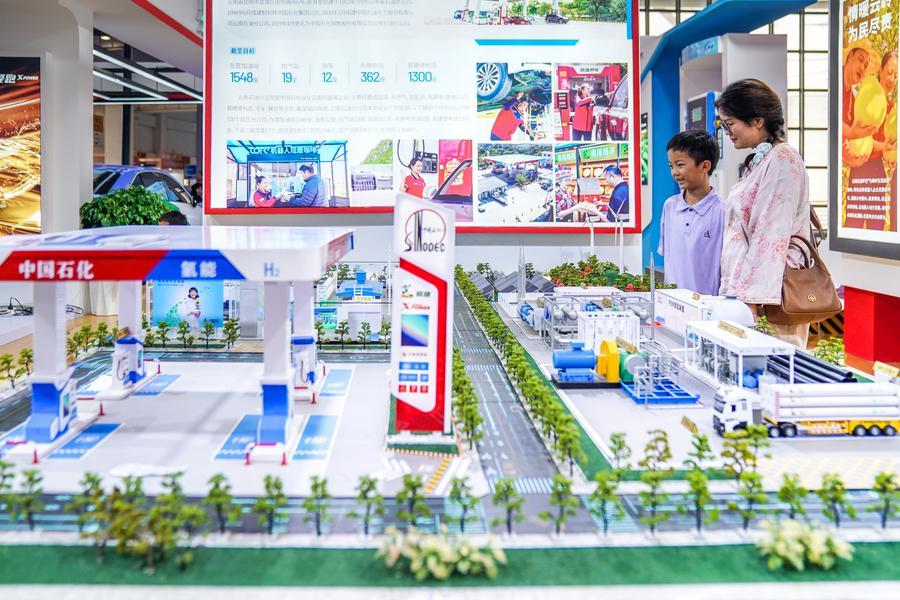
Cross-border investment and technological cooperation can support these efforts. China's growing green-energy cooperation with Europe provides one example.
A report by the Mercator Institute for China Studies and Rhodium Group showed that Chinese greenfield investment in Europe's energy sector reached 1.2 billion euros (about 1.4 billion U.S. dollars) in 2025, more than six times the previous year's level, including wind projects in Britain and a solar-module factory in France.
In Belgium, Chinese company Sungrow supplied storage systems for a battery project capable of storing electricity equivalent to the daily consumption of nearly 100,000 households.
Haier Europe has also worked with European partners on smart household energy management and energy-efficient heating systems.
"El Nino is one of the most closely monitored climate phenomena in the world. But forecasts in themselves do not prevent hazards; people do," WMO Secretary-General Celeste Saulo said. "The decisions we make today will shape the impacts we experience tomorrow."
(Video reporters: Ismael Peracaula, Neil Stokes, Meng Dingbo, Shan Weiyi, Liu Xiang and Ma Yueran; Video editors: Li Ziwei and Zhao Xiaoqing)■