NANNING, Aug. 12 (Xinhua) -- Freight trains linking south China's Guangxi Zhuang Autonomous Region with Vietnam now operate on a daily basis, up from the previous schedule of three days a week, carrying electronics and machinery south while bringing tropical fruit, including durian and mangosteen, to the north.
Latest data from Nanning Customs show Guangxi's trade with the Association of Southeast Asian Nations (ASEAN) reached 248.21 billion yuan (about 36.6 billion U.S. dollars) in the first seven months of 2026, up 2.5 percent year on year and a record for this period. Trade with neighboring Vietnam, notably, rose 3.3 percent to 183.71 billion yuan during the same period.
At the national level, China-ASEAN trade reached 4.34 trillion yuan in the first half of 2026, an increase of 18.2 percent from a year earlier. Trade in intermediate goods, namely parts, components and other production inputs, rose 24.5 percent to 2.86 trillion yuan in this period, accounting for roughly two-thirds of the total bilateral trade.
Lyu Daliang, spokesperson for the General Administration of Customs, attributed the steady growth in intermediate-goods trade to the deepening integration and interlinkages across industrial and value chains between China and ASEAN.
One framework supporting regional trade is the Regional Comprehensive Economic Partnership (RCEP), a 15-party trade pact bringing together China, Japan, the Republic of Korea, Australia, New Zealand and 10 ASEAN countries. RCEP took effect in January 2022 and has been in force for all 15 signatories since June 2023. Under its rules of origin, materials originating in one member country and used in the production process of another are treated as originating materials of the latter.
For enterprises like Anhui Sanley Machinery Co., Ltd., a Chinese maker of auto and motorcycle parts, this rule has translated into measurable savings. The company uses precision hardware from the Republic of Korea and rubber components from Thailand to manufacture products that are subsequently exported to markets including Indonesia and Malaysia.
Lin Jian, an executive at the company, said its exports to ASEAN reached 28 million yuan in the first five months of 2026, up more than 10 percent year on year, while RCEP certificates of origin helped its customers save over 2 million yuan in tariffs.
Xu Yingming, head of the international market research institute at a research academy under China's Ministry of Commerce, said RCEP and the China-ASEAN Free Trade Area have reduced transaction costs and created conditions for closer integration of regional industrial chains.
The arrangements allow companies to allocate resources across borders at a lower institutional cost, enabling production stages that were once dispersed across different countries to become more closely connected, Xu explained.
To support the seamless flow of resources, transport links are expanding alongside the booming trade. The China-Laos Railway, which opened in December 2021 and links Kunming in southwest China with the Lao capital Vientiane, handled 17.17 billion yuan worth of imports and exports in the first half of 2026, surging 33.8 percent year on year.
Imports of tropical fruits including durian, mangosteen and longan rose 25.8 percent to 4.22 billion yuan in this period. The railway now handles more than 3,900 categories of goods, with its freight services extending to markets in 19 countries and regions.
Southeast Asia remains a preferred destination for Chinese companies looking to expand overseas. A January survey by United Overseas Bank (UOB), a Singapore-headquartered Asian bank, of 380 owners, executives and key decision-makers at medium-sized and large Chinese companies, found that 80 percent planned to conduct business overseas over the next three years, with ASEAN emerging as their preferred region. Malaysia, Singapore and Thailand were cited by 56 percent, 54 percent and 51 percent of respondents, respectively, in this regard.
As these companies solidify their footprint in ASEAN markets, the demand for efficient cross-border financial services has grown correspondingly. Adaline Zheng, president and CEO of UOB China, told the Chinese financial newspaper Securities Times in a recent interview that the renminbi was being used in a growing range of scenarios, including cross-border trade, financing and day-to-day cash management.
In addition to the RCEP, China and ASEAN began building their free trade area in 2002, and the 1.0 version was fully established in 2010. The China-ASEAN Free Trade Area 3.0 Upgrade Protocol, signed in October 2025, covers nine areas, including the digital economy, green economy, supply-chain connectivity, customs procedures and trade facilitation. This protocol is still undergoing domestic approval procedures and has not yet entered into force.
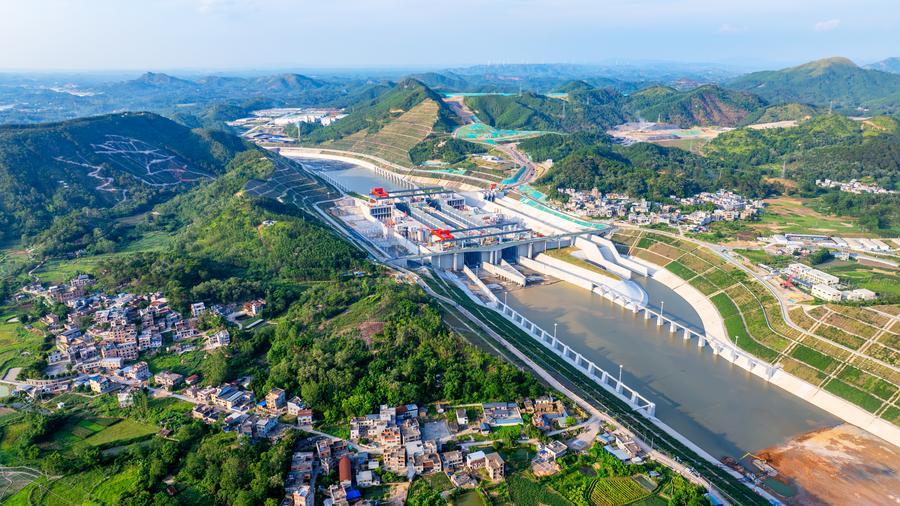
To support this robust economic and trade cooperation, major infrastructure projects within China are also accelerating. A major new transport link in Guangxi moved a step closer to operation on Wednesday, as the Pinglu Canal began vessel trials ahead of its planned opening in September.
Serving as a backbone project of the New International Land-Sea Trade Corridor, the 134.2-km waterway is designed for vessels of up to 5,000 tonnes. It will connect the Xijiang River system with the Beibu Gulf, cutting the inland-water route from parts of southwest China to the sea by more than 560 km compared with routes via Guangzhou Port in neighboring Guangdong Province in south China.
The expansion in regional trade comes against a more moderate global outlook. The World Trade Organization's Goods Trade Barometer, released in June, stood at 101.7, down from 102.3 in January but still above the trend baseline of 100. The WTO Secretariat's March baseline forecast projected global merchandise trade volume growth of 1.9 percent in 2026.
Asian economies, meanwhile, are projected to grow strongly in 2026 and remain a central engine of global expansion despite geopolitical and global economic headwinds, according to the Asia House Annual Outlook 2026.
The British think tank identified strong domestic consumption, rising investment, deepening inter-regional trade and rapid digitalization as key drivers underpinning Asia's growth prospects. Michael Lawrence, chief executive of Asia House, said the outlook confirms "Asia's economies are showing remarkable resilience and continuing to power ahead." ■