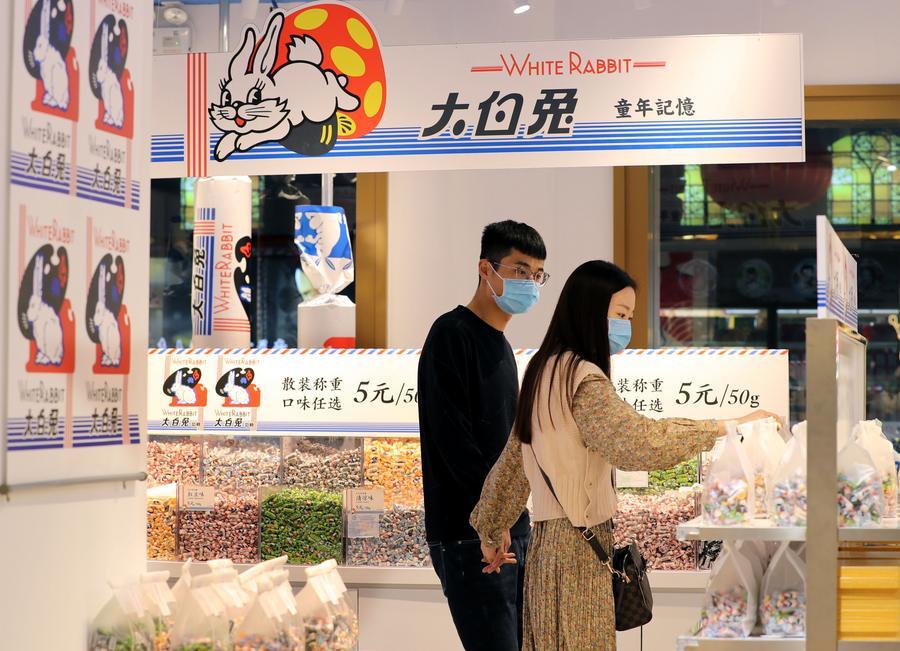
BEIJING, Aug. 12 (Xinhua) -- In 1972, then Chinese Premier Zhou Enlai presented White Rabbit milk candies as a state gift to visiting U.S. President Richard Nixon. More than half a century later, the Shanghai sweet is making another journey abroad -- this time through its wrapper.
Earlier this month, an X user posted two photographs. One featured a White Rabbit candy in its familiar red, blue and white wrapper; the other showed the paper unfolded and laid flat.
"This absolute masterstroke of graphic design..." wrote the user.
Within days, the post had drawn about 6 million views and 265,000 likes. The replies were soon filled with images of White Rabbit tattoos, T-shirts, phone cases and wrappers preserved in notebooks.
The two moments tell different stories about how Chinese culture travels. Once presented as a diplomatic gift, White Rabbit is now being discovered, shared and remade by ordinary people.
A DESIGN REDISCOVERED
For many Chinese, the overseas excitement came as a surprise. What was being celebrated as a design discovery was simply the wrapper of a childhood sweet -- once flattened inside schoolbooks and kept for its faint milky scent, or simply discarded after the candy was eaten.
Now, this object so deeply embedded in Chinese daily life has entered another culture, where people are admiring it, collecting it and making it their own. What a heartening development!
White Rabbit took its present name and image in 1959, replacing an earlier Mickey Mouse design used by a Shanghai candy factory. Its wrapper received a national packaging award in 1983 and remains in use ever since.
Unfolded, it has the coherence of a miniature poster. At the center, a white rabbit sits against a red background. Rows of smaller blue-and-white rabbits run along either side, while Chinese characters share the space with English lettering.
Zhang Di, a professor at Renmin University of China who studies cross-cultural content diffusion, told The Straits Times that the design's visual language requires no specific cultural knowledge for interpretation and is aesthetically accessible across cultures. Viewers can be drawn in before they know its history.
That history, however, gives the image another layer. In China, White Rabbit recalls an era when sweets were scarce, candy bowls were set out during festivals and a milky chew stuck to the teeth. Younger overseas viewers, by contrast, often encounter it without those associations. To them, it looks fresh precisely because its classic design has endured -- a piece of commercial art untouched by the polished uniformity of much contemporary packaging.
Its handmade quality may also hold new appeal. At a time when AI can produce a polished picture in seconds, the hand-drawn rabbit and old-fashioned lettering bear the imprint of a particular designer and era. Wu Weihua, a professor at the Communication University of China, has argued that vintage designs with cultural depth can resonate in an age increasingly filled with AI-generated content.
Yet enduring design alone cannot explain why a wrapper overlooked for decades has suddenly captured so much attention.
WHY NOW?
The rediscovery comes amid growing overseas curiosity about China. Social media users in the West have recently embraced "Chinamaxxing," adopting habits such as drinking hot water and wearing house slippers. Chinese apps, games, food brands and toys have also become more visible abroad.
As Chinese products become more familiar overseas, consumers may begin to look beyond their practical uses. Curiosity about an object can prompt questions about its design, history and origins.
Algorithms accelerate that process. Zhang said recommendation systems have carried content from Chinese diaspora communities to wider audiences, turning a wrapper associated with one community's memories into an image seen on millions of screens.
The result is a broader picture of Chinese culture abroad. Alongside ancient monuments, martial arts and cuisine, ordinary objects are entering the conversation. Reproduced on clothes, phone cases and even skin, the White Rabbit wrapper has shed its original function and become a visual symbol in its own right.
A QUIET INFLUENCE
Formal cultural promotion usually begins by explaining why something matters. Online discovery often works in reverse. Someone first notices the rabbit, saves the photograph or buys the candy. Questions about its origin come later. The encounter feels like a discovery rather than a lesson.
White Rabbit has pursued collaborations and launched new products over the years, yet the element attracting attention today is the very part it chose not to replace. Shi Anbin, a professor at Tsinghua University who studies China's cultural influence, sees the design's longevity as evidence that original Chinese designs can cross generational and cultural boundaries.
Its appeal suggests that going global does not always require a brand to hide where it came from. The wrapper that caught the world's attention was not redesigned for an international audience. It was the same wrapper that generations of Chinese children had peeled from their candy.
This brings the story back to the two photographs. In the first, the wrapper still held the sweet. In the second, it had been unfolded for a closer look.
The sweet would soon disappear. The image has already begun another journey. ■