
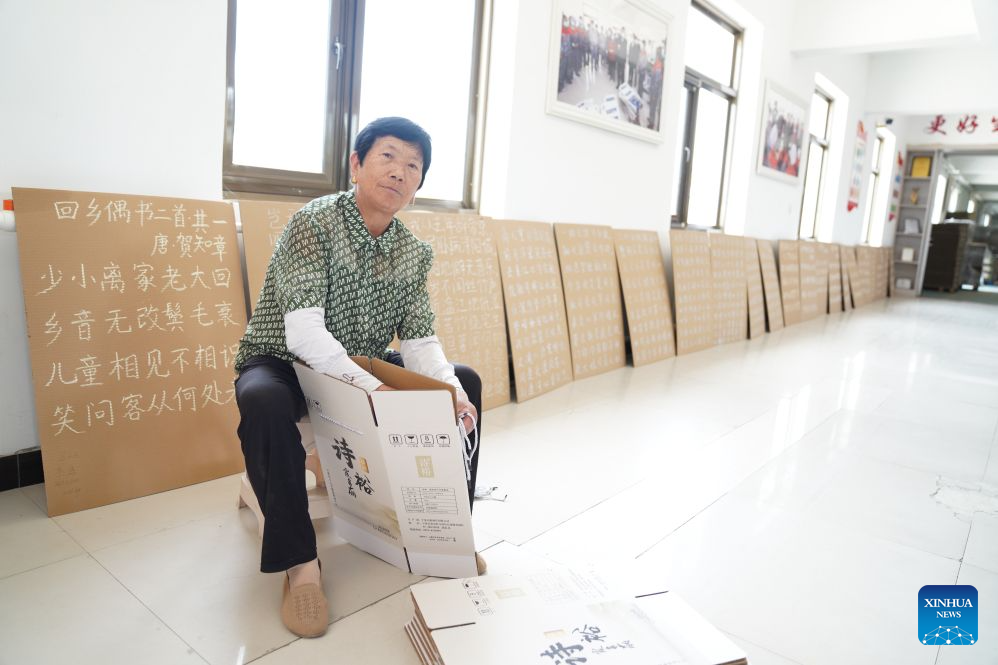
Cao Zhizhen works at a cardboard-box workshop in Hongde Village of Wuzhong City, northwest China's Ningxia Hui Autonomous Region, June 24, 2026. (Xinhua/Lu Jinbo)
YINCHUAN, Aug. 11 (Xinhua) -- When I walked into a village cardboard-box workshop in northwest China's Ningxia Hui Autonomous Region, I expected to see humming machines and busy workers.
Instead, I found poetry -- large pieces of cardboard hanging overhead and leaning against the walls, covered in handwritten lines from classical Chinese poems.
For the local workers, poetry has become part of daily life. Some are women and older villagers who take on flexible jobs at the workshop, earning extra income while staying close to their families.
Every morning at 7:30, before the machines have fully warmed up, the workshop turns into a classroom. Workers gather around the tables, their voices filling the room as they read the poems aloud, line by line, and commit each verse to memory.
Among them is Cao Zhizhen, a woman in her 70s who had never spent a single day at school. Here, for the first time in her life, she has found the opportunity to learn to read and write.
Cao can now recite more than 200 classical Chinese poems by heart, a feat that brought her and several of her co-workers from the workshop to the stage of The Chinese Poetry Conference, a popular national TV show, in 2024, where they shared their journey of learning poetry.
Her journey is nothing short of amazing. But even before poetry entered her life, deeper changes had already begun to take root.
Cao grew up in Xihaigu, a mountainous region in southern Ningxia long associated with harsh living conditions and deep poverty.
"All my life was spent working the barren land, with my face to the earth and my back to the sky," she told me.
In 2012, Cao's family and other residents of Xihaigu were relocated to Hongde Village in Hongsibu District in central Ningxia. Hongsibu, one of China's largest settlement areas for people relocated from inhospitable regions, has welcomed more than 200,000 residents from southern Ningxia over the past two decades.
Home to around 6,000 residents today, Hongde Village lifted itself out of poverty in 2019. Better infrastructure and growing employment opportunities have since given villagers a more stable life beyond the land.
When the workshop opened in the village in 2017 to offer jobs close to home, Cao took on light work like attaching rope handles to cardboard boxes.
The income was modest, but for Cao, the job meant having her own money, and maybe even more importantly, it gave her time that wasn't completely taken up by the daily struggle to make ends meet.
In July 2022, a year after China declared that it had eliminated absolute poverty, workshop manager Xu Ling felt that villagers needed more than jobs. She started a daily poetry class, explaining the meaning of each word and helping villagers use poems to express themselves.
"We need to enrich their pockets, but also their minds," Xu told me.
With no fixed textbook, she chose poems to match the season and the workers' daily lives -- describing snowy landscapes in winter and timely spring rain when the fields needed it. Poetry was no longer a collection of distant words on a page, but something they could see and feel in everyday life.
The class was initially met with skepticism. Some wondered what good reciting poems could do, while others questioned whether people with little or no formal education could really master the verses. "Those doubts naturally faded away when they started to see changes," Xu said.
For Cao, learning her first poem, the 20-character "Spring Dawn," took nearly 10 days. Unable to recognize a single character, she had to memorize every sound one by one. Then came another poem, and another. The verses gradually began to stick.
Today, more than 300 poems have been taught in the workshop. Some workers who once struggled to write their own names can now fill pages of their notebooks with poems. Others say that when willow trees turn green in spring, they instinctively think of the jade and green silk ribbons in a famous eighth-century poem.
Their surroundings have not changed. Their way of seeing them has.
Standing in the workshop built to help people make a living, I was struck by what it offered beyond a paycheck.
Every night, Cao told me, she holds her one-year-old grandson in her arms and recites poems to him. He is too young to understand the words, but he stares at her and listens.
For most of her life, Cao had little access to books or classrooms. Now, in her 70s, she plans to keep learning for as long as she can -- and is already thinking about which poems she will one day teach her grandson. ■
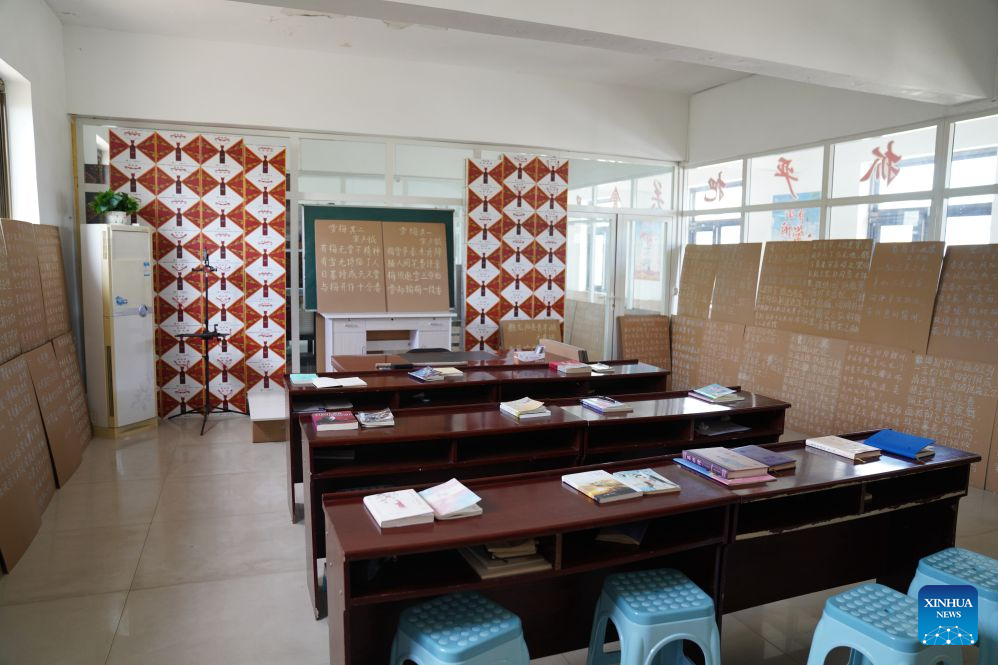
This photo taken on June 24, 2026 shows a room used for poetry classes at a cardboard-box workshop in Hongde Village of Wuzhong City, northwest China's Ningxia Hui Autonomous Region. (Xinhua/Lu Jinbo)


