
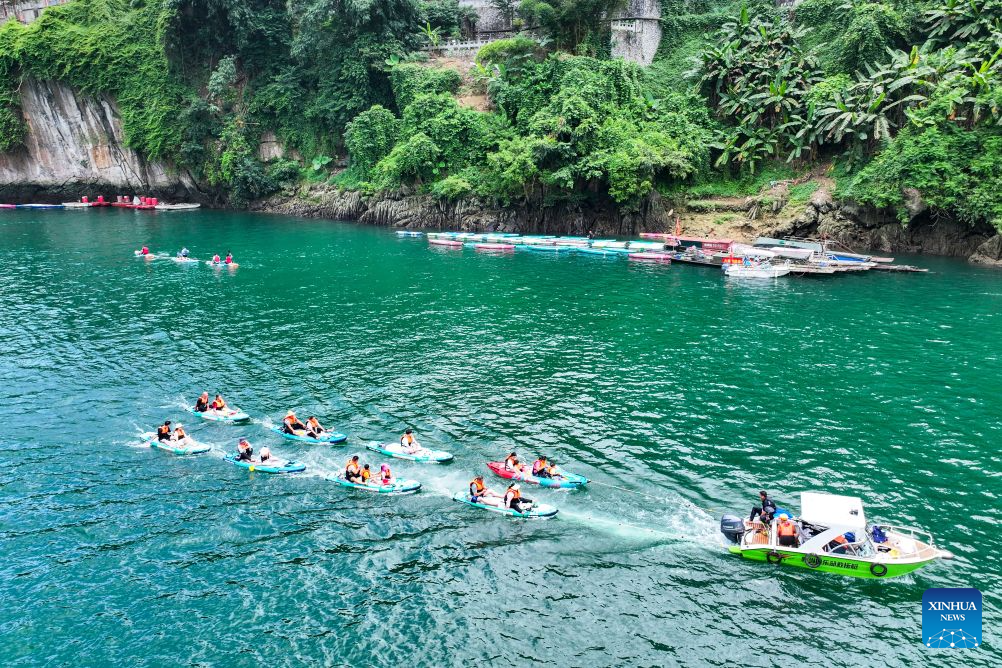
An aerial drone photo taken on Aug. 5, 2026 shows people experiencing water sports in Tian'e County, south China's Guangxi Zhuang Autonomous Region. (Xinhua/Cao Yiming)
By Xinhua Writers Tian Zijun and Cao Yiming
NANNING, Aug. 7 (Xinhua) -- On a clear morning on the Hongshui River in Tian'e County, south China's Guangxi Zhuang Autonomous Region, the water was a deep and glassy jade green, while limestone towers rose sharply from the riverbanks.
Every so often, a silver-blue shimmer erupted across the water surface, with large schools of small fish leaping in unison, their bodies flashing in the sun. Locals call this the "blue knife-fish storm."
A few dozen meters from shore, Li Xueting, a young woman from the neighboring Guangdong Province, stood on a paddleboard, while paddling in a slow, steady rhythm. She had taken paid leave and traveled to this spot to enjoy the water.
"In the city, you pay for overpriced yoga and Pilates classes, and make do with some overpriced 'rural retreat' on the outskirts," she told me as she toweled off at a riverside camp. "Here, you get both for the price of a board rental, and the view is immeasurably better."
Paddleboarding arrived in China as a niche import. Over the past five years, it has spread inland from cleaned-up urban rivers in cities like Beijing and east China's Hangzhou to the karst landscapes of Guangxi. Tian'e, a low-key county with a population under 200,000, has become the sport's most theatrical stage yet.
For China's growing number of tourists seeking experiential travel, the combination on offer is certainly attractive: a cardio workout, breathtaking scenery, and the appeal of discovering a place still largely unspoiled.
What distinguishes Tian'e from tamer river scenes elsewhere is the sheer visual spectacle. The water is so clear that paddlers can watch fish dart beneath their boards.
Forests cover more than 80 percent of the county, and its air quality is rated good to excellent nearly year-round. In 2015, the county was designated a "China Longevity Township." Paddleboarding is less a break from this brand than an extension of it: the same air and water once marketed to retirees are now being sold, with a paddle attached, to city dwellers.
Along the riverbank and county streets, tourists in colorful life jackets walk past eateries, board-rental stores and guesthouses that have reinvented themselves as one-stop paddleboard outfits.
The fish storm is not only a natural wonder but also the result of a government cleanup. The glassy water that paddlers skim across today was, until a couple of years ago, heavily polluted.
According to Luo Hui, head of the county's urban management bureau, the riverbanks were long dominated by large-scale fish farming. For decades, locals operated floating fish pens, dumping tons of fish feed directly into the Hongshui River. The excess feed sank and rotted, causing nutrient pollution that depleted oxygen and harmed aquatic life.
Between 2018 and 2025, local authorities launched a major cleanup. Net-cage operations were dismantled, eliminating over 800 square meters of fish cages.
This turnaround triggered an economic reinvention. Among those who benefited is Tu Jiawei, a local water-sports enthusiast and early player in the county's new industry. Tu started out with little more than a stack of paddleboards rented by the hour to visitors chasing a thrill.
During May Day holiday this year, Tu received up to 300 customers per day.
"The draw isn't just paddling," Tu explained. "It's gliding right through the middle of the school when the fish start jumping."
Farther down the bank, Ban Huazhong runs a riverside complex funded by 95 local village cooperatives. Ban's facility offers 19 guest rooms, an infinity pool overlooking the river, and 300 parking spots next to a highway exit that opened in 2022.
"Our guests can simply step from their rooms onto the water," said Ban. "We aim to turn what used to be a thin stream of day-trippers into multi-night stays and higher per-capita spending."
By late summer, his venture had generated 1.5 million yuan (about 220,900 U.S. dollars) in revenue, with the May Day holiday alone contributing over 400,000 yuan.
This boom has prompted the return of young locals eager to cash in. "Many of my old classmates have traded coastal jobs for paddleboard rental shops here," said Hu Qi, head of the county meteorology bureau.
Social media rewards the photogenic and the novel. "A single well-shot clip of a paddleboarder gliding past karst peaks with leaping fish travels farther than any official brochure," said Pang Jie, owner of a local grill shop who moved back from Nanning, capital of Guangxi, after witnessing the steady influx of visitors.
Since May 2024, when the knife-fish phenomenon first erupted across short-video platforms, related topics have accumulated over 200 million views. Official data show tourist arrivals reached 5.51 million in 2025, up 26.5 percent year on year, and yielding 5.7 billion yuan in tourism spending. During this year's five-day May Day holiday, visitor numbers jumped 13.46 percent to over 196,000, bringing in 132.1 million yuan in revenue.
Yet getting to Tian'e remains a test of endurance. Even after the Guiyang-Nanning high-speed railway opened in late 2023, cutting travel time from Nanning to Hechi to under an hour, Tian'e itself still lacks a rail station. From Hechi, travelers face an additional two-hour drive along a winding highway. "Most people get here by car, and our limitations are obvious," one local official said. "The lack of rail access keeps our real-world popularity at bay."
On the ground, local infrastructure is stretched. Parking along the narrow river corridors is scarce, catering is overwhelmed on peak weekends, and the number of local guesthouses, which are mostly self-built houses hastily converted by residents, has multiplied over the past year, leading to wide variations in hospitality standards.
The rapid rise of water sports has also outpaced the rules meant to govern it, creating acute challenges for local cadres.
"It is a boon for the county, but it is also uncharted territory where management experience is lacking across the country," said Luo Dong, head of Tian'e's tourism management authority.
Furthermore, Tian'e, tucked inside a deep river ravine, is particularly susceptible to sudden, unpredictable microclimates. This vulnerability was tested one afternoon this May, when the sky over the Hongshui River turned dark in minutes. A sudden squall brought severe winds and hail while dozens of paddlers were out on open water, flipping boards in the chop.
Even though all stranded paddlers were brought safely ashore within 90 minutes, the incident served as a wake-up call. "We designed a 'circuit breaker' mechanism," said Hu. "The moment forecasters pick up a sustained strong convective weather process, everything kicks into gear -- law enforcement hauls paddlers ashore and keeps people out of the water until the warning is lifted."
For local cadres, the dilemma is acute. The county's economic future hinges on its water-sports reputation, but managing a sector unfamiliar to most of the country is tricky.
"Social media trends tend to be notoriously fickle, but the investments required to build safe, sustainable tourism are heavy and long-term," Luo noted.
Tian'e's ultimate test will be whether a small rural county can build the regulatory and physical infrastructure needed to sustain the spectacle that put it on the map, before the river, or its visitors, pay the price. ■
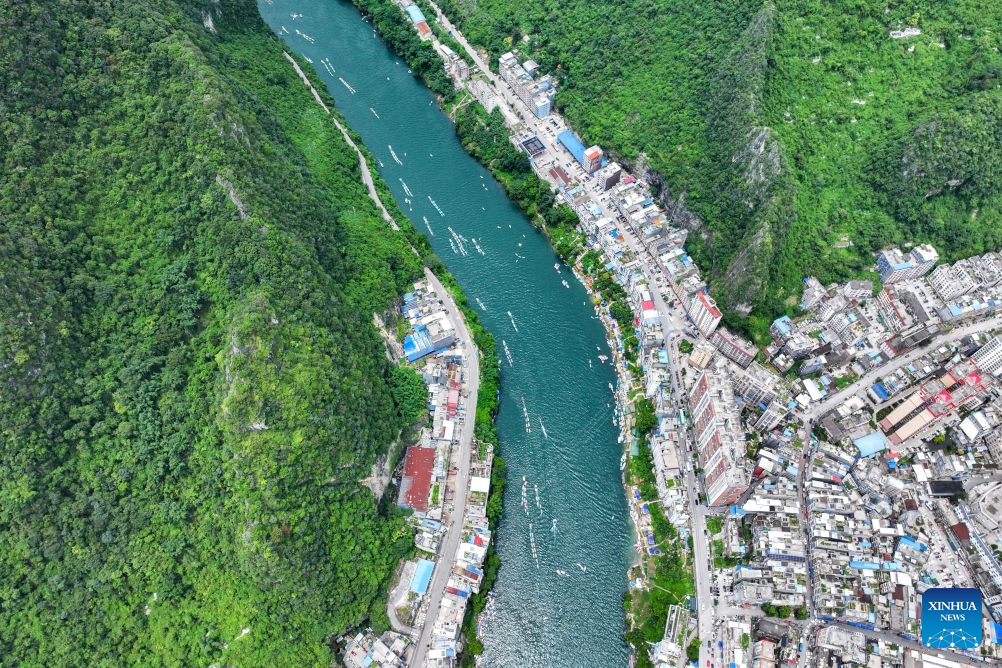
An aerial drone photo taken on Aug. 4, 2026 shows people experiencing water sports in Tian'e County, south China's Guangxi Zhuang Autonomous Region. (Xinhua/Cao Yiming)
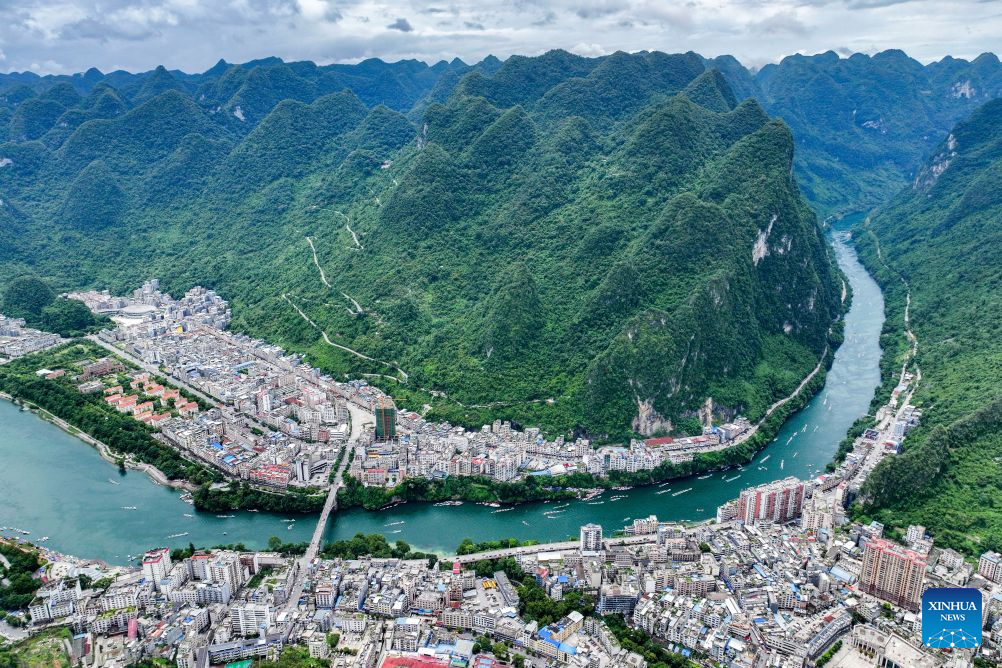
An aerial drone photo taken on Aug. 4, 2026 shows a view of Tian'e County, south China's Guangxi Zhuang Autonomous Region. (Xinhua/Cao Yiming)
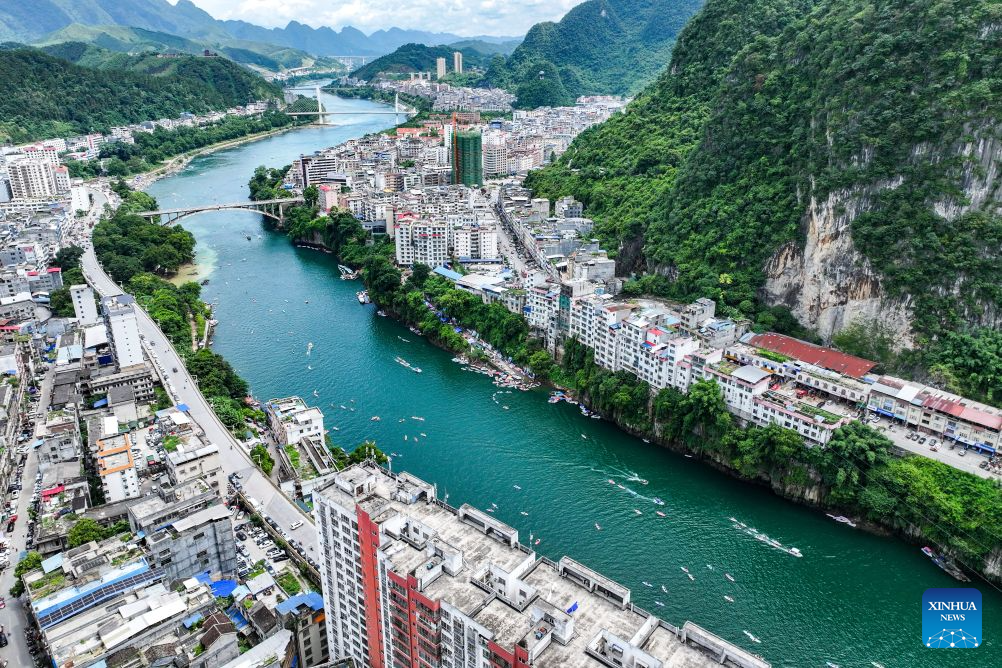
An aerial drone photo taken on Aug. 5, 2026 shows people experiencing water sports in Tian'e County, south China's Guangxi Zhuang Autonomous Region. (Xinhua/Cao Yiming)


