
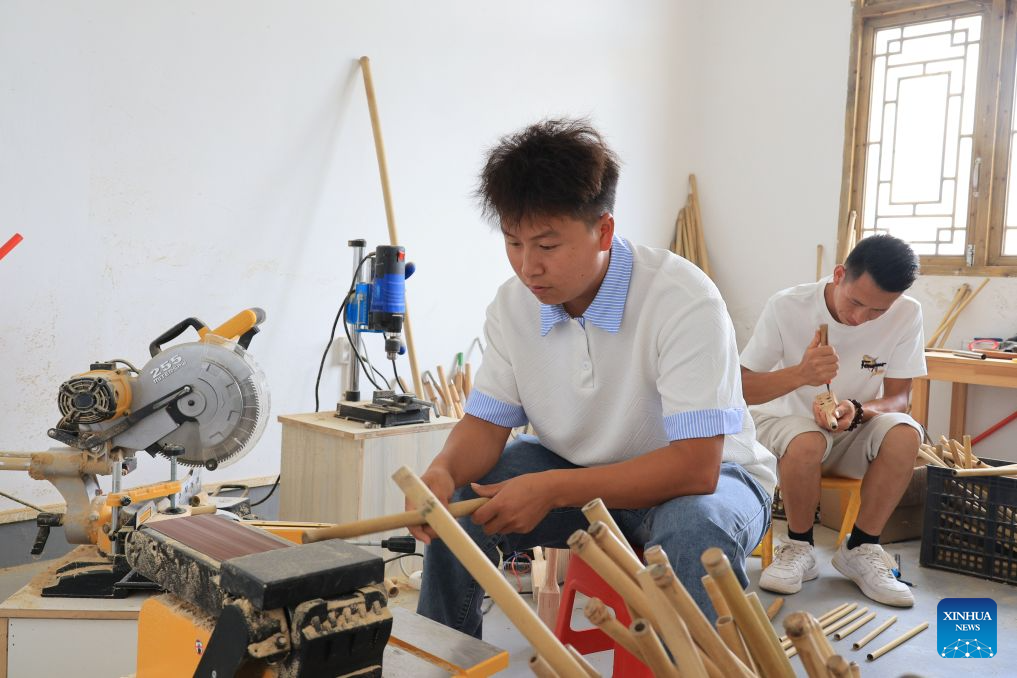
Wang Pinggui (L) and Wang Tingliang craft Lusheng at a workshop in Gaopo Township of Guiyang, southwest China's Guizhou Province, July 11, 2026. (Xinhua)
GUIYANG, Aug. 7 (Xinhua) -- As a teenager, Luo Tingkai would hoist his father's handcrafted Lusheng onto his back and trek three hours from his home in Pilin Village to sell the instruments at the bustling township market.
Gaopo Township in Guiyang, capital of southwest China's Guizhou Province, is a Miao ethnic community nestled in the mountains, where Pilin Village is located.
The craft of making the Miao Lusheng, an ancient instrument of six bamboo pipes, has been passed down here for over two centuries. Its music weaves through every stage of Miao life, from birth and marriage to farewell, marking each passage with its timeless sound.
Now 62, Luo is a devoted guardian of this time-honored sound. He began learning to play the Lusheng at just 12 years old, and after junior high, he apprenticed under his father to master the craft. Over the decades, Luo has dedicated his life to preserving and passing on the rich culture of the Lusheng.
"The Lusheng is a symbol of our Miao people and a lifelong companion," Luo said. "Wherever we go, we can never be without it."
In 2006, the craft of Miao Lusheng-making was inscribed on China's first national list of intangible cultural heritage items. Passed down orally from master to apprentice, with no written manuals, the tradition demands at least five years of study before an apprentice can craft a Lusheng independently.
Keeping this "sound of an ethnic people" alive, however, has not been easy. For a long time, fewer and fewer young people were willing to invest the time to learn the craft. Luo admitted that for the young, working away from home means "easy money," while making Lusheng yields "just one pair a week."
In 2020, Luo was honored as a provincial-level inheritor of intangible cultural heritage. His greatest hope is to see more people embrace the craft. These days, his city-dwelling son returns home on weekends and holidays to learn it from him.
Thanks to Lusheng courses widely offered in local primary and secondary schools, many Miao children still learn to play the instrument from an early age. Wang Tingliang and Wang Pinggui, both in their 30s, started learning in their early teens.
They have played the Lusheng at countless festivals, and gradually came to realize that if no one carried on the craft, the sound would one day fall silent. So, three years ago, they sought out Luo and became his apprentices.
"Our ethnic heritage has to be passed on," Wang Pinggui said. "We've always loved playing the Lusheng, and now it's our generation's turn to carry it forward."
The process of crafting a Lusheng, from selecting the bamboo and shaping the wind chest to forging the reeds and tuning, tests the artisan's patience and precision. Carving the wind chest is a delicate, high-stakes task; the slightest misstep can undo days of painstaking work. As the bamboo pipes are sanded again and again, the constant friction of bamboo dust against the palms leaves hands covered in thick calluses.
"We were so engrossed in the craft when we first started that we often stayed up until the early hours," Wang Pinggui recalled.
"There is no room for fear in craftsmanship," Luo added. "Those who truly want to learn will never flinch from the hard work, and those who can't stand the heat are better off not starting."
During festivals, Luo organizes Lusheng performances and sets up educational display boards to raise villagers' awareness of preserving the tradition. Whenever the sound of the Lusheng fills the air, local Han and Buyi residents gather to watch, and people from neighboring villages and beyond frequently make the trip to seek his guidance.
"Everyone is welcome to learn," he said. "I don't charge a penny. My only wish is to pass this craft on to the next generation."
Luo has also brought his self-made compact three-pipe Lusheng into local primary and secondary schools. By using modern numbered musical notation to transcribe traditional melodies, he helps children pick up the playing techniques more quickly.
In addition, he has shared the Lusheng-making process on short-video platforms. His clips, which show everything from teaching children to play the instrument to fine-tuning its pitch, have each garnered over 10,000 views online. "This is the pride of our ethnic group, and it means a lot to me," one netizen commented.
There was a time when it was Lusheng-making that put food on the table for Luo's family. Today, thanks to online exposure, the traditional art has gradually reached beyond Gaopo, and brought in a growing number of orders. "Our Lusheng sell very well," he said. "Every one we make finds a buyer."
But in Luo's view, the wider the reach, the more crucial it is to keep standards high. "The tone, the appearance, the craftsmanship -- everything has to be up to standard," he said. "If the quality isn't there, customers won't come back."
To promote the deep integration of intangible cultural heritage preservation with rural revitalization, a Lusheng workshop was established in Gaopo in August 2025. Integrating Lusheng-making, skills training, cultural exhibitions and hands-on learning experiences, the workshop invited Luo to serve as its technical director. Visitors can observe the entire Lusheng-making process up close and even try their hand at tuning reeds and assembling bamboo pipes.
The workshop has introduced modern tools such as polishers, sanders and drilling equipment, which, while preserving traditional craftsmanship, have improved production efficiency and the finished products' visual quality.
Last year, Gaopo also hosted its first Lusheng competition, drawing 49 teams from southwest China's provinces of Guizhou and Yunnan and beyond. During the event, more than 100,000 people tuned in either online or in person, giving a significant boost to local catering and accommodation businesses.
"The Lusheng is the soul of Gaopo. We want its voice to reach even farther," said Tang Jialin, director of the township's industrial development service center. ■
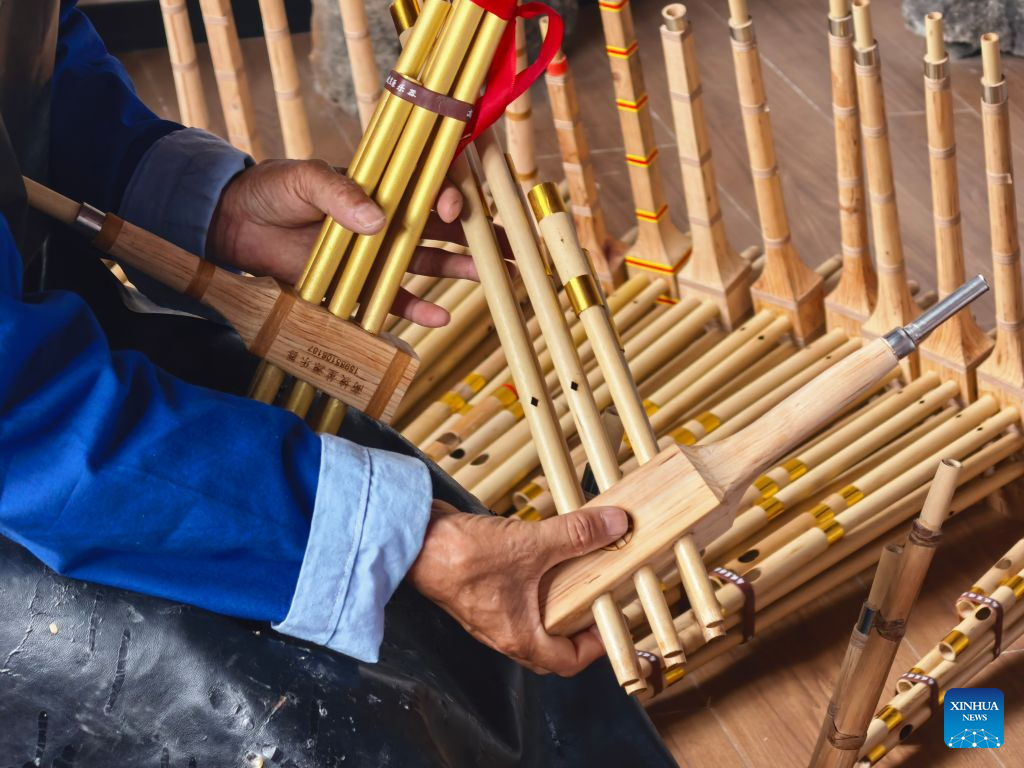
Luo Tingkai, an inheritor of the craft of making the Miao Lusheng, introduces Lusheng at a workshop in Gaopo Township of Guiyang, southwest China's Guizhou Province, July 11, 2026. (Xinhua)
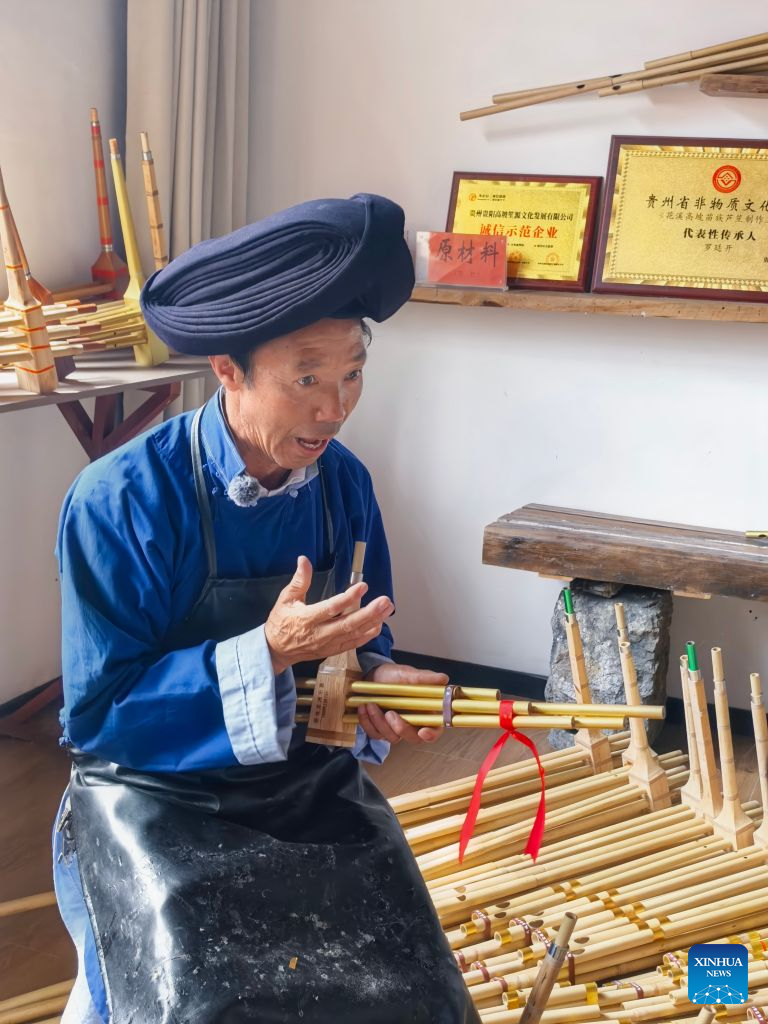
Luo Tingkai, an inheritor of the craft of making the Miao Lusheng, introduces Lusheng at a workshop in Gaopo Township of Guiyang, southwest China's Guizhou Province, July 11, 2026. (Xinhua)
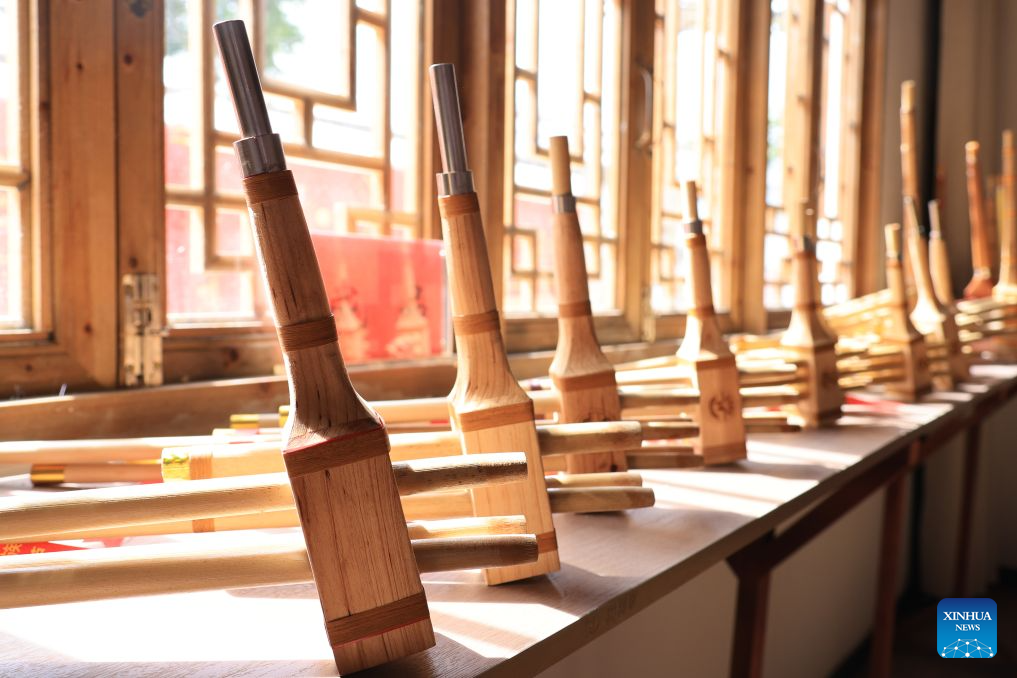
This photo taken on July 11, 2026 shows Lusheng, an ancient instrument of six bamboo pipes, at a workshop in Gaopo Township of Guiyang, southwest China's Guizhou Province. (Xinhua)


