
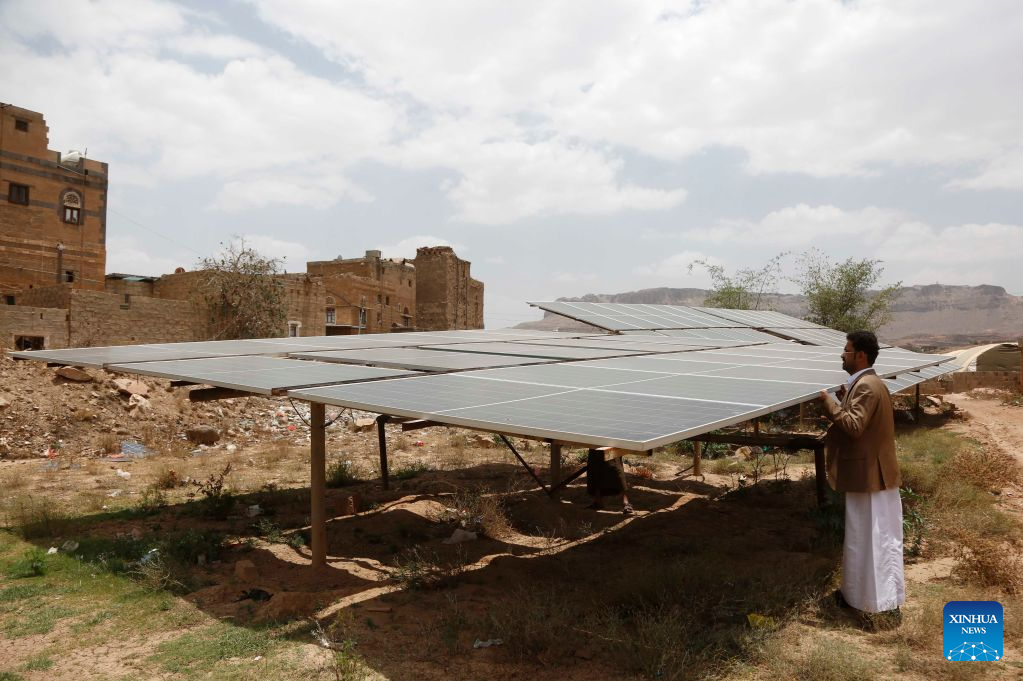
A farmer turns solar panels toward the sun for grape irrigation in Bani Hushaysh, northeast of Sanaa, Yemen, Aug. 6, 2026. (Photo by Mohammed Mohammed/Xinhua)
SANAA, Aug. 6 (Xinhua) -- Watching the water thread its way toward the thirsty grapevines, their leaves already brittle from the drought, Mukhtar Qasim let out a long, quiet breath of relief.
For Qasim and other Yemeni grape growers like him, the vine is more than a crop; it is the mainstay of their livelihoods.
Grapes have been cultivated in Yemen since ancient times, particularly in the northern highlands. Sanaa, Saada, Amran and Al-Jawf are among the main producing governorates.
For years, Yemeni grape growers kept their vines alive with fuel-powered pumps, irrigating the fields in the hope of securing each season's harvest. This year, however, rising energy prices have turned that routine into a burden many can no longer carry.
A farming season could consume around 25 to 30 barrels, with a single barrel sometimes costing as much as 150,000 Yemeni rials (about 300 U.S. dollars), Qasim said.
"With diesel, I had to reduce irrigation because I couldn't keep paying the fuel costs," Qasim murmured.
To keep their livelihoods afloat, these growers have to look for other ways forward.
Under the summer sun in Bani Hushaysh, northeast of the capital Sanaa, Qasim walked between rows of vines heavy with ripening grapes as his pump hummed almost silently. At the edge of the field, rows of solar panels had taken over the irrigation work once powered by costly diesel.
"Now I can irrigate for around six hours a day, and the difference is clear in this year's harvest," he said.
Qasim's vineyard reflects a broader adaptation unfolding across Yemen's war-battered countryside. After years of conflict that disrupted fuel supplies and pushed up farming costs, solar-powered pumps are allowing grape growers to reduce their dependence on diesel and irrigate their fields more reliably.
The change is improving harvests, but it has yet to translate into significant gains.
The solar pumping system that now keeps Qasim's vineyard irrigated cost him and several other farmers a total of about 15 million Yemeni rials.
Rabie Awad, another grape grower, said a solar system for his farm would cost more than 2 million Yemeni rials.
"Solar power could save me much of what I spend on irrigation," he said. "But I can't afford the cost of installing it."
This is the dilemma facing Yemen's grape growers: without solar power, they have little choice but to reduce irrigation, making lower yields almost inevitable. But installing a solar-powered irrigation system comes with a steep upfront cost that adds another layer of expense for farmers already struggling to make ends meet.
In Qasim's vineyard, clusters of purple grapes hung heavy on the vines, a sign of what promised to be a good harvest. He moved carefully among the rows, gently running his fingers over the bunches.
"We have no other choice. I know that a good harvest does not always translate into better profits. But without water, there would be no harvest at all," he said. "After all these hardships, we need a little hope to carry us through." ■
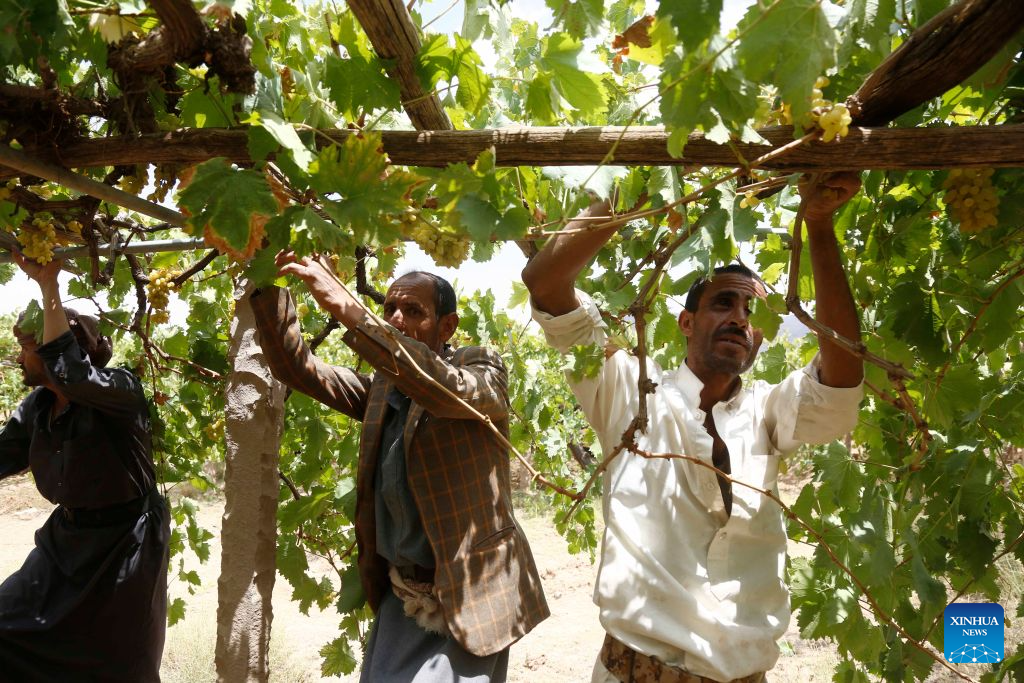
Farmers pick grapes in Bani Hushaysh, northeast of Sanaa, Yemen, Aug. 6, 2026.
TO GO WITH "Feature: A lifeline, but no cure -- solar power becomes bitter choice for Yemeni grape growers" (Photo by Mohammed Mohammed/Xinhua)


