
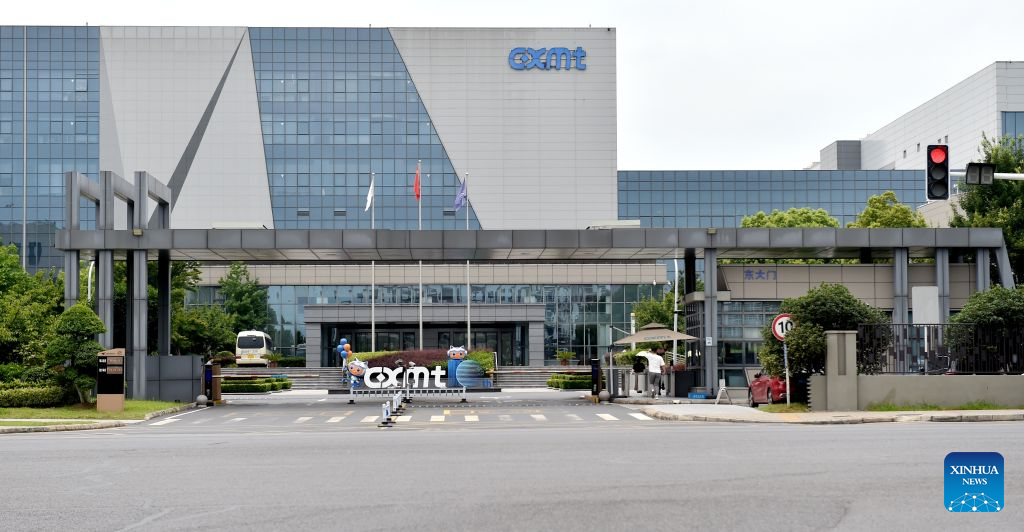
This photo taken on July 27, 2026 shows Chinese memory chipmaker ChangXin Memory Technologies (CXMT) in Hefei, east China's Anhui Province. (Photo by Ge Chuanhong/Xinhua)
BEIJING, Aug. 6 (Xinhua) -- In just one decade, Chinese memory chipmaker ChangXin Memory Technologies (CXMT) has transformed from a startup in an industry long dominated by global players into one of the world's largest producers of dynamic random-access memory (DRAM) and the most valuable listed company on the A-share market.
The company's shares closed up 465.82 percent on its July 27 market debut, giving it a market capitalization of over 3.2 trillion yuan (about 471.2 billion U.S. dollars). Behind the blockbuster listing lies a decade-long story of technological breakthrough and an industrial experiment that offers a closer look at how China's memory chip sector is finding its own path.
DECADE OF LEAPFROG R&D
Founded in Hefei, capital of east China's Anhui Province, in 2016, CXMT has become China's largest and most comprehensive integrated device manufacturer (IDM) for DRAM.
As the generative AI boom drives unprecedented demand for memory chips, the company has carved out a formidable foothold in a sector where DRAM, one of the two primary memory chips and a cornerstone of the semiconductor industry, serves as a high-capacity "scratchpad" for computing systems, temporarily storing and retrieving active data.
"Driven by our mission to bridge technological gaps and secure the supply chain, we choose the arduous path of independent R&D, which demands heavy investment and a long-term commitment," said Zhu Yiming, chairman of CXMT.
Rather than pursuing a traditional, linear catch-up strategy, CXMT adopted an aggressive "leapfrog" R&D approach. In 2019, it launched its self-designed and manufactured 8Gb DDR4 product, a milestone in the Chinese mainland's DRAM industry.
Within a few years, the company mass-produced four generations of process platforms and integrated high-end DDR5 products, achieving world-class standards in its core technologies.
The rapid technological leap is underpinned by CXMT's IDM business model. Recognizing that few fabless designers can navigate the extreme barriers of large-scale DRAM production, CXMT maintains full control over its R&D, design and manufacturing processes. This vertical integration has enabled highly efficient internal synergy, creating a robust intellectual property portfolio.
The company reported that by the end of 2025, it had amassed nearly 7,000 patents covering the entire value chain from chip design to module applications, and invested more than 20.6 billion yuan in R&D between 2023 and 2025, accounting for 21.67 percent of its revenue over the period.
The strategy has yielded tangible commercial results. Operating three 12-inch wafer fabs in Hefei and Beijing, CXMT ranks first in China and fourth globally in capacity, capturing a 7.67 percent global market share in the fourth quarter of 2025.
Financially, the turnaround is just as striking. After accumulating losses of 36.65 billion yuan through the end of 2025, CXMT expects first-half net profit of 50 billion to 57 billion yuan this year, according to its prospectus.
CXMT is also pressing ahead with next-generation LPDDR6 memory, which industry sources say could put it at the forefront of global product launches, as the company seeks to move from catching up to setting the pace in DRAM technology.
PATIENT CAPITAL, WIDER INDUSTRY
The company's rise was not powered by market forces alone. Over the past decade, state capital from Hefei kept investing in CXMT, holding its position through industry downturns -- a display of what economists call patient capital -- and prioritizing long-term industrial development, employment and ecosystem building over short-term returns.
According to Liu Zhiying, a professor at the University of Science and Technology of China, the approach reflects a distinctive feature of China's industrial development, where government capital steps in early to fill gaps that private investors cannot or will not bear, and steps back as the industry matures.
At the institutional level, a registration-based IPO system enabled the loss-making company to list, making it one of the STAR Market's anchor companies.
CXMT's impact now extends far beyond the company itself. Around CXMT and wafer foundry Nexchip, Hefei has built an integrated circuit industry cluster that covers the entire chain from design, manufacturing, packaging, testing, to equipment and materials, one of only a handful of Chinese cities with such full-chain capabilities.
More than 500 companies now operate in the cluster, including memory packaging firm Payton Technology, drawn by the ecosystem anchored by CXMT. The city's integrated circuit output value soared more than sevenfold, rising from 18 billion yuan in 2016 to over 150 billion yuan in 2025. This growth has fostered an industrial ecosystem where upstream and downstream firms thrive together.
Despite CXMT's major breakthrough in DRAM chips, challenges remain. The company faces a shortage of high-end talent and is still climbing the learning curve of full-chain operations and capacity ramp-up.
CXMT is not alone in China's memory push. Yangtze Memory Technologies (YMTC), the country's leading NAND flash chipmaker, filed for an IPO in May, and the two are widely seen as the twin engines of China's memory chip sector.
"CXMT's technology-driven entry into the global market confirms a new path, where technological breakthroughs are emerging as another engine of growth," said Tian Lihui, a finance professor at the Nankai University.
"This trend reveals the core of China's economic transformation of rebuilding global industrial chains with core technological breakthroughs and converting independent innovation into sustainable growth momentum, which opens a new track led by new quality productive forces," Tian said. ■
This photo taken on July 27, 2026 shows the logo of Chinese memory chipmaker ChangXin Memory Technologies (CXMT) in Hefei, east China's Anhui Province. (Photo by Ge Chuanhong/Xinhua)


