
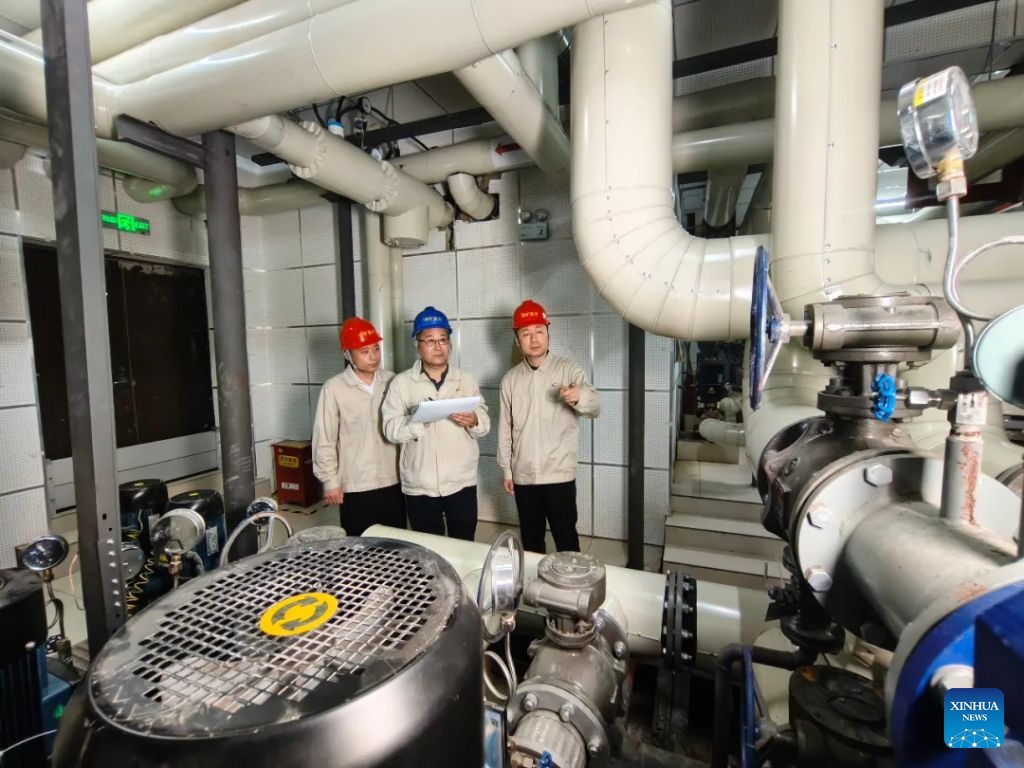
Staff members of a residential centralized cooling project check pipelines at a residential community in Xuzhou City, east China's Jiangsu Province, Aug. 2, 2026. (Xinhua)
NANJING, Aug. 5 (Xinhua) -- As summer heatwaves scorch parts of China, a city in east China's Jiangsu Province has launched the country's first residential centralized cooling project that uses water from abandoned coal mines, offering a cost-effective and eco-friendly cooling solution.
In the city of Xuzhou, resident Wang Qingmei, 76, prepares meals in her kitchen without switching on an air conditioner. Outside, the mercury has climbed to 36 degrees Celsius, while her apartment stays at a comfortable 26 degrees Celsius with humidity at 54 percent.
"It feels just right," she said, pointing to a thermometer and hygrometer on her living room wall.
The refreshing chill comes from a pioneering centralized cooling project launched in Xuzhou, where an exhausted coal mine has been transformed into a natural source of clean cooling for residents.
Underground water, which maintains a year-round temperature in the low teens, is circulated through the community's existing heating network and underfloor pipes. Even in its pilot phase, the system has already brought centralized, low-carbon cooling to nearly 100 households.
For her apartment of about 100 square meters, Wang paid just 400 yuan (about 59 U.S. dollars) for the cooling season, which runs from June to the end of September. "That's roughly what I used to spend on electricity for running air conditioners for just one month," Wang said.
Zhang Tao, head of the cooling project, said that chilled water circulating through the underfloor coils gradually absorbs indoor heat through radiant cooling, creating a quieter and more evenly distributed cooling effect than conventional air conditioners.
Zhang noted that the project team collaborated with research teams to develop a special dehumidification device, which helps maintain comfortable indoor humidity and avoid wall and floor condensation caused by low pipeline temperatures in humid summer weather.
Beyond enhancing living comfort, the project delivers environmental benefits. Unlike conventional air conditioners, the system requires no outdoor compressor units, which intensify the urban heat island effect, and uses no fluorinated refrigerants.
It also cuts energy consumption by around 50 percent and is expected to reduce annual carbon dioxide emissions by more than 50 tonnes per 100 households served, according to the project team.
The innovative low-carbon cooling model underscores China's commitment to achieving its dual carbon goals of peaking carbon dioxide emissions before 2030 and achieving carbon neutrality before 2060. According to a national climate change plan for the 15th Five-Year Plan period (2026-2030) released last week, China aims to reduce carbon dioxide emissions per unit of GDP by 17 percent by 2030 from 2025 levels.
Across the country, prolonged heatwaves and the country's push toward low-carbon solutions have accelerated public interest in centralized cooling.
Public facilities in cities such as Guangzhou and Chongqing, including office buildings, metro stations and libraries, are increasingly adopting centralized cooling systems that distribute chilled water from shared cooling stations rather than relying on separate cooling equipment for individual buildings.
Most existing systems employ ice thermal storage technology, producing and storing ice during off-peak nighttime hours and releasing the stored cooling capacity during the day to reduce electricity demand.
Xuzhou's approach, however, takes a different path by turning abandoned mining resources into a low-carbon asset.
Endowed with 303 million cubic meters of abandoned mine voids and over 75 million cubic meters of water storage capacity, Xuzhou plans to scale up the mine-water cooling system across more residential communities, according to Zhang.
Han Jian, a professor at Nanjing University Business School, said many cities possess untapped abandoned mining areas and water channels suitable for seasonal underground energy storage as well as integrated cooling and heating.
"The practice in Xuzhou offers valuable inspiration to turn idle industrial resources into sustainable resources for low-carbon urban governance," Han said. ■


