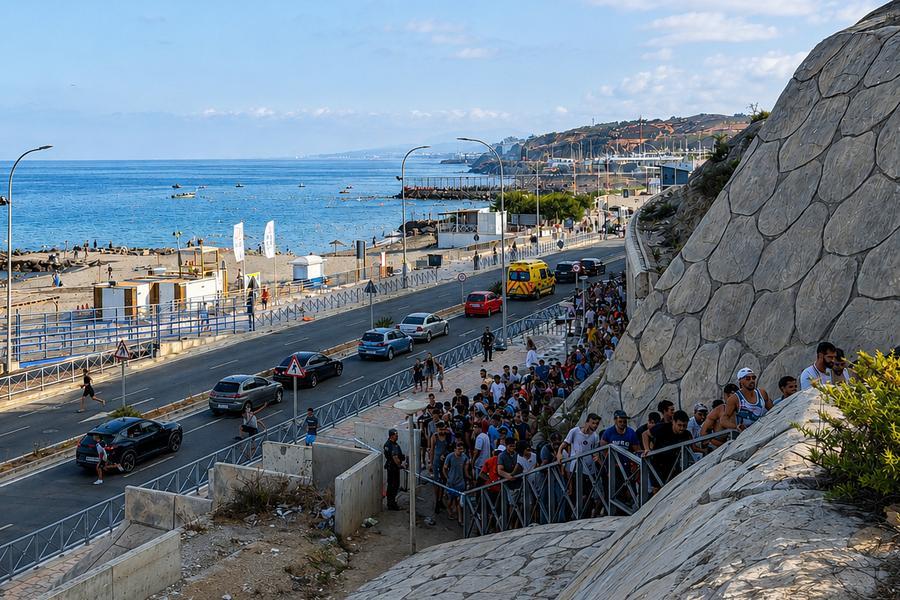
MADRID/RABAT, Aug. 2 (Xinhua) -- A recent surge of undocumented migrants crossing from Morocco into Spain's North African enclave of Ceuta has triggered one of the most serious border crises Spain has faced in recent years, placing renewed pressure on migration management and exposing divisions within the European Union (EU).
The influx prompted Madrid to deploy military support, tighten border controls and enhance coordination with Rabat, while reigniting debate within the EU over how to manage migration at its external borders.
WHAT'S SPECIAL WITH CEUTA?
Ceuta is one of Spain's two exclaves on the North African coast, alongside Melilla. Although geographically located in Africa, it forms part of the EU's external border.
Its location has long made it one of Europe's most sensitive migration gateways. For years, undocumented migrants have attempted to reach the enclave by climbing border fences or swimming around coastal barriers before trying to continue to mainland Spain and other parts of Europe.
Spain and Morocco have expanded cooperation in recent years on border control, migrant returns and efforts to combat human trafficking and smuggling networks.
WHAT TRIGGERED SURGE?
In late June and early July, Spain's Supreme Court ruled that migrants intercepted at sea near Ceuta and Melilla could not be summarily returned under the special "pushback" regime applied at land borders. Instead, they must go through standard legal procedures that provide access to legal assistance and the opportunity to apply for international protection.
The ruling was quickly distorted online into claims that anyone who reached Ceuta by sea would automatically be allowed to stay in Spain and eventually obtain legal residency. The narrative spread rapidly across various social media platforms, leading many to believe the route was effectively open.
Abdellah, a Moroccan who attempted to reach Ceuta but was later turned back by police, said videos circulating online had convinced him to make the journey.
Mohammed Zakaria Aboudahab, a professor of public law and political science at Mohammed V University in Morocco, said migrant-smuggling networks had deliberately amplified false information on social media, creating the impression that reaching Ceuta guaranteed legal status.
SPAIN AND MOROCCO'S RESPONSE
The latest influx saw more than 50,000 undocumented migrants enter Ceuta, many by swimming around the Tarajal border crossing or using makeshift flotation devices. At least 67 people died during the crossings, with the death toll expected to rise as search and recovery operations continue.
By Aug. 1, more than 48,000 migrants had returned to Morocco. None were allowed to travel onward to mainland Spain under Ceuta's special Schengen arrangements, and authorities said the immediate pressure at the border had largely eased.
Spain has since reinforced security by installing a new floating maritime barrier along Ceuta's breakwater. The 500-meter inflatable barrier is designed to prevent migrants from bypassing land border controls by sea.
At the same time, Madrid and Rabat have intensified cooperation on returns and law enforcement while stepping up efforts against migrant-smuggling networks.
Moroccan authorities said they had arrested 70 people suspected of organizing or participating in violence linked to the mass crossing. Xinhua reporters in Rabat and Casablanca also observed tighter security at railway stations and bus terminals, where police were screening and, when necessary, turning back groups of young people heading toward northern Morocco.
EU AND REGIONAL REACTIONS
The crisis has once again exposed divisions within Europe over migration policy.
The European Commission reaffirmed that Ceuta forms part of the EU's external border and said the bloc stands ready to support Spain through Frontex and other mechanisms while strengthening cooperation with Morocco.
Italy was among the first countries to criticize Spain's migration policy. It later joined Denmark in leading a letter signed by 22 EU member states calling for an emergency ministerial meeting to discuss the crisis and the bloc's external border management.
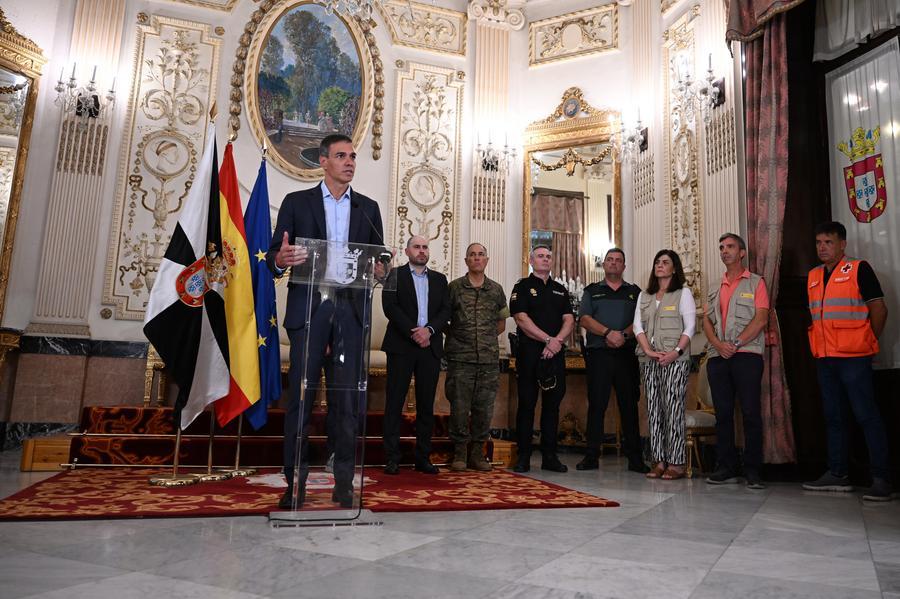
Spanish Prime Minister Pedro Sanchez responded by writing to European Commission President Ursula von der Leyen, expressing "serious concern" over what he described as "selfish," politically motivated reactions from some governments that he said violated EU law, including proposals to suspend Schengen cooperation with Spain. He also called for an EU-wide ministerial meeting.
Ireland, which currently holds the rotating presidency of the Council of the EU, subsequently announced that EU interior ministers would hold a videoconference on Tuesday to discuss the Ceuta crisis. ■